Building a Sustainable and Circular Future for India's Textile Industry
#GS-2 #GS-3 #Governance & Social Justice #Economy #Environment #Infrastructure #Employment #Sustainable Development #National
Why in News
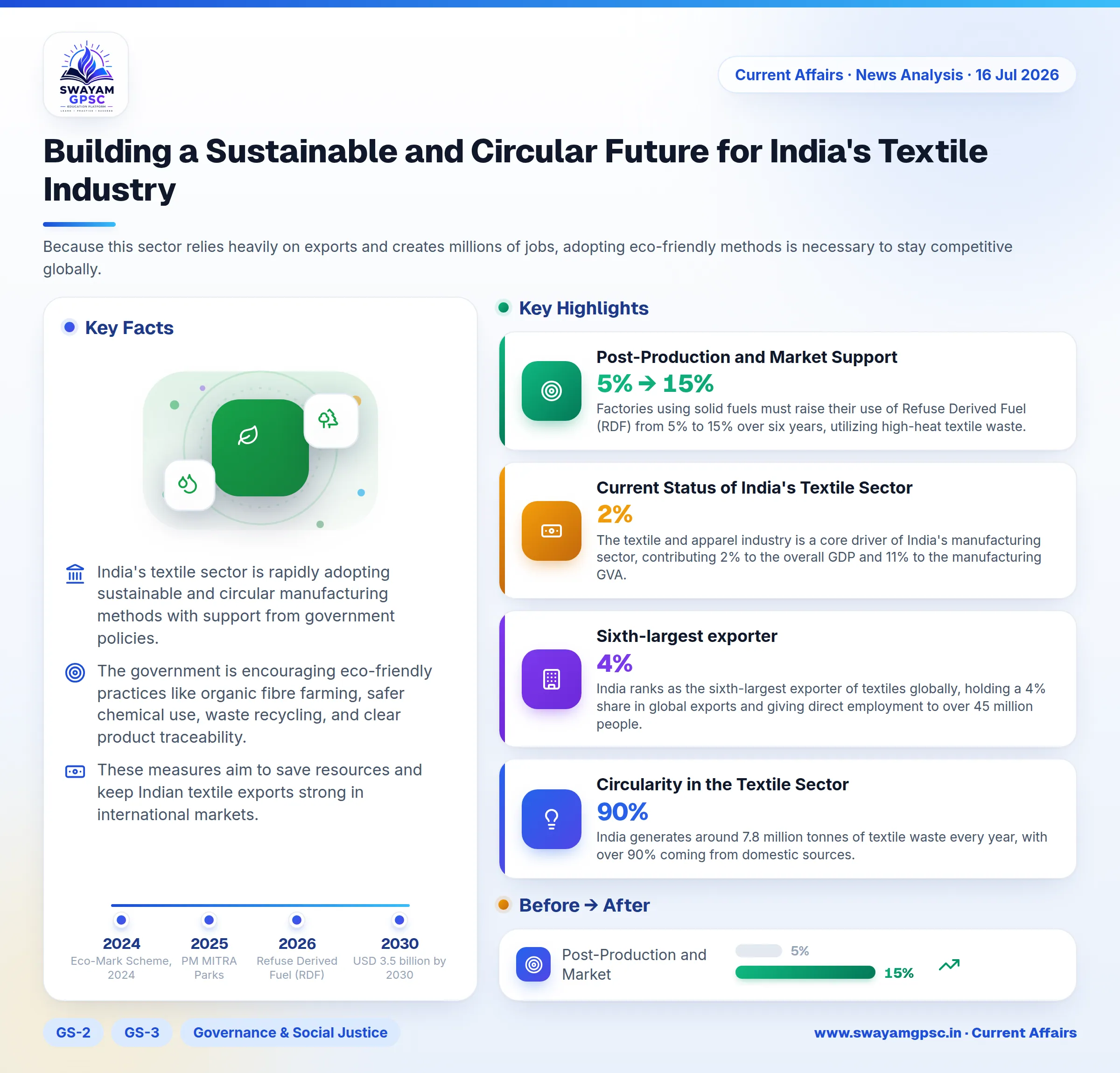
- India's textile sector is rapidly adopting sustainable and circular manufacturing methods with support from government policies.
- The government is encouraging eco-friendly practices like organic fibre farming, safer chemical use, waste recycling, and clear product traceability.
- These measures aim to save resources and keep Indian textile exports strong in international markets.
Current Status of India's Textile Sector
- The textile and apparel industry is a core driver of India's manufacturing sector, contributing 2% to the overall GDP and 11% to the manufacturing GVA.
- India ranks as the sixth-largest exporter of textiles globally, holding a 4% share in global exports and giving direct employment to over 45 million people.
- Because this sector relies heavily on exports and creates millions of jobs, adopting eco-friendly methods is necessary to stay competitive globally.
- Adopting circular economic models builds directly on traditional Indian habits of re-using and conserving textile materials.
- Bringing sustainability into textiles requires changes across every step of production, from buying raw materials to final retail sales.
Circularity in the Textile Sector
- A circular textile system keeps old clothes and fabrics in use longer through recycling, repairing, and re-making, which cuts the need for fresh raw materials.
- The main idea is to keep inputs cycling within the economy so that leftover material goes back into production rather than ending up in trash dumps.
- Reusing existing textiles directly reduces water use, chemical pollution, energy consumption, and landfill waste.
- Adopting circular practices helps Indian exporters meet strict new environmental rules set by foreign buyers.
- India generates around 7.8 million tonnes of textile waste every year, with over 90% coming from domestic sources.
- Over 70% of all textile waste in India gets collected and recycled, and nearly 95% of factory cutting waste is collected and reused.
- India's thread-spinning mills show high circularity, as almost all yarn waste is put back into the spinning process.
- About 55% of discarded household clothes are saved from dumpsites thanks to scrap collectors and sorting networks.
- This informal recycling system supports 40 to 45 lakh livelihoods, providing income to many women and weaker sections of society.
- For example, Navi Mumbai runs a municipal facility that collects, sorts, and upcycles old textiles under one roof.
- The city of Panipat processes 3,500 to 5,250 tonnes of fabric waste daily, making it India's top textile recycling hub.
- Local markets like Mongolpuri Katran Market in Delhi collect over 10 tonnes of fabric scraps daily and send them to recycling hubs like Panipat.
Sustainability at the Input Stage
- Government policies are pushing for natural and organic raw materials because raw choice determines the environmental footprint of the final fabric.
- The National Programme for Organic Production (NPOP) sets standards for organic farming, including organic cotton, which is recognized by Europe and Switzerland.
- Organic farming protects soil quality and long-term land fertility by avoiding harmful chemical fertilizers and synthetic pesticides.
- The Jute-ICARE initiative gives farmers improved seeds and modern retting tools, expanding coverage from 1.11 lakh hectares to 2.15 lakh hectares in 2024-25.
- Under the Cotton Mission, Mini-Mission III promotes climate-resilient farming and natural alternative fibres like ramie, flax, and sisal.
- The National Fibre Scheme supports natural and modern synthetic fibres to boost local supply, cut imports, and lower raw material impact.
Reducing Hazardous Chemicals
- India banned harmful benzidine dyes, restricted 70 azo dyes, and signed the Stockholm Convention in 2006 to remove toxic pollutants from textiles.
- Special pilot programs across textile centers are training manufacturers to swap out hazardous chemicals for safer alternatives.
- A dedicated clean-chemical drive is working directly with 400 factories, 8 industrial clusters, and 4 fashion houses.
- This chemical reduction program aims to cut toxic chemical use by 10,530 tonnes and reduce emissions by 1,47,000 tonnes of carbon equivalent.
Sustainability at the Production Stage
- Since textile factories consume vast amounts of water and power, state policies are funding cleaner production methods and energy-saving machinery.
- The government is building seven PM MITRA Parks based on the 5F framework: Farm to Fibre to Factory to Fashion to Foreign.
- These modern parks feature shared Common Effluent Treatment Plants (CETPs), water recycling systems, and scientific waste disposal.
- The PM MITRA Parks have a budget of ₹4,445 crore through 2027-28, attracting investment MoUs worth over ₹27,434 crore by December 2025.
- Since small businesses run over 80% of India's textile capacity, the RAMP Programme offers financial assistance to help MSMEs go green.
- The MSE-GIFT scheme offers interest discounts for eco-friendly technology, while MSE-SPICE provides a 25% capital subsidy for circular economy setups.
Emissions Reduction and Waste Circularity
- Textile factories must now meet mandatory carbon limits under the Carbon Credit Trading Scheme (CCTS) within the Indian Carbon Market (ICM).
- Covered units must track and report their Scope 1 emissions from factory operations and Scope 2 emissions from purchased power.
- Factories that reduce emissions below their assigned target receive tradable carbon credits, while cleaner plants can sell extra credits for profit.
- Technical guidelines like BREF/COINDS and the Tex Eco Initiative give factories concrete steps to improve water, energy, and chemical efficiency.
- India's textile recycling industry is expected to reach USD 3.5 billion by 2030 and create nearly 1 lakh green jobs over five years.
- The Solid Waste Management Rules, 2026 mandate waste sorting and push industries to use Refuse Derived Fuel (RDF) made from non-recyclable fabric scraps.
- The National Technical Textiles Mission (NTTM) finances research to convert agricultural and fabric waste into high-tech carbon fibres.
- Textile units must set up Effluent Treatment Plants (ETPs) to ensure wastewater is thoroughly cleaned before leaving the factory.
- The voluntary SURE initiative, backed by the Ministry of Textiles and industry bodies, encourages apparel brands to adopt sustainable fashion.
- Student programs like Circle Back and national expos like Vastra Katha at Bharat Tex spread awareness about recycling clothing.
- The government created an ESG Task Force and platforms like Circular Samvaad to help manufacturers share clean technologies.
- The global Bharat Tex trade event brings together farmers, manufacturers, and buyers to trade sustainable and technical textiles.
Post-Production and Market Support
- Post-production efforts focus on sorting used clothes and industrial scraps so they are remade into new items rather than dumped in landfills.
- Starting 1st April, 2026, updated waste management rules enforce producer responsibility and strict waste sorting under the Environment (Protection) Act, 1986.
- Factories using solid fuels must raise their use of Refuse Derived Fuel (RDF) from 5% to 15% over six years, utilizing high-heat textile waste.
- The 2026 report on Textile Waste Mapping gives a clear picture of fabric waste across India and offers practical blueprints for recycling.
- Under the Eco-Mark Scheme, 2024, textiles meeting 13 Indian Standards on low energy, minimal pollution, and safety can earn green certificates.
- Quality marks like Kasturi Cotton and Silk Mark guarantee purity and full supply-chain tracking for domestic and international buyers.
- A 2024 agreement between the Textiles Committee, GeM, and SCOPE encourages government offices to buy upcycled textile products.
- Combining green labels, tracking tools, and official government buying builds strong market demand for eco-friendly clothing.
Way Forward
- India's textile sector bridges centuries-old traditions of resource saving with modern economic growth and export opportunities.
- Traditional habits of reusing and repairing cloth provide a natural starting point for modern circular economy models.
- Strong government backing for organic farming, non-toxic chemicals, eco-parks, and waste recovery will build a world-class green industry.
- Shifting to a circular model will protect the environment, boost export earnings, support MSMEs, and secure millions of green livelihoods.