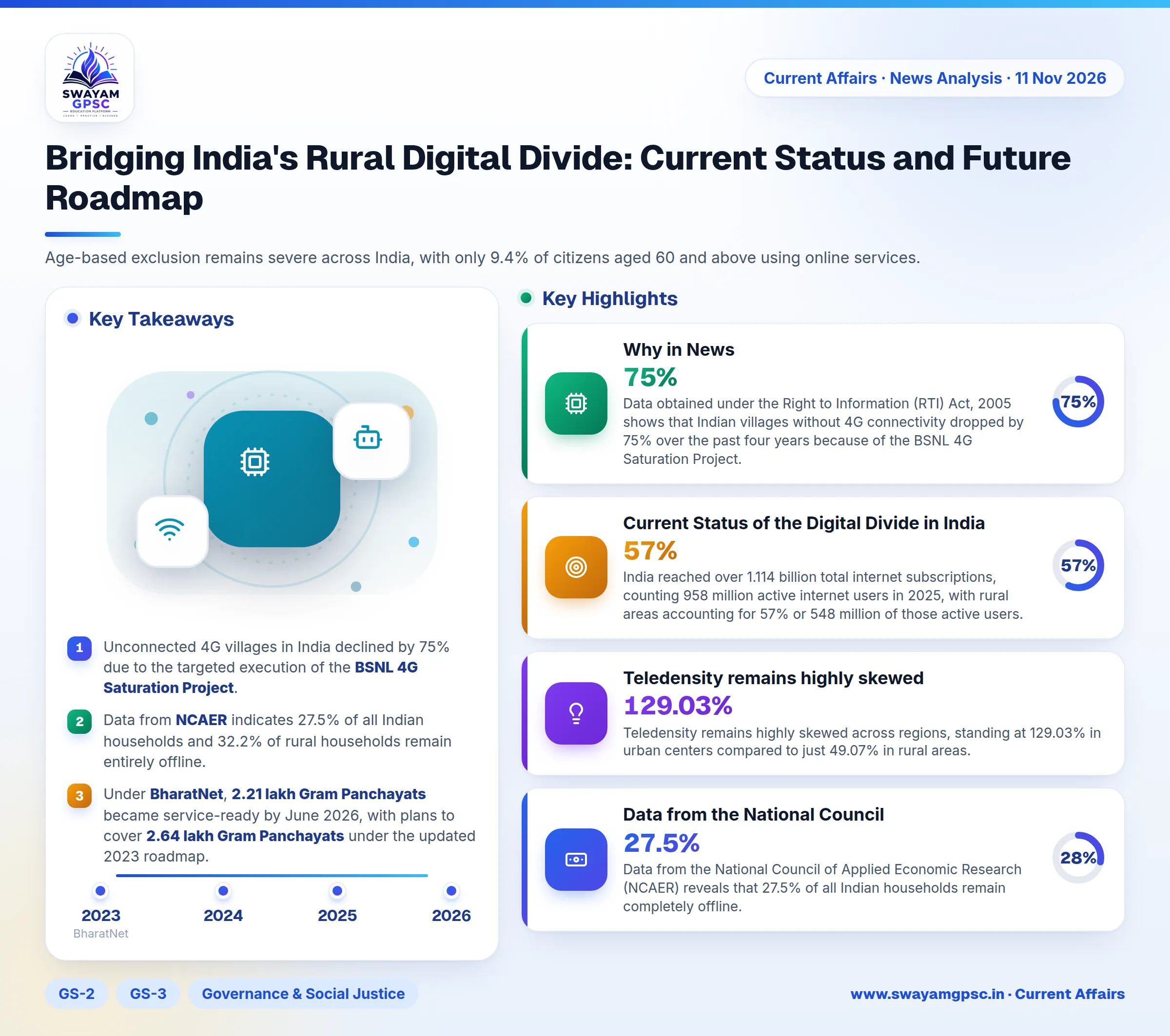
Bridging India's Rural Digital Divide: Current Status and Future Roadmap
#GS-2 #GS-3 #Governance & Social Justice #Infrastructure #E-Governance #Digital Divide #BharatNet #Telecom Sector
Key takeaways
- Unconnected 4G villages in India declined by 75% due to the targeted execution of the BSNL 4G Saturation Project.
- Data from NCAER indicates 27.5% of all Indian households and 32.2% of rural households remain entirely offline.
- Under BharatNet, 2.21 lakh Gram Panchayats became service-ready by June 2026, with plans to cover 2.64 lakh Gram Panchayats under the updated 2023 roadmap.
- A significant gender gap exists in digital adoption, as NFHS-5 reports only 33% of women have ever used the internet compared to 57% of men.
- While wireless data consumption reached 28.39 GB per user monthly according to TRAI, operator revenue per GB fell 5.07% to Rs 7.13.
Why in News
- Data obtained under the Right to Information (RTI) Act, 2005 shows that Indian villages without 4G connectivity dropped by 75% over the past four years because of the BSNL 4G Saturation Project.
- Universal internet access remains an unfinished task as the Department of Telecommunications works to finalize procedures for approving satellite broadband providers to close the remaining network gap.
Summary
- Rural 4G connectivity has improved substantially with a 75% reduction in uncovered villages, but persistent geographical, gender, and affordability gaps still restrict universal digital access.
- Achieving inclusive digital growth requires strengthening BharatNet, rolling out satellite internet, expanding digital literacy programs, and making computing devices affordable for rural households.
Current Status of the Digital Divide in India
- India reached over 1.114 billion total internet subscriptions, counting 958 million active internet users in 2025, with rural areas accounting for 57% or 548 million of those active users.
- Teledensity remains highly skewed across regions, standing at 129.03% in urban centers compared to just 49.07% in rural areas.
- Data from the National Council of Applied Economic Research (NCAER) reveals that 27.5% of all Indian households remain completely offline.
- Geographic digital exclusion is significantly higher in countryside locations, where 32.2% of rural homes lack internet access compared to 17.2% of urban homes.
- Infrastructure progress under BharatNet made 2.21 lakh Gram Panchayats service-ready by June 2026, while the Amended BharatNet Programme (2023) aims to connect 2.64 lakh Gram Panchayats and 3.8 lakh non-GP villages on demand.
- Gender disparities persist in digital adoption, with only 35.6% of working-age women using the internet compared to 57.6% of men.
- Survey findings from the National Family Health Survey (NFHS-5) confirm that only 33% of women have ever used the internet, compared to 57% of men.
- Age-based exclusion remains severe across India, with only 9.4% of citizens aged 60 and above using online services.
- Current internet usage focuses heavily on entertainment at 66% and social media at 53.8%, while productive uses like online education stand at 16.1% and e-governance services at 11.4%.
- A total of 20.4% of households still need outside assistance from local middlemen or Common Service Centres (CSCs) to access basic online platforms.
Impact of the Digital Divide
- Expanding Digital Public Infrastructure (DPI) like Aadhaar services, UPI, and government portals makes continuous internet essential for accessing public benefits.
- Poor internet connectivity forces rural residents to rely on middlemen or travel to distant Common Service Centres (CSCs) to receive welfare under Direct Benefit Transfers (DBT) and PM-KISAN.
- Students in remote areas lack access to online educational platforms, while rural teleconsultation services on portals like eSanjeevani face frequent connection drops.
- Rural small businesses, farmers, and artisans miss out on digital commerce networks like ONDC, real-time weather updates, and digital banking facilities.
- The physical availability of digital services does not guarantee real access unless network quality, affordable prices, and digital literacy exist together.
Challenges in Universalizing Rural Internet Connectivity
- Telecom companies face a low return on investment because laying optical fiber in low-density rural areas requires high Capital Expenditure (CAPEX) but yields a low Average Revenue Per User (ARPU).
- Data from the Telecom Regulatory Authority of India (TRAI) Q1 FY27 Performance Report shows quarterly wireless data consumption grew 8.30% and monthly user consumption rose 6.32% to 28.39 GB.
- Revenue collection per gigabyte dropped by 5.07% down to Rs 7.13, creating a gap between rising data traffic and falling revenue per unit.
- Declining unit revenues strain telecom providers as they fund 5G rollouts, buy spectrum, and upgrade networks, reducing their ability to invest in unviable rural areas.
- Rugged mountain terrain and difficult topography make physical cable deployment extremely hard for infrastructure teams.
- Rural locations rely excessively on shared mobile towers, leading to network congestion, while flagship initiatives like BharatNet suffer from unlit dark fiber cables.
- Telecom operators face delays and cost overruns due to inconsistent Right of Way (RoW) clearance rules across state governments.
- The legacy Universal Service Obligation Fund (USOF), now renamed Digital Bharat Nidhi, has faced historic delays in spending its allocated funds.
- High smartphone ownership of 95% masks a computer ownership rate of just 8%, creating a mobile-only environment that limits complex tasks like programming or advanced e-learning.
- A persistent capability gap remains because device costs, poor digital literacy, language barriers, and spotty service stop families from using public digital portals.
Way Forward
- Expand rural digital literacy campaigns following the pattern of Pradhan Mantri Gramin Digital Saksharta Abhiyan (PMGDISHA), which trained 6.39 crore individuals against its initial target of 6 crore before ending in March 2024.
- Approve Low Earth Orbit (LEO) satellite broadband providers quickly to deliver high-speed connectivity to remote locations where laying fiber cables is impractical.
- Encourage public-private partnerships by offering Viability Gap Funding (VGF) to help private telecom operators expand 5G networks into tier-3 and tier-4 regions.
- Require government, banking, and educational applications to support all Eighth Schedule languages so non-English speakers can use digital tools easily.
- Provide direct subsidies for basic laptop or desktop computers to Below Poverty Line (BPL) families to lower entry costs for advanced digital learning.
- Strengthen community digital infrastructure by setting up BharatNet public Wi-Fi hotspots and expanding Common Service Centres (CSCs) managed by Village Level Entrepreneurs (VLEs).