Bridging Civic Infrastructure and Governance Deficit in Indian Cities
#GS-2 #GS-3 #Indian Polity & Constitution #Governance & Social Justice #Economy #Environment #Current Events #Constitution #Good Governance #Regulatory Bodies #Infrastructure #Climate Change #Sustainable Development #Urbanization #National
Key takeaways
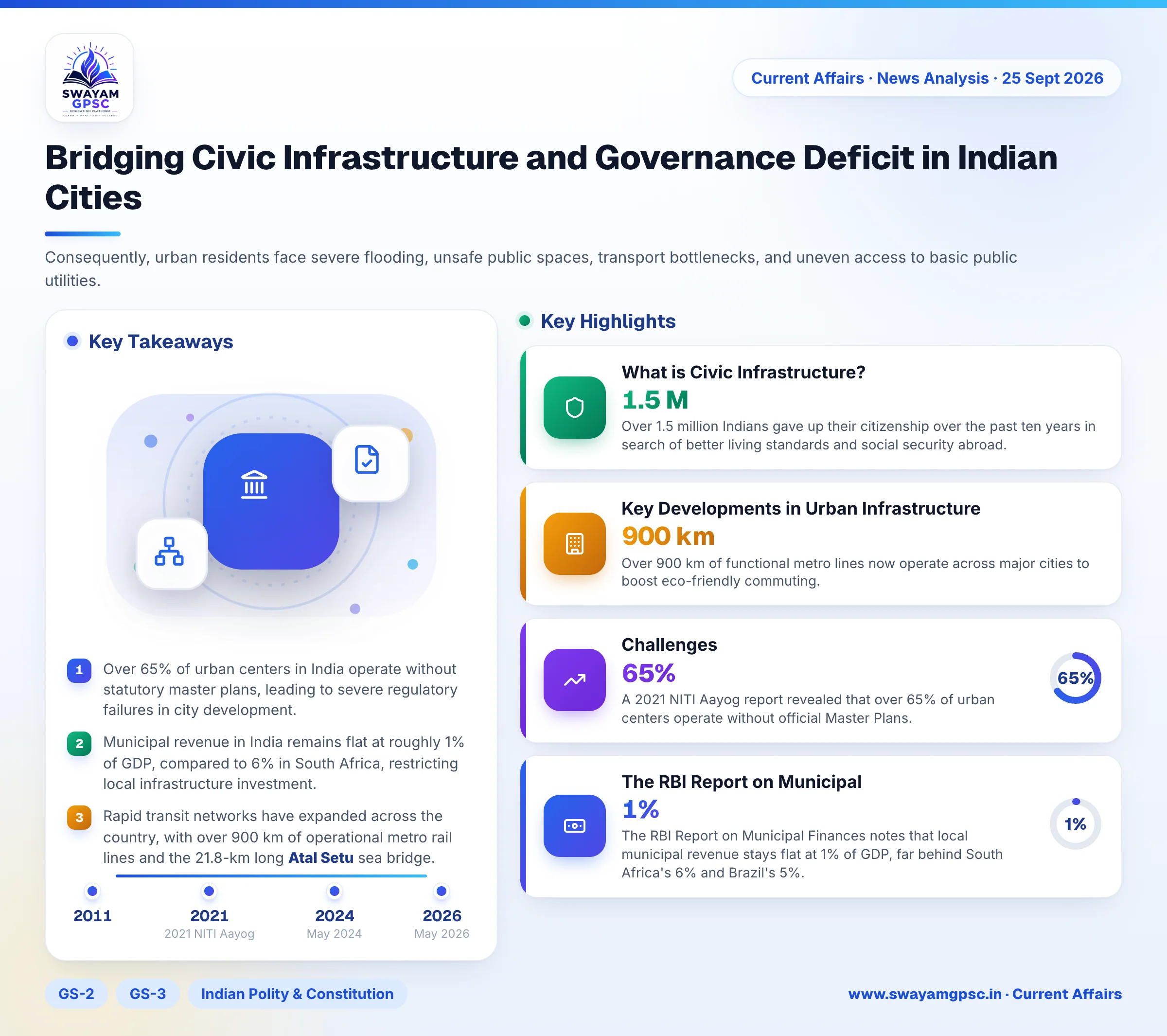
- Over 65% of urban centers in India operate without statutory master plans, leading to severe regulatory failures in city development.
- Municipal revenue in India remains flat at roughly 1% of GDP, compared to 6% in South Africa, restricting local infrastructure investment.
- Rapid transit networks have expanded across the country, with over 900 km of operational metro rail lines and the 21.8-km long Atal Setu sea bridge.
- Nearly 50% of urban daily commutes cover distances under 5 km, highlighting the massive potential for pedestrian and cycling infrastructure.
Why in News
- Frequent urban accidents across Indian cities show deep systemic problems in local governance, civic infrastructure, and urban planning.
- These ongoing safety failures stem from administrative indifference, weak spatial planning, and a lack of enforcement against unauthorized building projects.
Summary
- Rapid city growth in India reveals major shortcomings in basic amenities, municipal funding, spatial planning, and administration.
- Consequently, urban residents face severe flooding, unsafe public spaces, transport bottlenecks, and uneven access to basic public utilities.
- Fixing these issues demands strong urban local bodies, increased financial devolution, climate-resilient building design, efficient transit options, and strict administrative accountability.
What is Civic Infrastructure?
- Basic physical structures and administrative systems needed for a city to work properly form its civic infrastructure.
- Clean drinking water and safe public spaces fall under the Article 21 right to live with dignity.
- In Municipal Council, Ratlam v. Vardichand (1980), the Supreme Court ruled that municipalities hold a mandatory legal duty to maintain public health and sanitation.
- Poor living conditions force skilled professionals and wealthy citizens to leave the country.
- Over 1.5 million Indians gave up their citizenship over the past ten years in search of better living standards and social security abroad.
- High quality urban facilities enhance daily living, which keeps skilled workers in domestic cities and stops talent drain.
- Modern urban networks attract foreign direct investment, private capital, and regular job opportunities.
- On the flip side, neglected cities suffer from low private investment, distress migration, and high unemployment.
- Inadequate drainage networks, improper trash collection, and dirty water trigger widespread disease outbreaks.
- These health issues raise medical expenses and reduce overall workforce productivity.
- Low cost housing and accessible public transport offer equal growth opportunities to all citizens.
- These essential services prevent underprivileged communities from falling into long term poverty traps.
Key Developments in Urban Infrastructure
- Over 900 km of functional metro lines now operate across major cities to boost eco-friendly commuting.
- The Namo Bharat Delhi-Meerut rail corridor offers high-speed regional links to spread urban expansion beyond capital borders.
- The 21.8-km long Atal Setu sea bridge connects Mumbai and Navi Mumbai to ease regional traffic movement.
- The Swachh Bharat Mission-Urban expanded access to toilets and scientific waste processing, making Indore a national benchmark.
- Under the Smart Cities Mission, around 100 cities built Integrated Command and Control Centres using data sensors and geographic maps to coordinate traffic and emergency responses.
- Authorities encourage residential and commercial space construction around public transit stations to control uncontrolled city expansion.
- The newly built Bharat Mandapam international convention center in Delhi hosts major global events and boosts business travel.
- The Yashobhoomi convention complex in Dwarka provides world-class exhibition spaces tied directly to the metro grid.
- The Surat Diamond Bourse provides a central office space for the global gem trading network as the largest office complex in the world.
Challenges
- Overlapping municipal agencies and development boards work in isolation across large cities.
- For example, the May 2024 billboard collapse in Ghatkopar, Mumbai, showed how confusion between railway management and city officials creates fatal safety gaps.
- State governments often sideline elected local councils despite the 74th Constitutional Amendment Act 1992.
- Instead, state governments hand control to state-appointed boards, leaving Metropolitan Planning Committees under Article 243ZE non-functional.
- A 2021 NITI Aayog report revealed that over 65% of urban centers operate without official Master Plans.
- This failure became evident during the July 2024 Delhi coaching center accident, where illegal basement usage and blocked drains caused avoidable deaths.
- Indiscriminate concrete construction blocks natural stream networks and harms city drainage capabilities.
- The severe water shortages and recurring floods in Bengaluru demonstrate how destroying natural channels like Bellandur lake causes twin water crises.
- Structural accidents like the June 2024 canopy collapse at Delhi Airport show that city authorities neglect long-term maintenance and structural safety checks against severe weather.
- The Second Administrative Reforms Commission (2005) and the High-Powered Expert Committee (2011) emphasized that states fail to transfer funds, functions, and functionaries to local bodies.
- The RBI Report on Municipal Finances notes that local municipal revenue stays flat at 1% of GDP, far behind South Africa's 6% and Brazil's 5%.
- Eliminating local duties post-GST without replacing lost revenue, alongside property tax collections under 30-40%, limits money available for maintaining civic networks.
- Furthermore, the market for Municipal Bonds remains underdeveloped in most cities.
- Urban planners favor concrete drains over natural solutions like urban forests and retention ponds, which lowers rainwater absorption.
- Construction projects regularly claim natural riverbanks and wetlands that once contained seasonal monsoon floods.
- Most Indian cities lack protected paths for pedestrians and cyclists, and existing footpaths are frequently encroached upon.
- Concrete surfaces trigger urban heat traps while old storm drains fail during cloudbursts, creating widespread flooding and thermal stress.
- Basic safety enforcement remains weak across administrative bodies, as seen in the May 2026 Saket building collapse that killed six people despite early municipal notices.
- Disasters usually lead to temporary suspensions of lower-level staff while senior leaders and structural engineers escape prosecution.
- Even after legal mandates like Municipal Council, Ratlam v. Vardichand (1980), municipal departments continue to ignore public safety obligations without facing direct punishment.
Government Initiatives Related to Urban Infrastructure
- The AMRUT 2.0 mission works to secure water supplies for all towns through water recycling, lake revival, and complete sewage network coverage.
- Under PMAY-U, the central government builds permanent, low-cost residential houses for low-income urban families.
- The PM-eBus Sewa scheme introduces 10,000 electric buses across cities through public-private partnerships to advance clean transport.
- Cities like Surat and Ahmedabad use land-pooling Town Planning schemes and Bus Rapid Transit Systems to organize suburban expansion before building starts.
- The Jaga Mission in Odisha awards land rights to slum dwellers and upgrades informal settlements instead of executing forced evictions.
- Internationally, Singapore relies on a single planning agency, strict zoning enforcement, and advanced water recycling like NEWater.
Way Forward
- States should implement the NITI Aayog suggestion for a 500 Healthy Cities Programme and fill the 42% vacancy rate among town planners through direct hiring.
- Since nearly 50% of city trips cover under 5 km, cities must build dedicated cycling tracks and footpaths.
- Following Punjab's Right to Walk initiative, agencies like NHAI must provide safe walkways along roads.
- Following the 2011 High-Powered Expert Committee report, cities should introduce a Mayor-in-Council setup to centralize executive power and end agency conflict.
- Metropolises need to adopt Sponge City designs by restoring lakes, using porous paving materials, and enforcing rainwater harvesting.
- Local governments should mandate Cool Roof technologies and green tree corridors to prevent urban heat buildup.
- Small cities can utilize credit support programs like the Pooled Finance Development Fund to issue Municipal Bonds, learning from green bond successes in Ahmedabad and Vadodara.
- State governments must follow Article 243Y rules via State Finance Commissions and tie local grants to the 16th Finance Commission performance standards.
- Technical institutes like the IITs or CBRI should conduct mandatory safety, structural, and hydrological checks every 5 years.
- Cities must publish structural safety records online in compliance with Section 4 of the RTI Act, 2005 to maintain public transparency.
Conclusion
- Cities serve as primary engines of national economic expansion, but long-term growth requires durable infrastructure and efficient administration.
- Leaders must stop treating urban accidents as unavoidable events and instead treat urban governance as a binding constitutional responsibility.