Bridge Man of India: Girish Bharadwaj
#GS-1 #Indian Society #Social Justice #GS-2 #Governance & Social Justice #Good Governance #GS-3 #Economy #Infrastructure #GS-4 #Ethics #Compassion #Leadership
Key takeaways
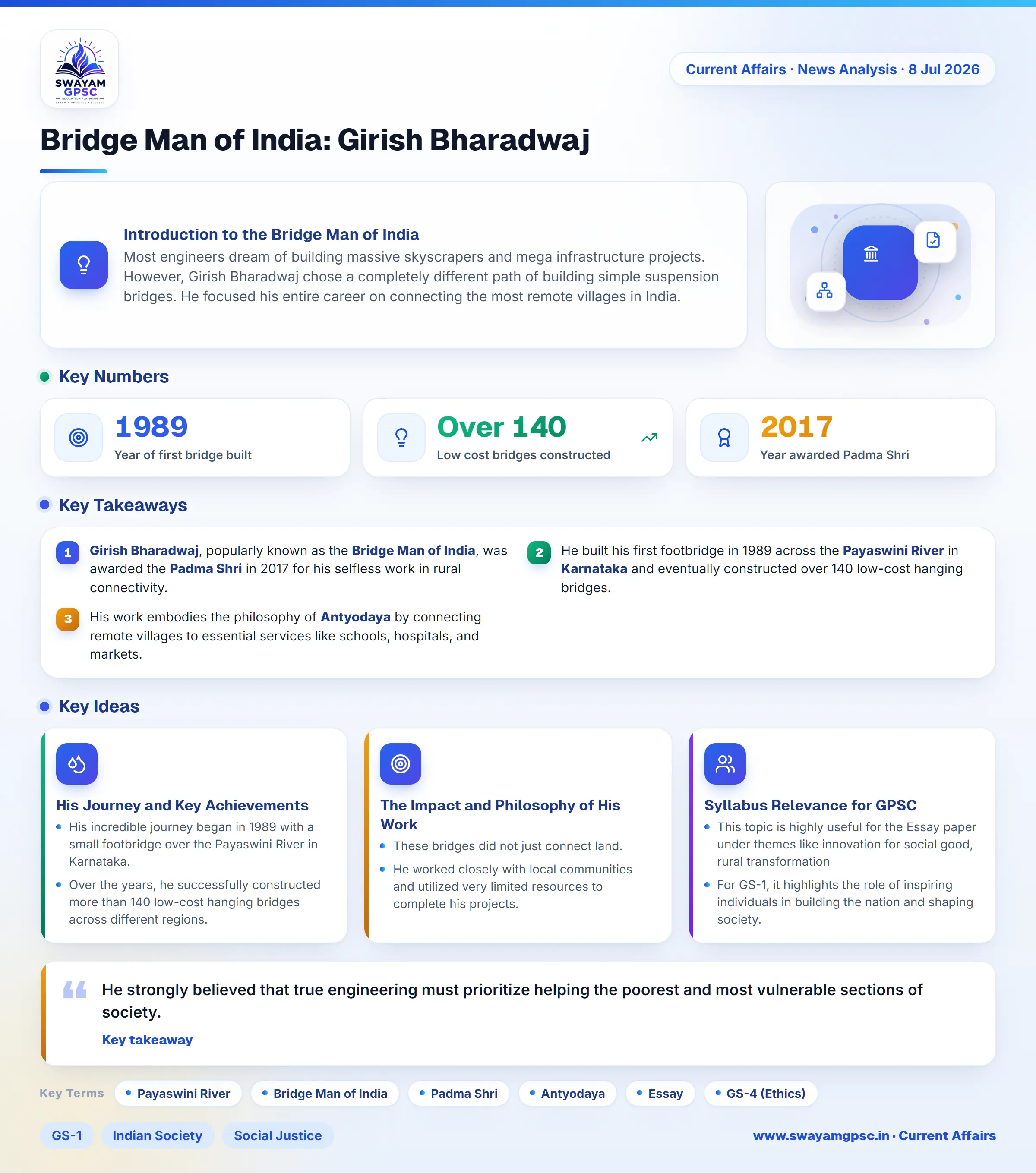
- Girish Bharadwaj, popularly known as the Bridge Man of India, was awarded the Padma Shri in 2017 for his selfless work in rural connectivity.
- He built his first footbridge in 1989 across the Payaswini River in Karnataka and eventually constructed over 140 low-cost hanging bridges.
- His work embodies the philosophy of Antyodaya by connecting remote villages to essential services like schools, hospitals, and markets.
Introduction to the Bridge Man of India
- Most engineers dream of building massive skyscrapers and mega infrastructure projects. However, Girish Bharadwaj chose a completely different path of building simple suspension bridges.
- He focused his entire career on connecting the most remote villages in India. This selfless work helped thousands of people who were cut off from basic facilities.
His Journey and Key Achievements
- His incredible journey began in 1989 with a small footbridge over the Payaswini River in Karnataka.
- Over the years, he successfully constructed more than 140 low-cost hanging bridges across different regions.
- Because of his massive contribution, people affectionately call him the Bridge Man of India.
- In recognition of his outstanding service, the government honored him with the prestigious Padma Shri award in 2017.
The Impact and Philosophy of His Work
- He strongly believed that true engineering must prioritize helping the poorest and most vulnerable sections of society.
- These bridges did not just connect land. They connected children to schools, patients to hospitals, and local farmers to nearby markets.
- He worked closely with local communities and utilized very limited resources to complete his projects.
- His approach proved that meaningful innovation depends on strong purpose rather than huge financial budgets.
- He truly represented the philosophy of Antyodaya which focuses on bringing development to the very last person.
- His legacy shows that we should measure nation-building by how many lives we quietly transform through compassion.
Syllabus Relevance for GPSC
- This topic is highly useful for the Essay paper under themes like innovation for social good, rural transformation, and inclusive development.
- For GS-1, it highlights the role of inspiring individuals in building the nation and shaping society.
- In GS-2, it serves as an excellent case study for rural development, inclusive governance, and community participation.
- For GS-3, it relates directly to infrastructure development, appropriate technology, and sustainable growth models.
- In GS-4 (Ethics), it perfectly demonstrates values like compassion, empathy, public service, and dedication to the common good.