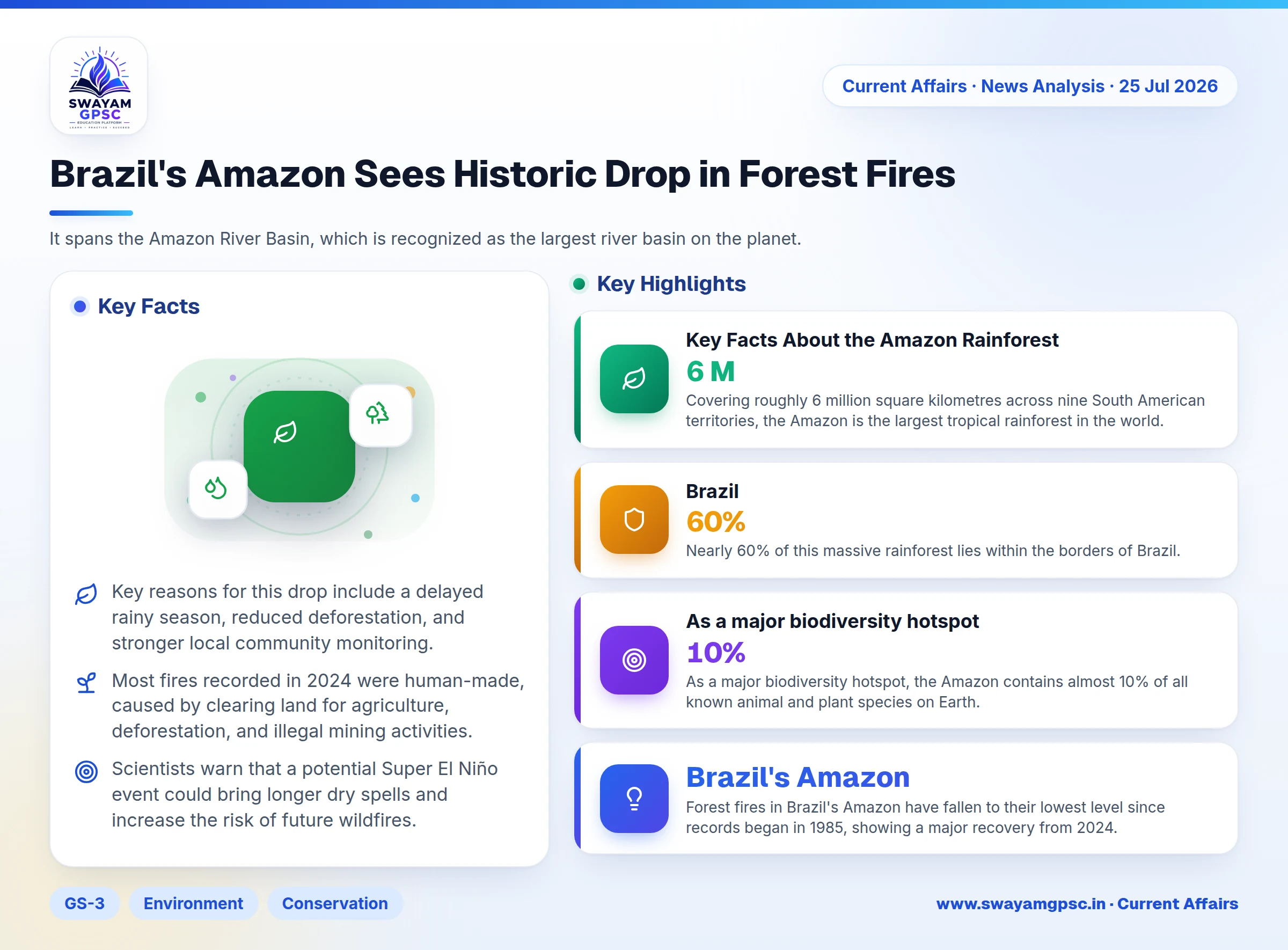
Brazil's Amazon Sees Historic Drop in Forest Fires
#GS-3 #Environment #Conservation #Biodiversity #Climate Change #GS-1 #Geography #Physical Geography
Why in News
- Forest fires in Brazil's Amazon have fallen to their lowest level since records began in 1985, showing a major recovery from 2024.
- Key reasons for this drop include a delayed rainy season, reduced deforestation, and stronger local community monitoring.
- Most fires recorded in 2024 were human-made, caused by clearing land for agriculture, deforestation, and illegal mining activities.
- Scientists warn that a potential Super El Niño event could bring longer dry spells and increase the risk of future wildfires.
Key Facts About the Amazon Rainforest
- Covering roughly 6 million square kilometres across nine South American territories, the Amazon is the largest tropical rainforest in the world.
- Nearly 60% of this massive rainforest lies within the borders of Brazil.
- It spans the Amazon River Basin, which is recognized as the largest river basin on the planet.
- The forest is surrounded by the Guiana Highlands to the north, the Andes Mountains to the west, the Brazilian Plateau to the south, and the Atlantic Ocean to the east.
- High rainfall, intense humidity, and warm temperatures create ideal conditions for this dense tropical evergreen ecosystem.
- As a major biodiversity hotspot, the Amazon contains almost 10% of all known animal and plant species on Earth.
- Notable plants include the Brazil nut, rubber, mahogany, cedar, and rosewood.
- Prominent wildlife species found here include the jaguar, capybara, tapir, sloth, anaconda, caiman, toucan, and macaw.
- Significant protected zones include Yasuni National Park in Ecuador, Jaú National Park, Tumucumaque National Park, and Pico da Neblina National Park in Brazil.
- Additional protected areas are Manu National Park and Pacaya-Samiria National Reserve in Peru, along with Amacayacu National Natural Park in Colombia.
- Often called the "Lungs of the Earth," the rainforest acts as a critical carbon sink that helps stabilize the global climate.
- The Amazon River originates in the Peruvian Andes, serving as the largest river by discharge volume and the second longest river after the Nile.
- Major tributaries feeding into the main river include the Rio Negro, Madeira, and Xingu.