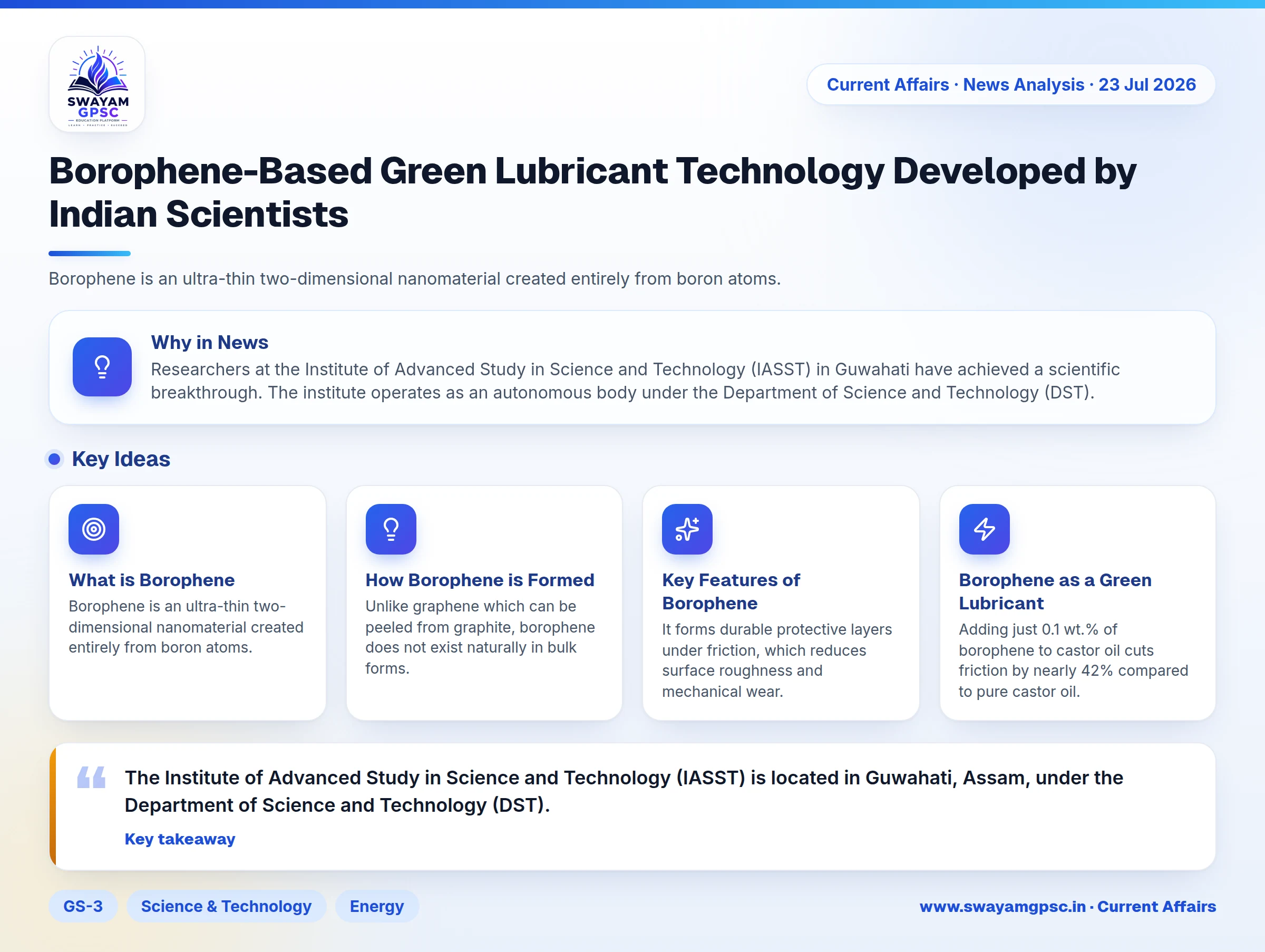
Borophene-Based Green Lubricant Technology Developed by Indian Scientists
#GS-3 #Science & Technology #Energy #Environment #Sustainable Development #Current Events #National #Achievements of Indians in Science & Technology #Nanomaterials
Why in News
- Researchers at the Institute of Advanced Study in Science and Technology (IASST) in Guwahati have achieved a scientific breakthrough.
- The institute operates as an autonomous body under the Department of Science and Technology (DST).
- They demonstrated the first-ever application of borophene as an additive in castor oil to build efficient green lubricants.
What is Borophene
- Borophene is an ultra-thin two-dimensional nanomaterial created entirely from boron atoms.
- It consists of a single-atom-thick layer and serves as the boron equivalent of graphene.
- Unlike standard bulk boron which behaves as a semiconductor, borophene conducts electricity and heat like a metal.
How Borophene is Formed
- Unlike graphene which can be peeled from graphite, borophene does not exist naturally in bulk forms.
- Scientists synthesize borophene artificially using Chemical Vapor Deposition (CVD) or Molecular Beam Epitaxy (MBE) inside ultra-high vacuum chambers.
- Pure boron gas evaporates onto clean metallic bases like silver, gold, or copper during production.
- The metallic base transfers electrons to stabilize the flat layer, forming a unique chemical bond network.
Key Features of Borophene
- It features direction-dependent physical properties, meaning its strength and conductivity change along different axes.
- It possesses extraordinary mechanical strength and flexibility with a very high tensile strength and Young's modulus.
- It forms durable protective layers under friction, which reduces surface roughness and mechanical wear.
- Its electron-deficient surface makes it reactive enough to mix evenly into organic liquids like castor oil without chemical modifications.
Borophene as a Green Lubricant Additive
- Industrial machines lose significant energy and face early component failure due to continuous friction and wear.
- Although castor oil is a renewable and biodegradable lubricant, its natural performance remains limited without additives.
- Adding just 0.1 wt.% of borophene to castor oil cuts friction by nearly 42% compared to pure castor oil.
- The mixture forms a protective tribofilm containing iron oxides, carbon species, and boron compounds that absorbs heavy working loads.
Key Applications
- This technology extends machine lifespan, lowers energy use, and improves operating efficiency in manufacturing industries.
- It provides clean lubrication solutions for renewable energy systems and marine transport.
- Its high storage capacity and fast ion transport make it ideal for next-generation batteries, supercapacitors, and hydrogen storage.
Prelims in Focus
- The Institute of Advanced Study in Science and Technology (IASST) is located in Guwahati, Assam, under the Department of Science and Technology (DST).
- While graphene is made of carbon, borophene consists of boron atoms and must be synthesized artificially under vacuum conditions.
- Combining plant-based lubricants like castor oil with 2D nanomaterials helps reduce industrial dependence on petroleum products.