Blue Micromoon: A Rare Astronomical Event
#Current Events #National #Science & Technology #Space #Geography #Physical Geography
Key takeaways
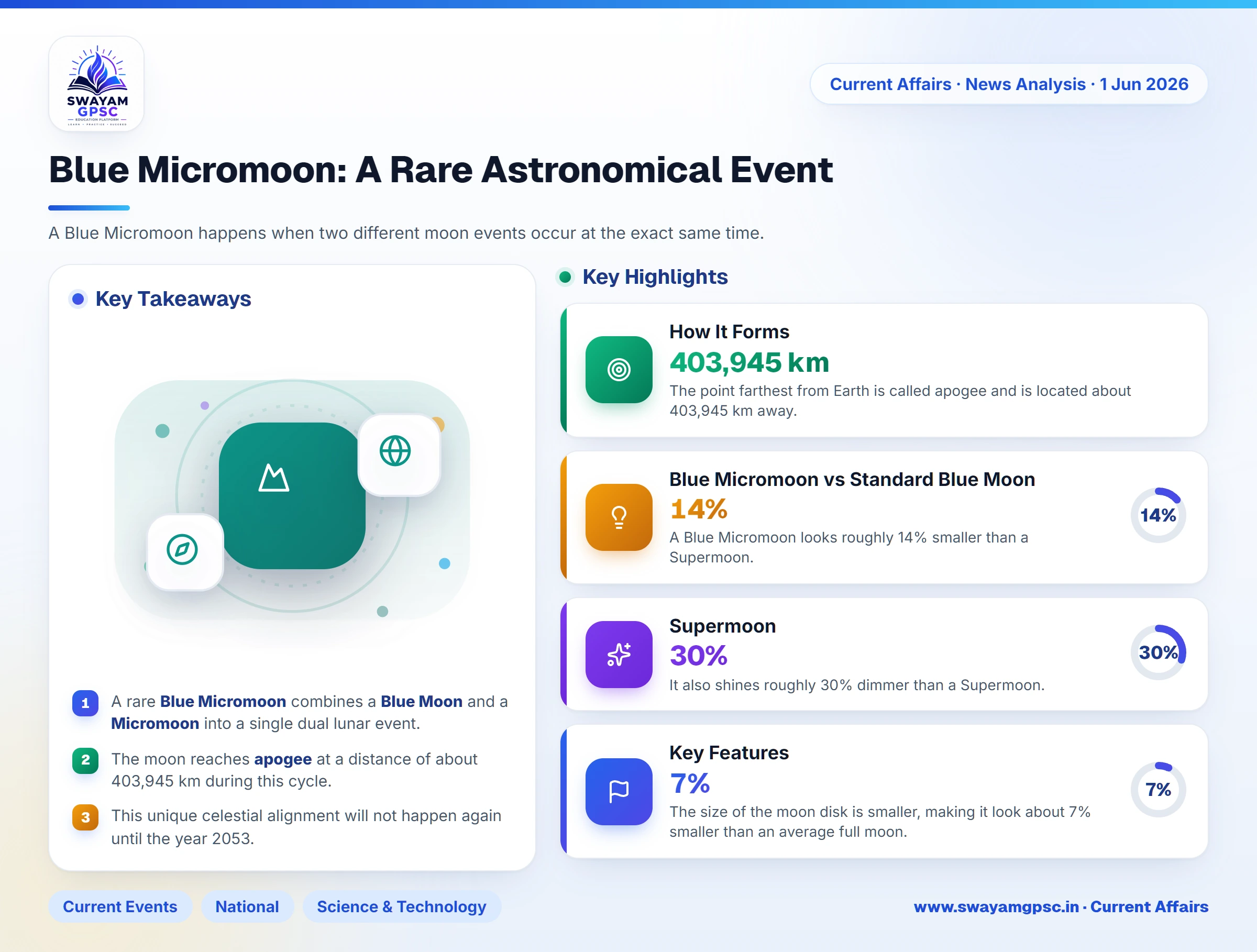
- A rare Blue Micromoon combines a Blue Moon and a Micromoon into a single dual lunar event.
- The moon reaches apogee at a distance of about 403,945 km during this cycle.
- This unique celestial alignment will not happen again until the year 2053.
- The moon appears roughly 14% smaller and 30% dimmer than a standard Supermoon.
Why in News
- A rare astronomical event called a Blue Micromoon recently appeared in the night sky.
- According to NASA, this full moon was the farthest, smallest, and dimmest of the year.
- This special event combines two lunar features that will not happen together again until 2053.
About Blue Micromoon
- A Blue Micromoon happens when two different moon events occur at the exact same time.
- The first part is a Blue Moon, which is the second full moon in a single calendar month.
- The second part is a Micromoon, which happens when a full moon occurs at apogee, the farthest point in the moon orbit.
How It Forms
- This rare event happens because of how the moon moves in its orbit and how our calendar works.
- The moon travels around Earth in an oval path that takes 27.3 days to complete.
- The point farthest from Earth is called apogee and is located about 403,945 km away.
- When a full moon happens near apogee, the moon looks smaller and less bright to people on Earth.
- A normal lunar cycle takes 29.5 days from one new moon to the next.
- Because months are 30 or 31 days long, an early full moon sometimes allows a second full moon to fit into the same month.
Blue Micromoon vs Standard Blue Moon
- A standard Blue Moon is simply a calendar trick where two full moons happen in one month.
- A Blue Micromoon combines this calendar timing with the moon being at its farthest point from Earth.
- A standard Blue Moon can happen anywhere along the moon orbital path.
- A Blue Micromoon must happen strictly at or near apogee.
- A Blue Micromoon looks roughly 14% smaller than a Supermoon.
- It also shines roughly 30% dimmer than a Supermoon.
- A standard Blue Moon happens every 2 to 3 years, but a Blue Micromoon will not return until 2053.
Key Features
- Because the moon is so far away at apogee, it reflects less light and becomes the dimmest full moon of the year.
- The size of the moon disk is smaller, making it look about 7% smaller than an average full moon.
- Despite its name, the moon does not actually turn blue.
- It keeps its normal pearly-gray color unless rare dust or smoke in the air changes how light looks.