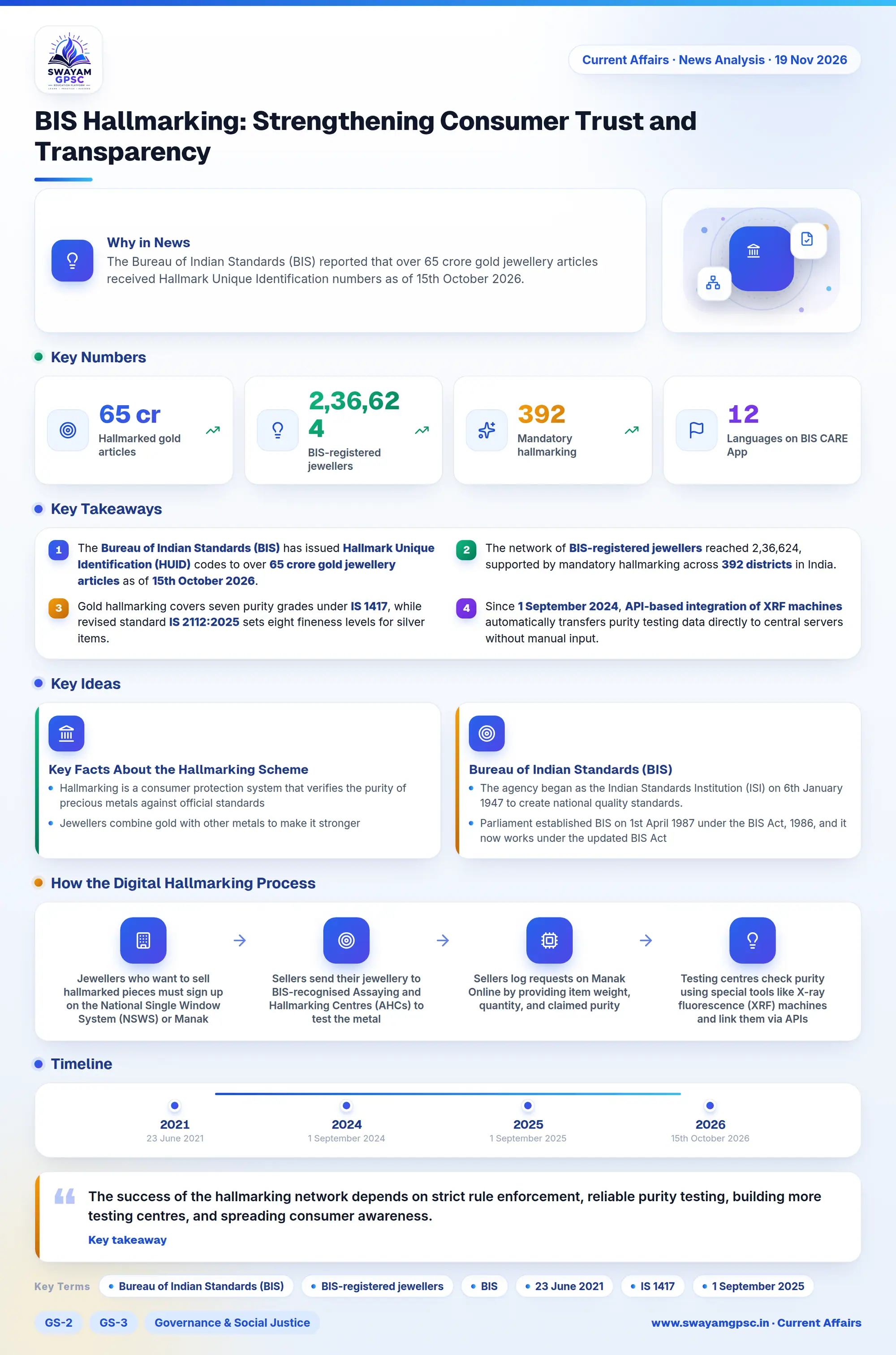
BIS Hallmarking: Strengthening Consumer Trust and Transparency
#GS-2 #GS-3 #Governance & Social Justice #Economy #E-Governance #Regulatory Bodies #Infrastructure #Government Policies & Interventions
Key takeaways
- The Bureau of Indian Standards (BIS) has issued Hallmark Unique Identification (HUID) codes to over 65 crore gold jewellery articles as of 15th October 2026.
- The network of BIS-registered jewellers reached 2,36,624, supported by mandatory hallmarking across 392 districts in India.
- Gold hallmarking covers seven purity grades under IS 1417, while revised standard IS 2112:2025 sets eight fineness levels for silver items.
- Since 1 September 2024, API-based integration of XRF machines automatically transfers purity testing data directly to central servers without manual input.
- Consumers can verify jewellery details, weight records, and photos in 12 languages using the official BIS CARE App.
Why in News
- The Bureau of Indian Standards (BIS) reported that over 65 crore gold jewellery articles received Hallmark Unique Identification numbers as of 15th October 2026.
- The count of BIS-registered jewellers grew to 2,36,624, showing the rapid spread of mandatory hallmarking and digital tracking across India.
Key Facts About the Hallmarking Scheme
- Hallmarking is a consumer protection system that verifies the purity of precious metals against official standards to shield buyers from fraud.
- Jewellers combine gold with other metals to make it stronger, which makes independent quality checks very important for buyers.
- The voluntary Hallmarking Scheme started in 2000 with BIS acting as the sole managing agency to protect buyers and boost export quality.
- The government introduced silver hallmarking in 2005, and the overall BIS Hallmarking Scheme now covers both gold and silver items.
- Mandatory gold hallmarking began on 23 June 2021 across 256 districts and later expanded to cover 392 districts.
- Under standard IS 1417, gold items receive hallmarking in seven purity levels: 9K375, 14K585, 18K750, 20K833, 22K916, 23K958, and 24KS995.
- Silver hallmarking stays voluntary, but any silver item hallmarked under this scheme must carry a unique tracking code from 1 September 2025.
- The updated IS 2112:2025 standard sets eight silver purity grades: 800, 835, 900, 925, 958, 970, 990, and 999.
- The Hallmark Unique Identification (HUID) is a six-character alphanumeric code given to each piece for digital verification and tracking.
- Official hallmarked gold and silver items carry three main stamps: the BIS Standard Mark, the metal purity stamp like 22K916 or 925, and the unique HUID Code.
Bureau of Indian Standards (BIS)
- The agency began as the Indian Standards Institution (ISI) on 6th January 1947 to create national quality standards.
- Parliament established BIS on 1st April 1987 under the BIS Act, 1986, and it now works under the updated BIS Act, 2016 which started on 12th October 2017.
- As India's National Standards Body, it handles product certification, quality checks, consumer safety, ISI Mark issuance, and hallmarking.
- A 25-member Governing Council manages the agency, and the Union Minister of Consumer Affairs, Food and Public Distribution serves as its ex-officio President.
How the Digital Hallmarking Process Works
- Jewellers who want to sell hallmarked pieces must sign up on the National Single Window System (NSWS) or Manak Online portal for a free lifetime registration.
- Sellers send their jewellery to BIS-recognised Assaying and Hallmarking Centres (AHCs) to test the metal purity.
- Sellers log requests on Manak Online by providing item weight, quantity, and claimed purity, creating a complete digital trail.
- Testing centres check purity using special tools like X-ray fluorescence (XRF) machines and link them via APIs directly to BIS servers since 1 September 2024 to stop manual editing.
- After passing testing, the BIS server creates a six-character HUID Code that gets stamped alongside the standard purity marks.
- Since 8 June 2026, testing centres must upload real photos of the jewellery, its hallmark stamp, and its recorded weight to Manak Online.
- The central server tracks timestamps to make sure purity checks happen before stamping, and the Transfer HUID tool launched on 1 June 2026 helps track movement between businesses.
- During 2025-26, BIS carried out more than 30 enforcement activities against sellers who misused the hallmark stamps.
- Buyers can check their jewellery details by entering the code in the free BIS CARE App, which shows photos, official weight, and seller details in 12 languages.
Way Forward
- The success of the hallmarking network depends on strict rule enforcement, reliable purity testing, building more testing centres, and spreading consumer awareness.