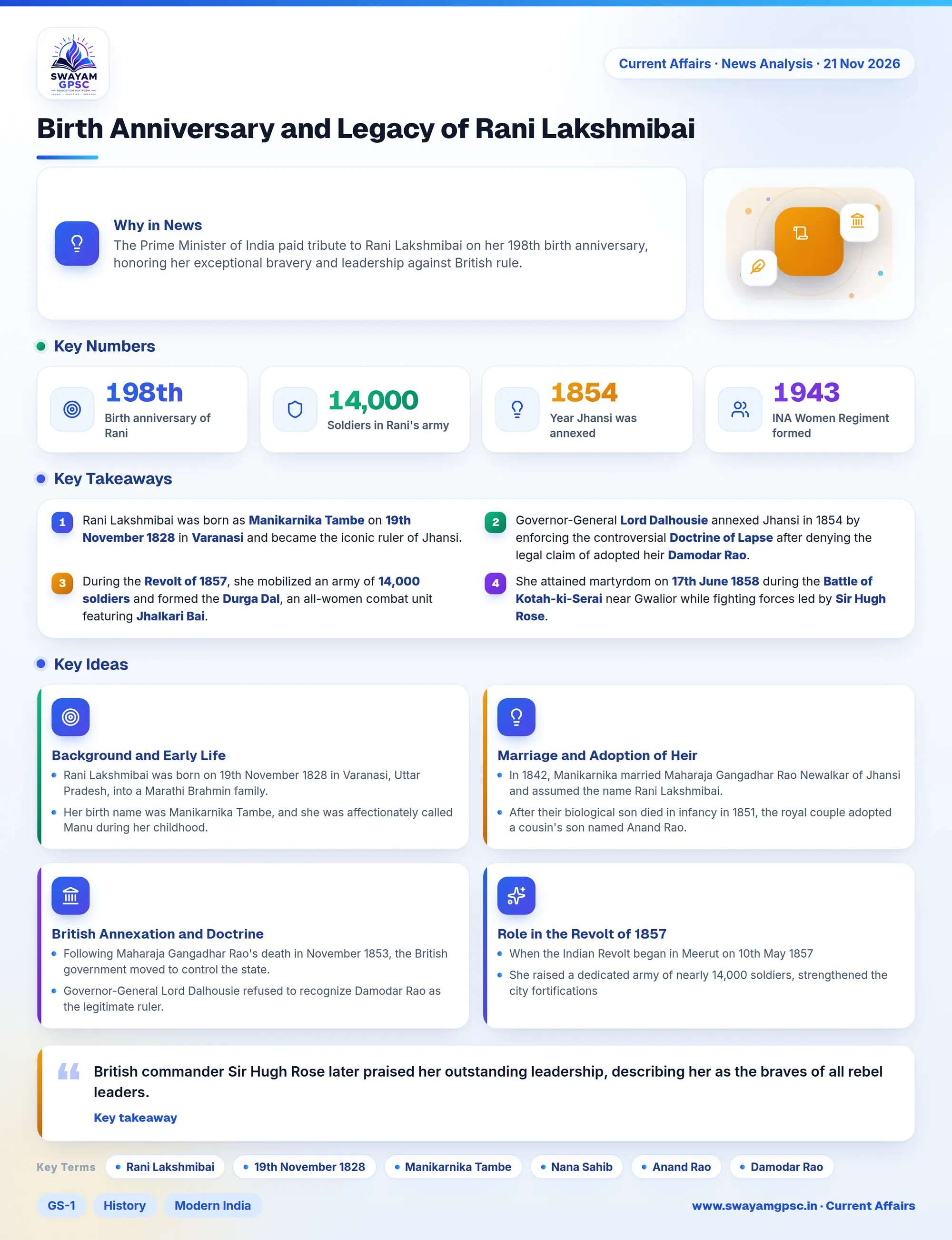
Birth Anniversary and Legacy of Rani Lakshmibai
#GS-1 #History #Modern India #Freedom Struggle #Women #Current Events #National #Rani Lakshmibai #Revolt of 1857 #Doctrine of Lapse
Key takeaways
- Rani Lakshmibai was born as Manikarnika Tambe on 19th November 1828 in Varanasi and became the iconic ruler of Jhansi.
- Governor-General Lord Dalhousie annexed Jhansi in 1854 by enforcing the controversial Doctrine of Lapse after denying the legal claim of adopted heir Damodar Rao.
- During the Revolt of 1857, she mobilized an army of 14,000 soldiers and formed the Durga Dal, an all-women combat unit featuring Jhalkari Bai.
- She attained martyrdom on 17th June 1858 during the Battle of Kotah-ki-Serai near Gwalior while fighting forces led by Sir Hugh Rose.
- Her legacy inspired Subhas Chandra Bose to establish the Rani of Jhansi Regiment under Captain Lakshmi Sahgal within the Indian National Army (INA) in 1943.
Why in News
- The Prime Minister of India paid tribute to Rani Lakshmibai on her 198th birth anniversary, honoring her exceptional bravery and leadership against British rule.
Background and Early Life
- Rani Lakshmibai was born on 19th November 1828 in Varanasi, Uttar Pradesh, into a Marathi Brahmin family.
- Her birth name was Manikarnika Tambe, and she was affectionately called Manu during her childhood.
- She grew up in Bithoor at the court of Peshwa Baji Rao II alongside Nana Sahib and Tatya Tope.
- Unlike most women of her era, she trained extensively in horsemanship, swordsmanship, archery, and shooting.
Marriage and Adoption of Heir
- In 1842, Manikarnika married Maharaja Gangadhar Rao Newalkar of Jhansi and assumed the name Rani Lakshmibai.
- After their biological son died in infancy in 1851, the royal couple adopted a cousin's son named Anand Rao.
- The adopted child was renamed Damodar Rao and declared the official heir to the throne of Jhansi.
British Annexation and Doctrine of Lapse
- Following Maharaja Gangadhar Rao's death in November 1853, the British government moved to control the state.
- Governor-General Lord Dalhousie refused to recognize Damodar Rao as the legitimate ruler.
- The British annexed Jhansi in 1854 under the policy known as the Doctrine of Lapse.
- Rani Lakshmibai firmly rejected this illegal seizure with her historic vow: 'Main apni Jhansi nahin doongi'.
Role in the Revolt of 1857
- When the Indian Revolt began in Meerut on 10th May 1857, Rani Lakshmibai assumed leadership of the uprising in Bundelkhand.
- She raised a dedicated army of nearly 14,000 soldiers, strengthened the city fortifications, and established weapon production units.
- She created Durga Dal, a women's military unit, which featured prominent fighters like Jhalkari Bai and Mundar.
- During March and April 1858, she heroically defended Jhansi against British forces commanded by Sir Hugh Rose.
- She managed to break through the enemy siege while carrying her young adopted son Damodar Rao on her back.
Final Battles and Death
- After escaping Jhansi, she joined forces with Tatya Tope at Kalpi to continue the military campaign.
- The combined rebel forces successfully captured the strategic fortress of Gwalior in June 1858.
- She personally led her army during the intense Battle of Kotah-ki-Serai near Gwalior.
- Rani Lakshmibai died fighting on the battlefield on 17th June 1858.
- British commander Sir Hugh Rose later praised her outstanding leadership, describing her as the braves of all rebel leaders.
Enduring Legacy
- Rani Lakshmibai remains an eternal symbol of national resistance against foreign colonial oppression.
- Her life inspired generations of patriotic literature, poetry, and folk songs across India.
- In 1943, Subhas Chandra Bose named the all-women unit of the Indian National Army (INA) as the Rani of Jhansi Regiment.
- This historic women's combat unit was commanded by Captain Lakshmi Sahgal during World War II.