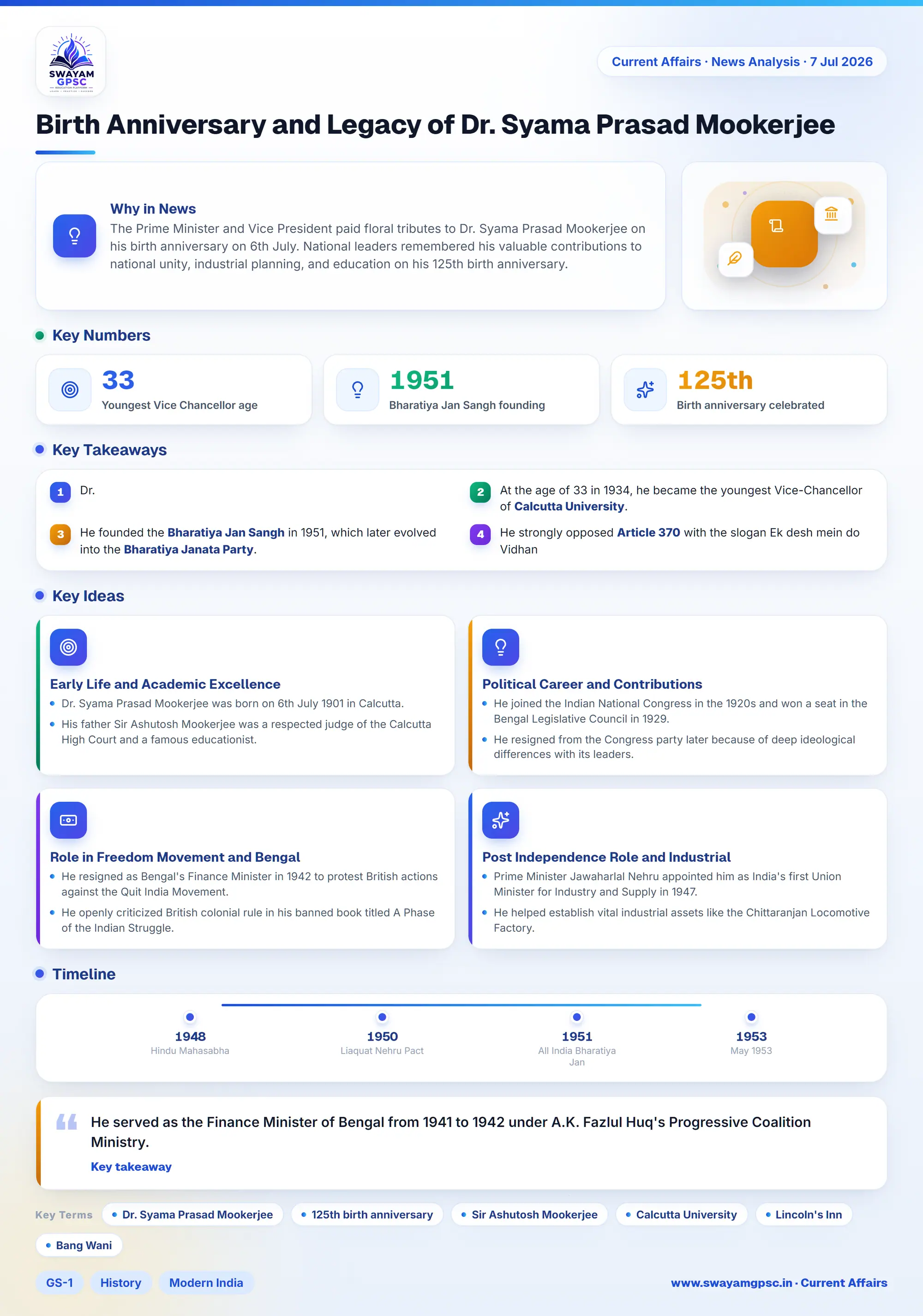
Birth Anniversary and Legacy of Dr. Syama Prasad Mookerjee
#GS-1 #History #Modern India #Freedom Struggle #Important Personalities #Culture
Key takeaways
- Dr. Syama Prasad Mookerjee served as Independent India's first Union Minister for Industry and Supply and laid the foundation for heavy industrial infrastructure.
- At the age of 33 in 1934, he became the youngest Vice-Chancellor of Calcutta University.
- He founded the Bharatiya Jan Sangh in 1951, which later evolved into the Bharatiya Janata Party.
- He strongly opposed Article 370 with the slogan Ek desh mein do Vidhan, do Pradhan aur do Nishan nahi chalenge and died in custody on 23rd June 1953.
Why in News
- The Prime Minister and Vice President paid floral tributes to Dr. Syama Prasad Mookerjee on his birth anniversary on 6th July.
- National leaders remembered his valuable contributions to national unity, industrial planning, and education on his 125th birth anniversary.
Early Life and Academic Excellence
- Dr. Syama Prasad Mookerjee was born on 6th July 1901 in Calcutta.
- His father Sir Ashutosh Mookerjee was a respected judge of the Calcutta High Court and a famous educationist.
- He graduated from Calcutta University and became a Senate Fellow in 1923.
- He qualified as an advocate in 1924 and completed his Barrister training from Lincoln's Inn in 1927.
- At the age of 33 in 1934, he became the youngest Vice-Chancellor of Calcutta University.
- During his time as Vice-Chancellor, he actively promoted mother tongue education in Bengal.
- He represented Calcutta University at the Conference of the Universities of the British Empire in England.
- He launched the Bengali journal Bang Wani in 1922 and the English newspaper The Nationalist in the 1940s.
Political Career and Contributions
- He joined the Indian National Congress in the 1920s and won a seat in the Bengal Legislative Council in 1929.
- He resigned from the Congress party later because of deep ideological differences with its leaders.
- He served as the Leader of the Opposition in the Bengal Assembly between 1937 and 1941.
- He served as the Finance Minister of Bengal from 1941 to 1942 under A.K. Fazlul Huq's Progressive Coalition Ministry.
- He joined the Hindu Mahasabha and served as its President between 1943 and 1946.
- He resigned from the Hindu Mahasabha in 1948 when the party rejected his proposal to allow non-Hindu members.
- In 1951, he founded the All India Bharatiya Jan Sangh and became its first national president.
- This party later evolved into the present day Bharatiya Janata Party.
Role in Freedom Movement and Bengal Famine
- He resigned as Bengal's Finance Minister in 1942 to protest British actions against the Quit India Movement.
- He openly criticized British colonial rule in his banned book titled A Phase of the Indian Struggle.
- During the severe Bengal Famine of 1943, he organized large scale relief work through the Ramakrishna Mission.
- He strongly opposed the United Bengal proposal in 1946 and saved West Bengal for the Indian Union.
- As a member of the Constituent Assembly, he actively shaped debates on minority rights and language policy.
Post Independence Role and Industrial Vision
- Prime Minister Jawaharlal Nehru appointed him as India's first Union Minister for Industry and Supply in 1947.
- He helped establish vital industrial assets like the Chittaranjan Locomotive Factory.
- He played a key role in building the Sindri Fertilizer Factory and the Hindustan Fertilizer Corporation.
- He resigned from the cabinet in 1950 to protest against the Liaquat Nehru Pact.
- He believed the pact failed to protect the security and rights of Hindus living in East Pakistan.
Opposition to Article 370 and Kashmir Satyagraha
- He strongly opposed special constitutional status for Jammu and Kashmir under Article 370.
- He popularized the famous slogan Ek desh mein do Vidhan, do Pradhan aur do Nishan nahi chalenge.
- This slogan declared that one country cannot have two constitutions, two prime ministers, and two national flags.
- He entered Jammu and Kashmir without an official permit in May 1953 to protest these restrictions.
- Police arrested him at the border, and he died in custody under mysterious circumstances on 23rd June 1953.
Legacy
- Fellow politicians called him The Lion of Parliament because of his powerful debate skills.
- His life continues to inspire national efforts toward administrative unity, industrial growth, and cultural identity.