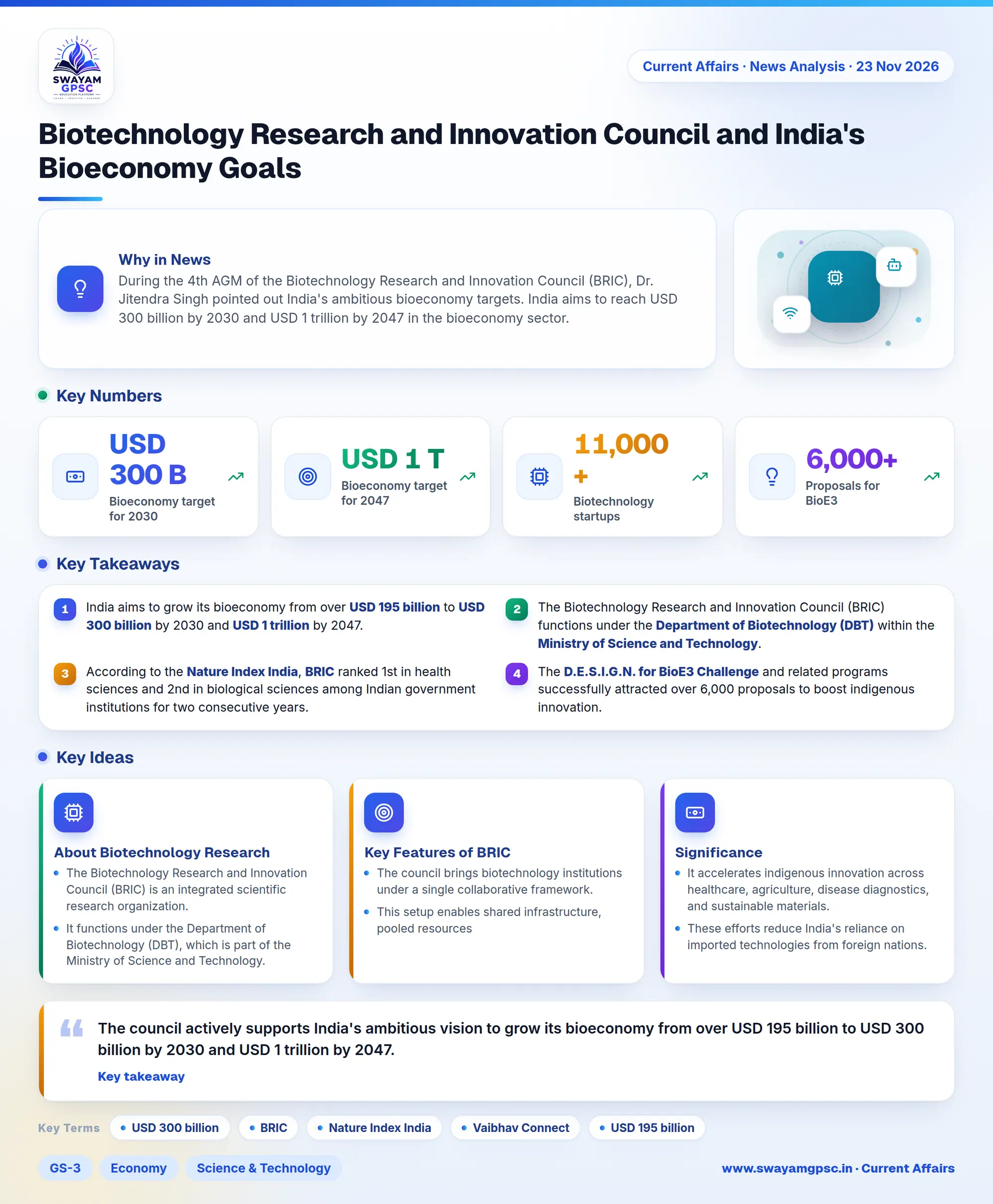
Biotechnology Research and Innovation Council and India's Bioeconomy Goals
#GS-3 #Economy #Science & Technology #Biotechnology #Infrastructure #Current Events #National #Biotechnology Research and Innovation Council
Key takeaways
- India aims to grow its bioeconomy from over USD 195 billion to USD 300 billion by 2030 and USD 1 trillion by 2047.
- The Biotechnology Research and Innovation Council (BRIC) functions under the Department of Biotechnology (DBT) within the Ministry of Science and Technology.
- According to the Nature Index India, BRIC ranked 1st in health sciences and 2nd in biological sciences among Indian government institutions for two consecutive years.
- The D.E.S.I.G.N. for BioE3 Challenge and related programs successfully attracted over 6,000 proposals to boost indigenous innovation.
- The council supports India's expanding ecosystem of more than 11,000 biotechnology startups through research commercialization and industry partnerships.
Why in News
- During the 4th AGM of the Biotechnology Research and Innovation Council (BRIC), Dr. Jitendra Singh pointed out India's ambitious bioeconomy targets.
- India aims to reach USD 300 billion by 2030 and USD 1 trillion by 2047 in the bioeconomy sector.
- The discussion strongly emphasized the importance of research commercialization and building strong industry partnerships.
About Biotechnology Research and Innovation Council
- The Biotechnology Research and Innovation Council (BRIC) is an integrated scientific research organization.
- It functions under the Department of Biotechnology (DBT), which is part of the Ministry of Science and Technology.
- The organization brings various biotechnology research institutions together through shared infrastructure, collaborative research, and unified governance.
- Its main aim is to strengthen India's biotechnology ecosystem by promoting interdisciplinary research and scientific innovation.
- It also focuses on industry partnerships and commercialization to directly contribute to India's national bioeconomy goals.
Key Features of BRIC
- The council brings biotechnology institutions under a single collaborative framework.
- This setup enables shared infrastructure, pooled resources, and unified governance while keeping individual scientific strengths safe.
- According to the Nature Index India, BRIC ranked 1st in health sciences and 2nd in biological sciences among Indian government institutions for two consecutive years.
- It actively promotes turning scientific discoveries into market-ready technologies, diagnostics, therapeutics, and sustainable biomaterials.
- This is achieved through targeted industry partnerships and entrepreneurship programs.
- The council encourages cross-disciplinary collaboration across artificial intelligence, biology, agriculture, and healthcare.
- It also runs initiatives like Vaibhav Connect to engage Indian scientific talent living abroad.
- Additional support includes the Entrepreneur-in-Residence programme and the D.E.S.I.G.N. for BioE3 Challenge, which successfully attracted over 6,000 proposals while improving institutional governance.
Significance
- The council actively supports India's ambitious vision to grow its bioeconomy from over USD 195 billion to USD 300 billion by 2030 and USD 1 trillion by 2047.
- It accelerates indigenous innovation across healthcare, agriculture, disease diagnostics, and sustainable materials.
- These efforts reduce India's reliance on imported technologies from foreign nations.
- The organization strengthens India's growing ecosystem of over 11,000 biotechnology startups.
- It achieves this by encouraging research commercialization, boosting industry investment, and creating high-skilled employment opportunities.