Biochar and its Agricultural and Environmental Applications
#GS-3 #Economy #Agriculture #Environment #Infrastructure #Climate Change #Sustainable Development
Key takeaways
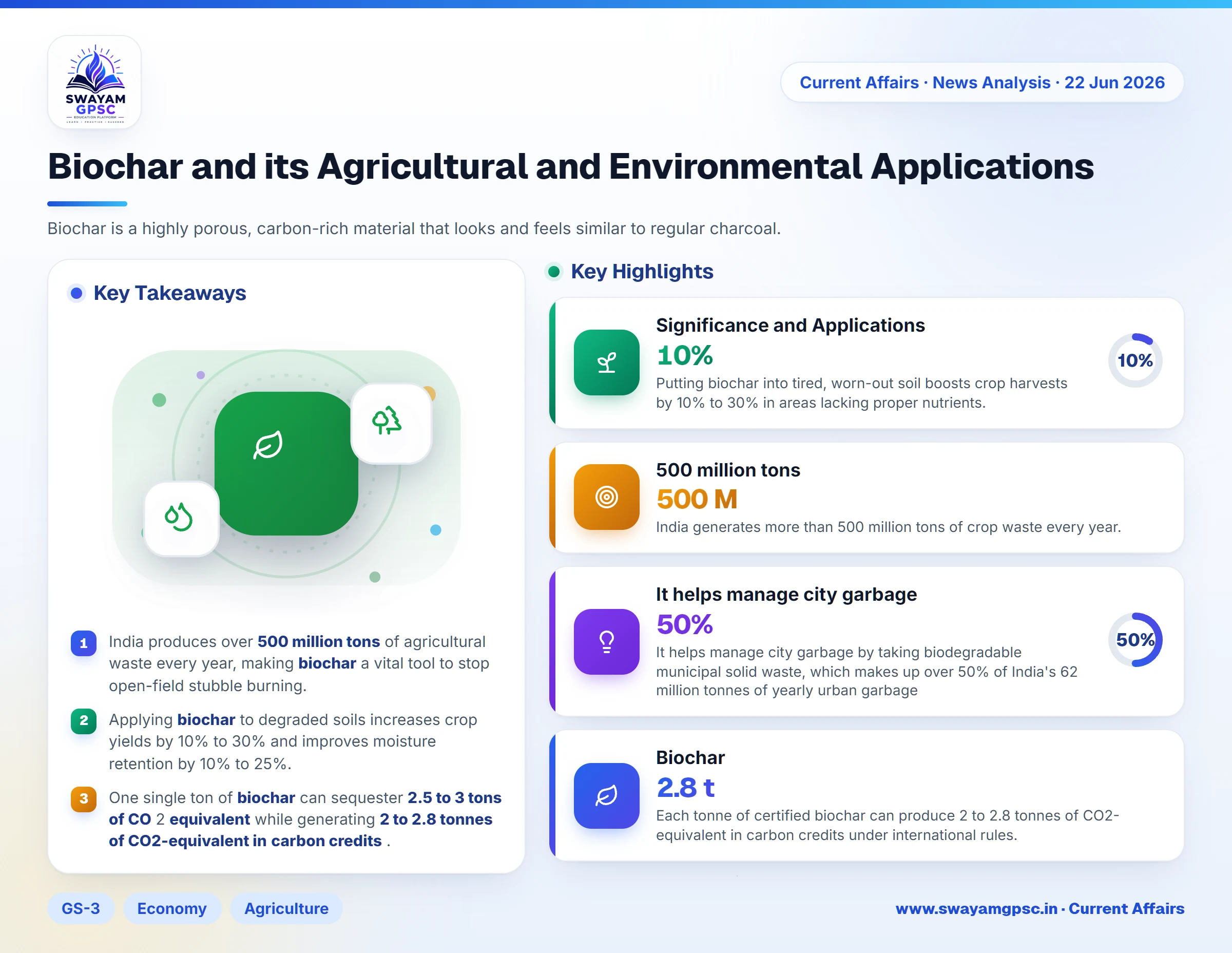
- India produces over 500 million tons of agricultural waste every year, making biochar a vital tool to stop open-field stubble burning.
- Applying biochar to degraded soils increases crop yields by 10% to 30% and improves moisture retention by 10% to 25%.
- One single ton of biochar can sequester 2.5 to 3 tons of CO 2 equivalent while generating 2 to 2.8 tonnes of CO2-equivalent in carbon credits .
- The pyrolysis process used to make biochar operates at temperatures between 300°C and 700°C in an oxygen-depleted environment.
Why in News
- Biochar offers a practical solution to two major problems in Indian agriculture: crop residue burning and poor soil health.
- India urgently needs sustainable and climate-friendly farming methods to protect the environment.
- Biochar helps by turning farm and organic waste into a helpful resource that enriches soil and captures carbon.
What is Biochar
- Biochar is a highly porous, carbon-rich material that looks and feels similar to regular charcoal.
- It is made by heating organic waste like farm leftovers, wood pieces, and food processing garbage.
- The manufacturing method is called pyrolysis , which means cooking the biomass in an environment with very little oxygen at temperatures from 300°C to 700°C .
- This heating process also creates useful by-products like syngas and bio-oil that can be used for clean energy.
- Inside the soil, its tiny holes act like a sponge to hold water and create a safe home for helpful microorganisms.
Significance and Applications
- Putting biochar into tired, worn-out soil boosts crop harvests by 10% to 30% in areas lacking proper nutrients.
- It raises the soil moisture-holding capacity by 10% to 25% to help plants survive dry spells and heatwaves.
- India generates more than 500 million tons of crop waste every year.
- Turning crop stubble into biochar stops open-field burning in North India and cuts down thick smoke and particulate matter.
- It helps manage city garbage by taking biodegradable municipal solid waste, which makes up over 50% of India's 62 million tonnes of yearly urban garbage, and sewage sludge to keep them out of landfills.
- Biochar traps atmospheric carbon in a solid form that stays in the earth for centuries instead of turning into methane or CO2.
- One single ton of biochar can lock away 2.5 to 3 tons of CO 2 equivalent , acting as a strong natural climate shield.
- Each tonne of certified biochar can produce 2 to 2.8 tonnes of CO2-equivalent in carbon credits under international rules.
- This gives farmers, village cooperatives, and rural communities a new way to earn money by selling the material or trading credits.
- Making biochar through pyrolysis in India can create approximately 20-30 million tonnes of syngas and 24-40 million tonnes of bio-oil as extra products.
- The resulting syngas can generate 8 to 13 Terawatt-hour of electricity every year.
- The generated bio-oil can replace 12 to 19 million tonnes of diesel or kerosene to lower crude oil imports and cut emissions by over 2%.
- Chemically treated pristine biochar cleans wastewater by filtering out dangerous heavy metals like chromium, arsenic, and lead.
- Adding 2% to 5% biochar into concrete makes buildings stronger, raises heat resistance by 20%, and traps about 115 kg of CO₂ in every cubic metre.
Domestic and Global Success Stories
- Field tests in the Akola district of Maharashtra using maize stalk biochar successfully repaired black soil fertility and increased organic carbon.
- Studies in Kerala proved that biochar made from coconut leaf stalks raised overall soil quality across different farming setups.
- The KISAN kiln project by IIT-Kharagpur helps small farmers turn their agricultural waste into profit.
- In Kenya , turning rice husks into biochar generated many certified carbon credits while fixing soil phosphorus and pH levels.
- The government of Thailand linked biochar certification to its national carbon registry system to encourage soil repair work.
- Brazil achieved high crop growth and strong carbon storage by using biochar made from sugarcane bagasse.
About Biochar
- Biochar is a solid material full of carbon and tiny pores made from wood chips, crop scraps, manure, and municipal waste that breaks down very slowly.
- Its main goal is long-term carbon sequestration to trap carbon dioxide taken in by plants so it cannot return to the atmosphere.
- The pyrolysis reaction heats organic waste in controlled, oxygen-free chambers.
- The final quality of the product depends on the original feedstock used and the specific heating and cooling steps.
- Its microscopic network works like an underground physical sponge.
- Unlike normal rotting plants, its strong carbon bonds protect it from bacteria so it stays safely in the dirt for thousands of years.
- Its exact pH balance, ash amount, and mineral value change depending on how the manufacturer made it.
- It has a high cation exchange capacity that lets it grip loose soil bits and hold onto vital minerals.
- It acts as a permanent carbon removal tool that meets strict global safety rules.
Prelims in Focus
- Biochar can serve as part of the growing medium in modern vertical farming setups.
- As part of a growing mix, biochar helps nitrogen-fixing microorganisms multiply and thrive.
- It allows soil and growing mixes to hold onto water for much longer periods.
- Bagasse from the sugar industry works well as a biomass fuel to create energy.
- Molasses from sugar mills can be used to produce clean ethanol .