The BHAVYA Portal for Industrial Parks
#GS-3 #Economy #Infrastructure #Growth #Industry #Government Schemes
Key takeaways
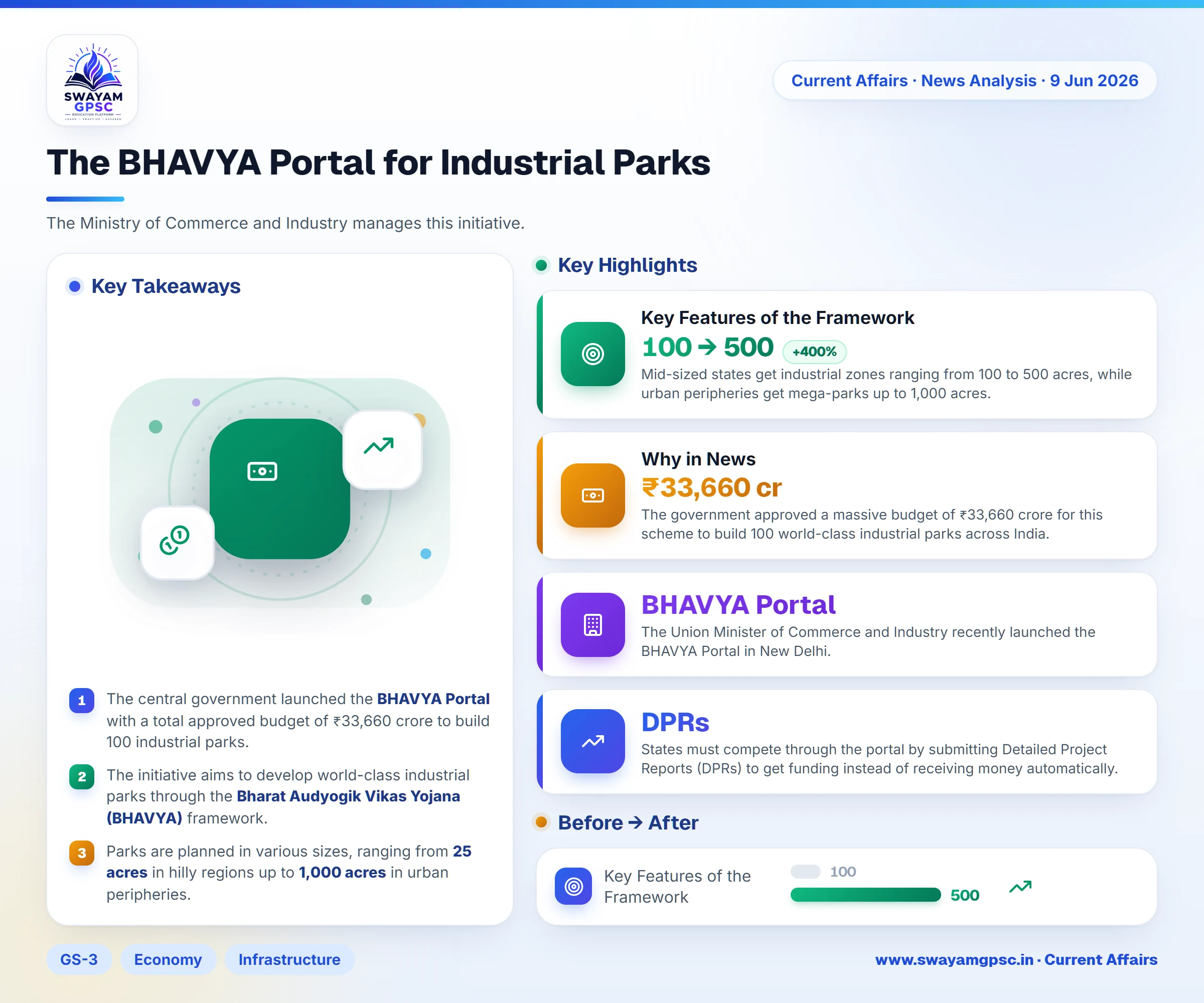
- The central government launched the BHAVYA Portal with a total approved budget of ₹33,660 crore to build 100 industrial parks.
- The initiative aims to develop world-class industrial parks through the Bharat Audyogik Vikas Yojana (BHAVYA) framework.
- Parks are planned in various sizes, ranging from 25 acres in hilly regions up to 1,000 acres in urban peripheries.
- The Central and State governments fund and build these parks using a 51:49 joint partnership model.
Why in News
- The Union Minister of Commerce and Industry recently launched the BHAVYA Portal in New Delhi.
- This launch marks the official start of the Bharat Audyogik Vikas Yojana (BHAVYA) scheme.
- The government approved a massive budget of ₹33,660 crore for this scheme to build 100 world-class industrial parks across India.
About The BHAVYA Portal
- The portal is an advanced digital platform created to manage the complete lifecycle of new industrial parks in India.
- It serves as a single window for state project submissions, real-time construction tracking, and remote investor mapping.
- The Ministry of Commerce and Industry manages this initiative.
- The National Industrial Corridor Development Corporation (NICDC) acts as the main execution body.
Aims and Objectives
- The framework aims to bridge infrastructure gaps for domestic and global manufacturing companies by offering ready-to-use industrial plots.
- It removes traditional problems like land acquisition delays and environmental clearance hurdles to speed up business setups.
- Ultimately, the initiative aims to create large-scale industrial employment across the country.
Key Features of the Framework
- States must compete through the portal by submitting Detailed Project Reports (DPRs) to get funding instead of receiving money automatically.
- Industrial parks are divided into three scales based on regional terrain, starting with 25 acres for hilly regions, Union Territories, and the Northeast.
- Mid-sized states get industrial zones ranging from 100 to 500 acres, while urban peripheries get mega-parks up to 1,000 acres.
- State governments provide the land, and the Central Government funds primary infrastructure using a 51:49 joint partnership model.
- Applications submitted between June 1 and July 31, 2026, will compete for the first batch of 20 parks.
- An additional 30 parks will be allotted based on dossiers received up to September 30.
- Parks will include specialized high-tech enclaves for deep-tech firms, startups, R&D labs, and Global Capability Centres (GCCs).
- Modern testing labs will be built inside the parks in partnership with BIS, EIA, and FSSAI to clear compliance checks quickly.
- The policy includes dedicated international enclaves with housing and social infrastructure for partners like Japan, Singapore, South Korea, and Switzerland.