Bharatiya Vayuyan Niyam 2026 and Draft Sustainable Aviation Fuel Policy
#GS-3 #Economy #Infrastructure #Environment #Climate Change #Civil Aviation #Sustainable Aviation Fuel #Bharatiya Vayuyan Niyam 2026
Key takeaways
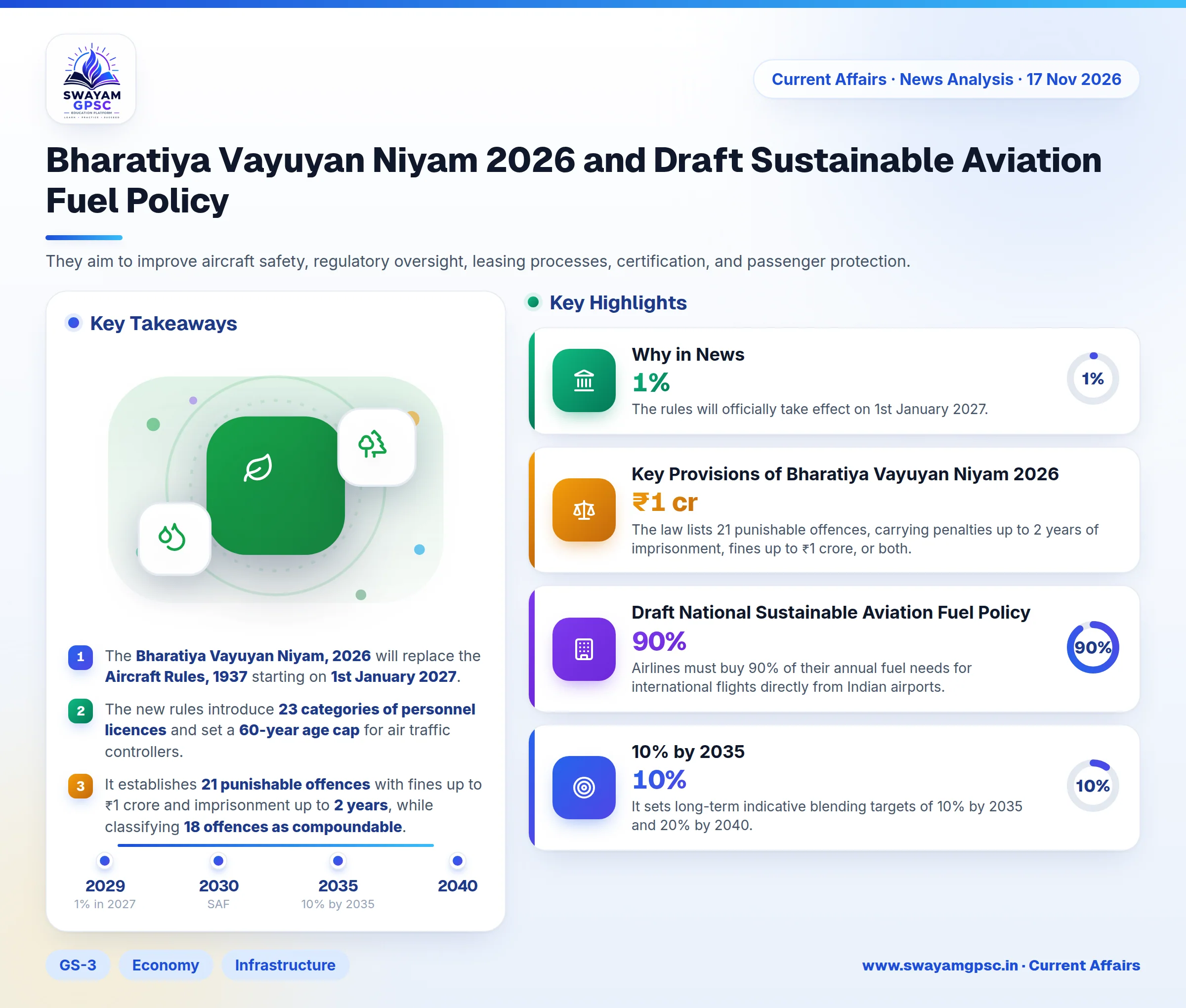
- The Bharatiya Vayuyan Niyam, 2026 will replace the Aircraft Rules, 1937 starting on 1st January 2027.
- The new rules introduce 23 categories of personnel licences and set a 60-year age cap for air traffic controllers.
- It establishes 21 punishable offences with fines up to ₹1 crore and imprisonment up to 2 years, while classifying 18 offences as compoundable.
- Draft SAF Policy proposes mandatory fuel blending for international flights, scaling from 1% in 2027 to 5% by 2030.
- Using Sustainable Aviation Fuel cuts lifecycle carbon emissions by up to 80% compared to standard jet fuel.
Why in News
- The Indian government notified the Bharatiya Vayuyan Niyam, 2026 to modernise the country's civil aviation framework.
- This new set of rules replaces the old Aircraft Rules, 1937.
- The rules will officially take effect on 1st January 2027.
- They aim to improve aircraft safety, regulatory oversight, leasing processes, certification, and passenger protection.
- The Ministry of Civil Aviation also prepared the draft National Sustainable Aviation Fuel (SAF) Policy.
- This draft policy proposes mandatory SAF blending for international flights, starting at 1% in 2027 and reaching 5% by 2030.
Key Provisions of Bharatiya Vayuyan Niyam 2026
- The rules provide a comprehensive legal framework for registering, manufacturing, and operating aircraft in India.
- The Bharatiya Vayuyan Adhiniyam, 2024 provides the legal foundation for these new aviation rules.
- The Ministry of Civil Aviation (MoCA) serves as the main administrative ministry.
- The Directorate General of Civil Aviation (DGCA) acts as the chief regulator for safety, licensing, and compliance.
- The main goals include improving flight safety, boosting local aircraft manufacturing, facilitating aircraft leasing, and protecting passenger rights.
- All aircraft must register with authorities and clearly display their prescribed nationality and registration marks.
- The framework sets strict operational rules to manage emergency situations, prevent dangerous flying, and maintain security.
- Operators need special permission to carry explosives, arms, animals, or to conduct parachuting and aerial photography.
- Civil aircraft are strictly prohibited from creating sonic booms while flying over Indian territory.
- The DGCA can issue or validate design certificates for local and foreign aircraft, engines, and propellers.
- The regulator can issue airworthiness directives to resolve safety issues in any aircraft or component.
- The rules create legal provisions to support domestic manufacturing of aircraft parts following strict safety standards.
- Aircraft operators must maintain complete records of all routine inspections, repairs, and modifications.
- Owners and lessors must notify authorities immediately whenever an aircraft changes hands.
- Authorities must clear Irrevocable De-registration and Export Request Authorisation (IDERA) applications within 5 working days.
- Clear guidelines are established to make exporting deregistered aircraft simpler and faster.
- Indian-registered aircraft must display the nationality mark VT, followed by a hyphen and 3 capital letters.
- The framework introduces 23 categories of licences, ratings, and certificates for aviation personnel.
- It sets clear rules for medical fitness, educational criteria, and professional training.
- These standards apply directly to pilots, flight engineers, maintenance crew, air traffic controllers, and radio operators.
- Air traffic controllers face a maximum age limit of 60 years to exercise their license privileges.
- The rules outline licensing criteria for both public and private aerodromes across India.
- Airport operators must prepare operational manuals and run safety management systems.
- The DGCA has full power to inspect airport equipment, safety records, and infrastructure facilities.
- Air traffic managers must maintain smooth, safe, and efficient airspace operations.
- Operators must certify navigation systems, maintain surveillance tools, and keep records of all communications.
- Authorities must provide accurate weather reports to flights and store all weather records for at least 30 days.
- The DGCA must approve the creation, change, or withdrawal of any instrument flight procedure.
- Airlines must enforce duty-time limits and rest periods to manage pilot and crew fatigue.
- Crew members cannot consume alcohol or intoxicants within 12 hours before a flight or while on duty.
- Commercial air transport operators must secure proper certifications before running scheduled flights.
- The DGCA will create and manage a State Safety Programme to track nationwide aviation security.
- Aviation companies must build internal systems to identify and manage operational risks continuously.
- The rules create mandatory and voluntary safety reporting channels, protecting voluntary whistleblowers with strict confidentiality.
- The government must usually publish draft Civil Aviation Requirements (CARs) for 30 days to collect public feedback.
- The law lists 21 punishable offences, carrying penalties up to 2 years of imprisonment, fines up to ₹1 crore, or both.
- It classifies 18 offences as compoundable, helping reduce criminal cases for minor regulatory mistakes.
- A new 10-level penalty system sets monetary fines ranging from ₹10,000 to ₹1 crore based on severity.
Draft National Sustainable Aviation Fuel Policy
- The draft policy encourages airlines to replace traditional Aviation Turbine Fuel (ATF) with clean fuel alternatives.
- As of 5th November 2026, this policy remains a draft proposal and is not yet a binding law.
- It aims to lower carbon emissions, build local fuel production, and improve national energy security.
- The blending targets align directly with the international Carbon Offsetting and Reduction Scheme for International Aviation (CORSIA) framework.
- Airlines must buy 90% of their annual fuel needs for international flights directly from Indian airports.
- This fuel-uplift rule stops airlines from carrying cheaper fossil fuel from abroad, applying to both local and foreign carriers.
- The government plans to offer viability gap funding, green finance, and tax relief to lower production costs.
- Domestic, medical, humanitarian, and emergency flights do not need to follow these blending rules.
- The draft policy sets mandatory blending goals of 1% in 2027, 2% in 2028, 3% in 2029, and 5% in 2030.
- It sets long-term indicative blending targets of 10% by 2035 and 20% by 2040.
- Airlines must submit verified fuel purchase reports to the DGCA, facing penalties for unapproved deviations.
- The regulator will establish a national SAF registry to monitor transactions and green credit claims.
- The mandates will give priority to locally produced sustainable fuel based on domestic supply and technology.
Understanding Sustainable Aviation Fuel
- Sustainable Aviation Fuel (SAF) is a clean alternative fuel made from organic waste and renewable materials.
- Common feedstocks include agricultural waste, used cooking oil, and plant biomass.
- It acts as a drop-in fuel, meaning airlines can mix it up to 50% with conventional fuel without changing existing engines.
- Using SAF cuts lifetime greenhouse gas emissions by up to 80% compared to traditional jet fuel.
- Currently, SAF costs 2 to 5 times more than traditional fuel, and global production remains limited.
Way Forward
- The new rules modernise Indian aviation by improving safety, simplifying leasing, and protecting passenger rights.
- Combining regulatory reforms with clean fuel targets helps India build an environmentally friendly aviation sector.
- Successful adoption requires strong coordination between government bodies, fuel producers, and commercial airlines.