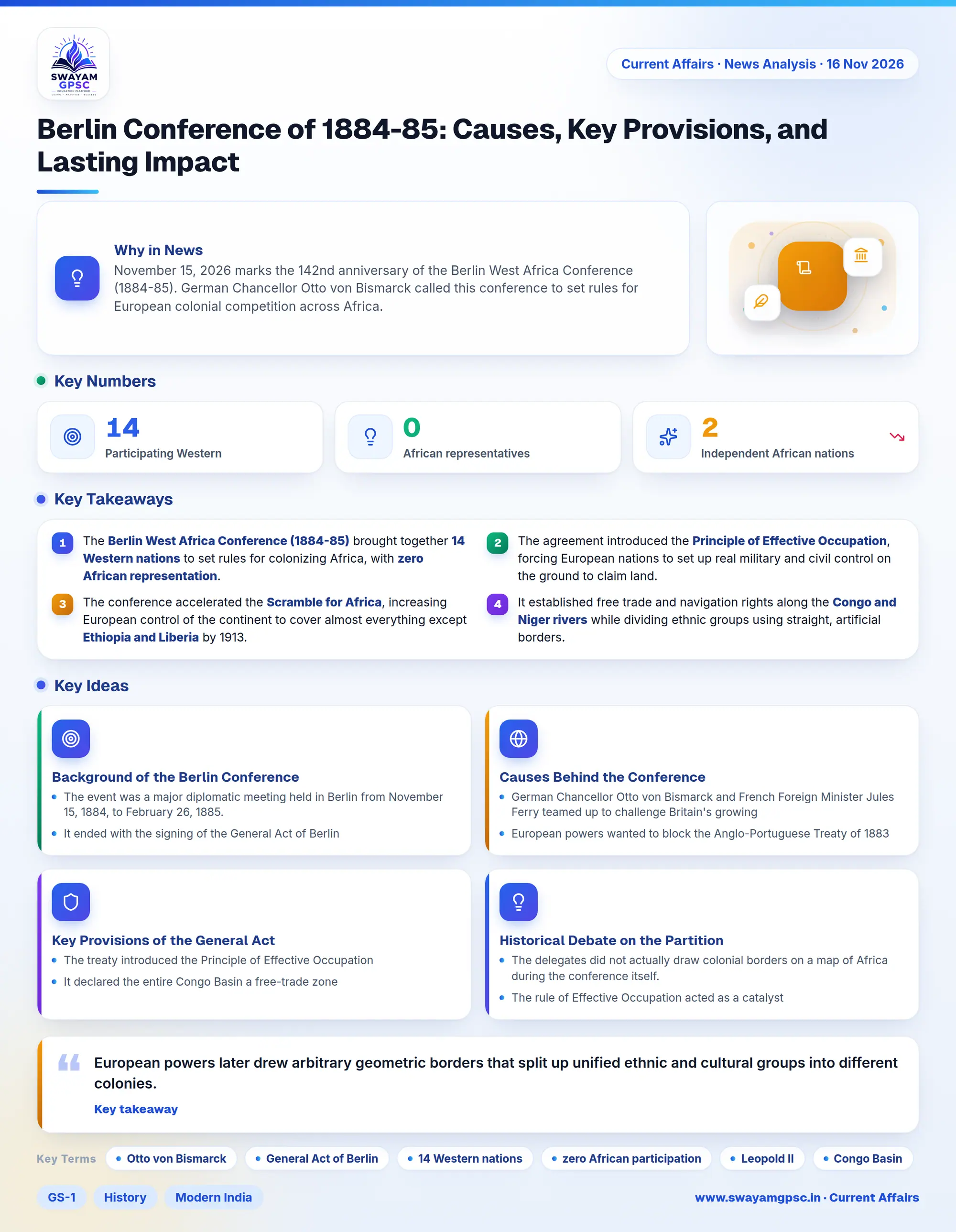
Berlin Conference of 1884-85: Causes, Key Provisions, and Lasting Impact
#GS-1 #History #Modern India #Freedom Struggle #Current Events #International #Colonialism #Berlin Conference #Scramble for Africa
Key takeaways
- The Berlin West Africa Conference (1884-85) brought together 14 Western nations to set rules for colonizing Africa, with zero African representation.
- The agreement introduced the Principle of Effective Occupation, forcing European nations to set up real military and civil control on the ground to claim land.
- The conference accelerated the Scramble for Africa, increasing European control of the continent to cover almost everything except Ethiopia and Liberia by 1913.
- It established free trade and navigation rights along the Congo and Niger rivers while dividing ethnic groups using straight, artificial borders.
Why in News
- November 15, 2026 marks the 142nd anniversary of the Berlin West Africa Conference (1884-85).
- German Chancellor Otto von Bismarck called this conference to set rules for European colonial competition across Africa.
Background of the Berlin Conference
- The event was a major diplomatic meeting held in Berlin from November 15, 1884, to February 26, 1885.
- It ended with the signing of the General Act of Berlin, which established the legal system for European expansion in Africa.
- A total of 14 Western nations attended the conference, including Great Britain, France, Germany, Portugal, Belgium, and the United States.
- The conference took place with zero African participation, leaving native populations completely unrepresented.
Causes Behind the Conference
- German Chancellor Otto von Bismarck and French Foreign Minister Jules Ferry teamed up to challenge Britain's growing imperial dominance after Britain occupied Egypt in 1882.
- European powers wanted to block the Anglo-Portuguese Treaty of 1883, which gave Portugal control over the mouth of the Congo River and threatened open trade.
- King Leopold II of Belgium used his Association Internationale du Congo to claim vast land in Central Africa, forcing other nations to demand clear international rules.
- European countries wanted to establish formal rules to avoid breaking out into direct wars with each other over African territories.
Key Provisions of the General Act of Berlin
- The treaty introduced the Principle of Effective Occupation, requiring countries to set up real physical administration and military presence on the ground before claiming land.
- It declared the entire Congo Basin a free-trade zone, allowing merchants from all nations to trade without paying discriminatory tariffs.
- It guaranteed free navigation for all international merchant ships along the Congo and Niger rivers.
- It required signatory nations to maintain the neutrality of the Congo Basin even during European wars.
- It included a official pledge to stop the land-based slave trade and protect local African populations.
Historical Debate on the Partition of Africa
- The delegates did not actually draw colonial borders on a map of Africa during the conference itself.
- The rule of Effective Occupation acted as a catalyst, starting a frantic rush among European powers to seize land across the continent.
- European control grew rapidly from coastal ports before 1884 to nearly the entire continent by 1913, leaving only Ethiopia and Liberia independent.
Long-Term Impact on Africa
- European powers later drew arbitrary geometric borders that split up unified ethnic and cultural groups into different colonies.
- Colonies set up extractive economies by building roads and ports designed only to ship raw materials back to Europe.
- The treaty enabled severe human rights abuses and violence against local populations, especially under King Leopold II in the Congo.
- Newly independent African nations inherited unstable borders and weak political systems, causing conflicts that continue today.
Conclusion
- The Berlin Conference of 1884-85 legally justified European conquest by establishing the rule of effective occupation.
- By ignoring African sovereignty, the conference caused the rapid partition of Africa, creating border issues and economic problems that affect the continent today.