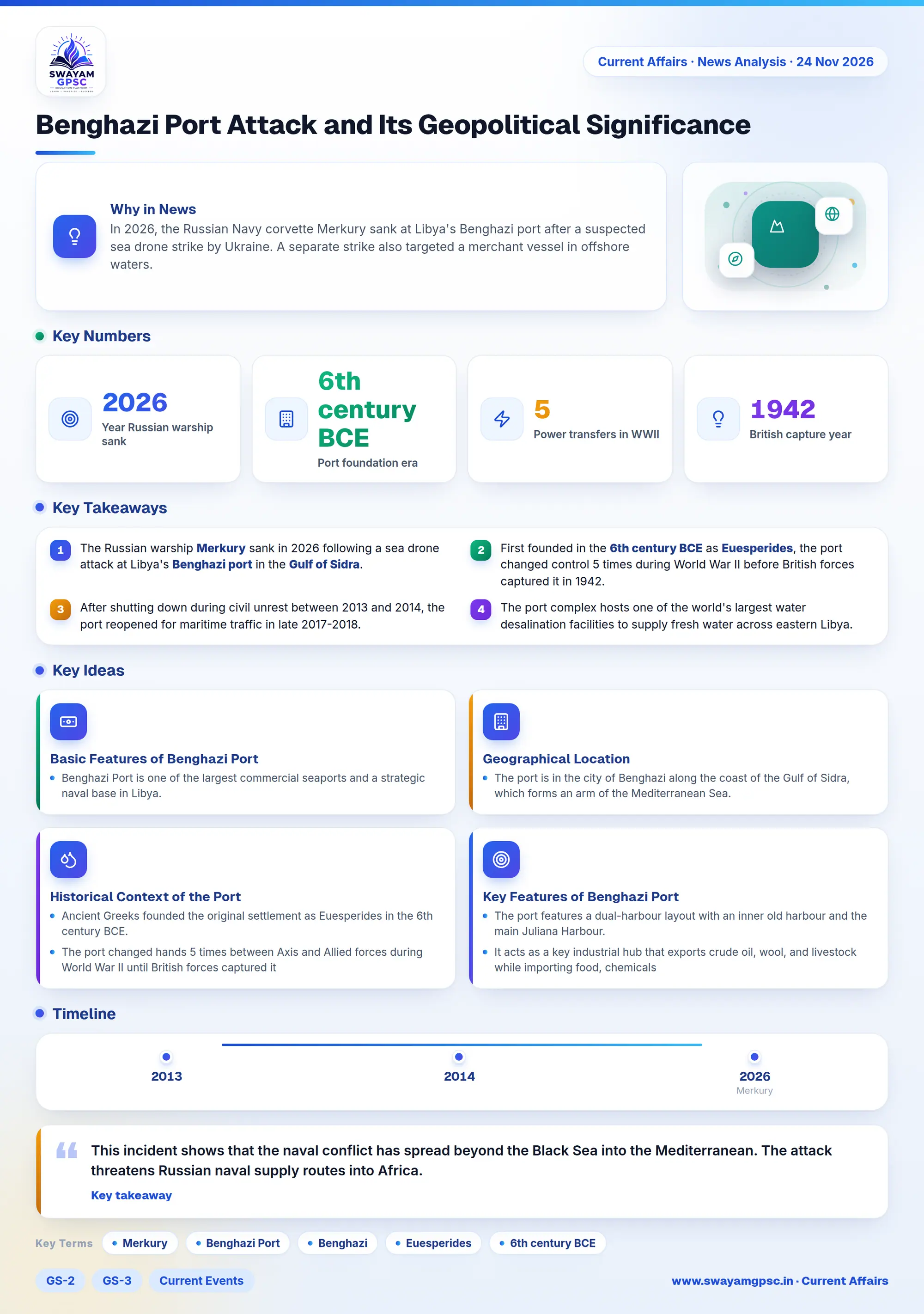
Benghazi Port Attack and Its Geopolitical Significance
#GS-2 #GS-3 #Current Events #Geography #International #Physical Geography
Key takeaways
- The Russian warship Merkury sank in 2026 following a sea drone attack at Libya's Benghazi port in the Gulf of Sidra.
- First founded in the 6th century BCE as Euesperides, the port changed control 5 times during World War II before British forces captured it in 1942.
- After shutting down during civil unrest between 2013 and 2014, the port reopened for maritime traffic in late 2017-2018.
- The port complex hosts one of the world's largest water desalination facilities to supply fresh water across eastern Libya.
Why in News
- In 2026, the Russian Navy corvette Merkury sank at Libya's Benghazi port after a suspected sea drone strike by Ukraine. A separate strike also targeted a merchant vessel in offshore waters.
Basic Features of Benghazi Port
- Benghazi Port is one of the largest commercial seaports and a strategic naval base in Libya. It acts as the primary maritime gateway for trade in eastern and southern Libya.
Geographical Location
- The port is in the city of Benghazi along the coast of the Gulf of Sidra, which forms an arm of the Mediterranean Sea. It sits within the historic Cyrenaica region of northeastern Libya.
Historical Context of the Port
- Ancient Greeks founded the original settlement as Euesperides in the 6th century BCE. Italian colonial rulers later modernized it into a deep-water harbour in the early 20th century.
- The port changed hands 5 times between Axis and Allied forces during World War II until British forces captured it in 1942. Following Libya's post-2011 civil war, fighting blocked the port after 2013-2014, but it reopened for commercial ships in late 2017-2018.
Key Features of Benghazi Port
- The port features a dual-harbour layout with an inner old harbour and the main Juliana Harbour. It manages shipping containers, general cargo, grain silos, livestock, and liquid bulk tankers.
- It acts as a key industrial hub that exports crude oil, wool, and livestock while importing food, chemicals, and machinery. The area also hosts oil refineries and food-processing plants.
- The port complex houses one of the world's largest water desalination facilities, which supplies drinking water to Benghazi and nearby cities.
- It serves as a critical strategic node near a naval base run by Khalifa Haftar's Libyan National Army (LNA). Russia uses this base for its naval logistics across the Mediterranean Sea.
Implications of the Attack
- This incident shows that the naval conflict has spread beyond the Black Sea into the Mediterranean. The attack threatens Russian naval supply routes into Africa.
- The strike endangers merchant shipping and risks turning politically divided Libya into a proxy battleground for foreign nations.