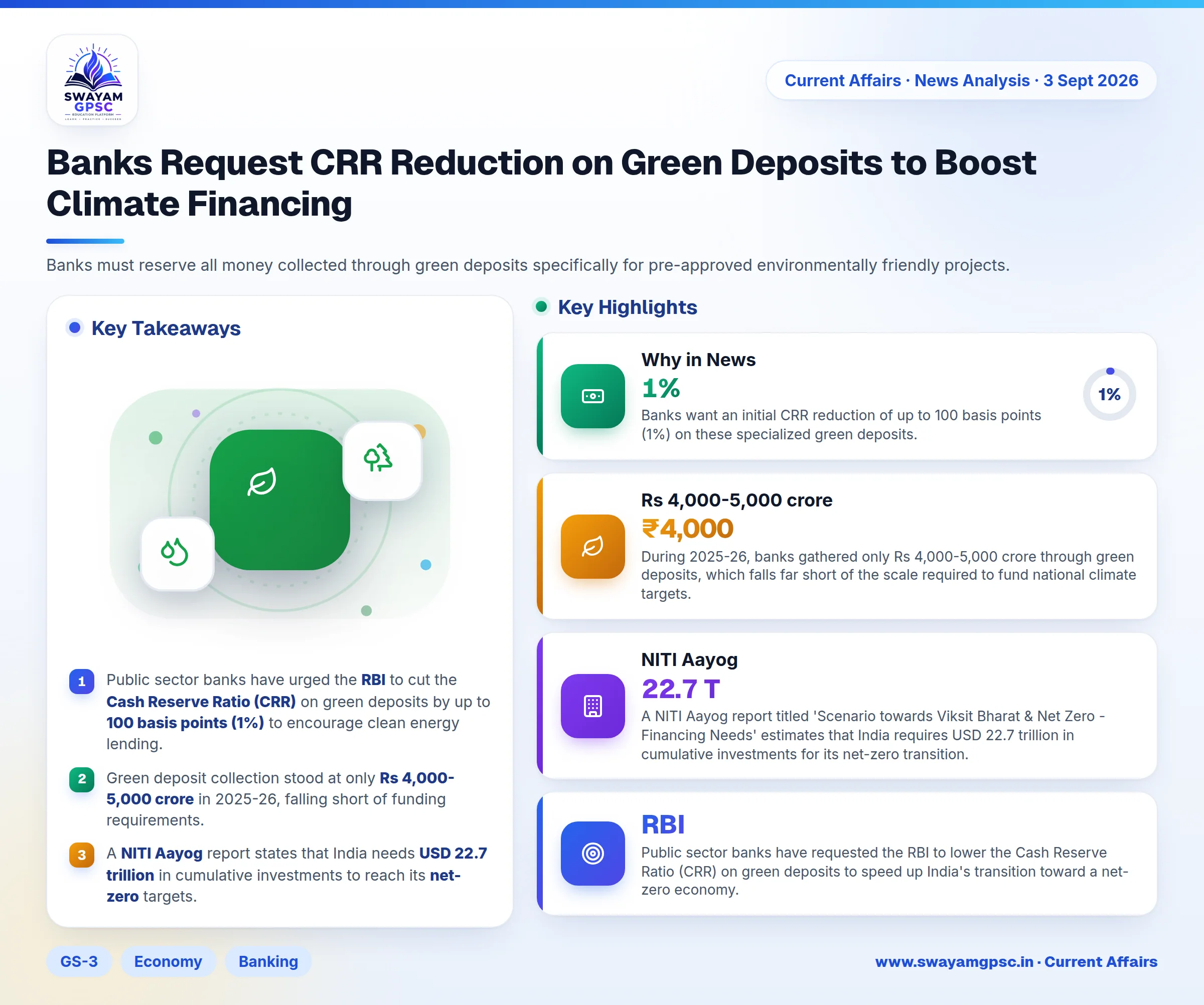
Banks Request CRR Reduction on Green Deposits to Boost Climate Financing
#GS-3 #Economy #Banking #Monetary Policy #Environment #Climate Change #Green Deposits
Key takeaways
- Public sector banks have urged the RBI to cut the Cash Reserve Ratio (CRR) on green deposits by up to 100 basis points (1%) to encourage clean energy lending.
- Green deposit collection stood at only Rs 4,000-5,000 crore in 2025-26, falling short of funding requirements.
- A NITI Aayog report states that India needs USD 22.7 trillion in cumulative investments to reach its net-zero targets.
- Regulated by the RBI Green Deposit Framework 2023, these earmarked funds are dedicated to sectors like renewable energy, waste management, and energy efficiency.
Why in News
- Public sector banks have requested the RBI to lower the Cash Reserve Ratio (CRR) on green deposits to speed up India's transition toward a net-zero economy.
- Banks want an initial CRR reduction of up to 100 basis points (1%) on these specialized green deposits.
- Lowering the reserve requirement will make green credit cheaper for borrowers and encourage sustainable projects.
- During 2025-26, banks gathered only Rs 4,000-5,000 crore through green deposits, which falls far short of the scale required to fund national climate targets.
- A NITI Aayog report titled 'Scenario towards Viksit Bharat & Net Zero - Financing Needs' estimates that India requires USD 22.7 trillion in cumulative investments for its net-zero transition.
- Reducing the CRR will lower funding costs and release capital, compensating banks for the high costs of evaluating projects to prevent greenwashing.
Green Deposits Framework
- A green deposit is a fixed-term, interest-bearing deposit accepted by regulated institutions like commercial banks and NBFCs.
- Banks must reserve all money collected through green deposits specifically for pre-approved environmentally friendly projects.
- Under the RBI Green Deposit Framework 2023, eligible sectors include renewable energy, waste management, clean transportation, climate change adaptation, and energy efficiency.
- Green deposits differ from green bonds, which are tradable debt instruments sold in capital markets to fund sustainable activities.
Cash Reserve Ratio (CRR)
- The CRR is the specified percentage of a bank's Net Demand and Time Liabilities (NDTL) that must be parked as cash reserves with the RBI.
- Commercial banks do not earn any interest income on the cash reserves maintained under the CRR mandate.
- A high CRR absorbs excess cash from the banking sector and reduces overall lending capacity, whereas a lower CRR releases liquidity to support credit growth.
Way Forward
- India needs to finalize its climate finance taxonomy to create clear rules for sustainable investment across the financial sector.
- Building a coordinated regulatory system will ease compliance burdens on banks and NBFCs and help attract long-term global capital.