Bankim Chandra Chattopadhyay
#GS-1 #Modern India #Literature #Freedom Struggle #Culture #History
Key takeaways
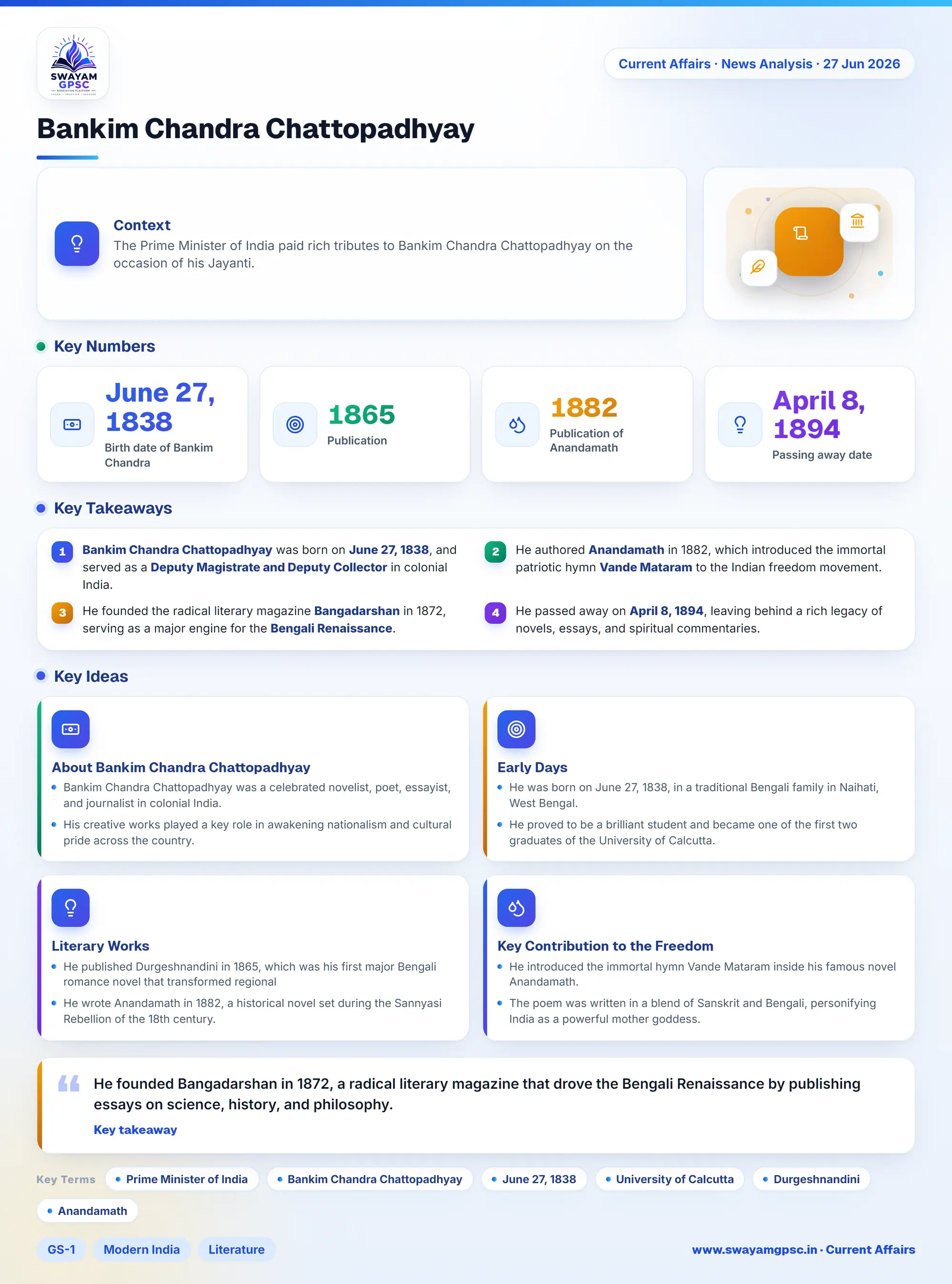
- Bankim Chandra Chattopadhyay was born on June 27, 1838, and served as a Deputy Magistrate and Deputy Collector in colonial India.
- He authored Anandamath in 1882, which introduced the immortal patriotic hymn Vande Mataram to the Indian freedom movement.
- He founded the radical literary magazine Bangadarshan in 1872, serving as a major engine for the Bengali Renaissance.
- He passed away on April 8, 1894, leaving behind a rich legacy of novels, essays, and spiritual commentaries.
Context
- The Prime Minister of India paid rich tributes to Bankim Chandra Chattopadhyay on the occasion of his Jayanti.
About Bankim Chandra Chattopadhyay
- Bankim Chandra Chattopadhyay was a celebrated novelist, poet, essayist, and journalist in colonial India.
- His creative works played a key role in awakening nationalism and cultural pride across the country.
Early Days
- He was born on June 27, 1838, in a traditional Bengali family in Naihati, West Bengal.
- He proved to be a brilliant student and became one of the first two graduates of the University of Calcutta.
- He joined the colonial administration as a Deputy Magistrate and Deputy Collector, serving for over thirty years before retiring.
Literary Works
- He published Durgeshnandini in 1865, which was his first major Bengali romance novel that transformed regional literature.
- He wrote Anandamath in 1882, a historical novel set during the Sannyasi Rebellion of the 18th century.
- He authored Devi Chaudhurani, another historical novel that highlighted women's strength and resistance against British tax systems.
- He founded Bangadarshan in 1872, a radical literary magazine that drove the Bengali Renaissance by publishing essays on science, history, and philosophy.
Key Contribution to the Freedom Movement
- He introduced the immortal hymn Vande Mataram inside his famous novel Anandamath.
- The poem was written in a blend of Sanskrit and Bengali, personifying India as a powerful mother goddess.
- Vande Mataram quickly evolved from a simple poem into the official battle cry of Indian freedom fighters.
- His writings instilled the core idea of deshbhakti, teaching that working for national liberation is a supreme spiritual duty.
Last Days
- During his final years, he stepped away from official public roles to focus on religious, philosophical, and literary writings.
- He wrote detailed commentaries on the Bhagavad Gita during this quiet phase of his life.
- He passed away on April 8, 1894, in Calcutta after dedicating his life to literature and public service.