Bangladesh RMG Crisis: Strategic Opportunity for India's Textile Sector
#GS-2 #Governance & Social Justice #Regulatory Bodies #GS-3 #Economy #Growth #Infrastructure #Current Events #International #National #Mobilization of Resources
Key takeaways
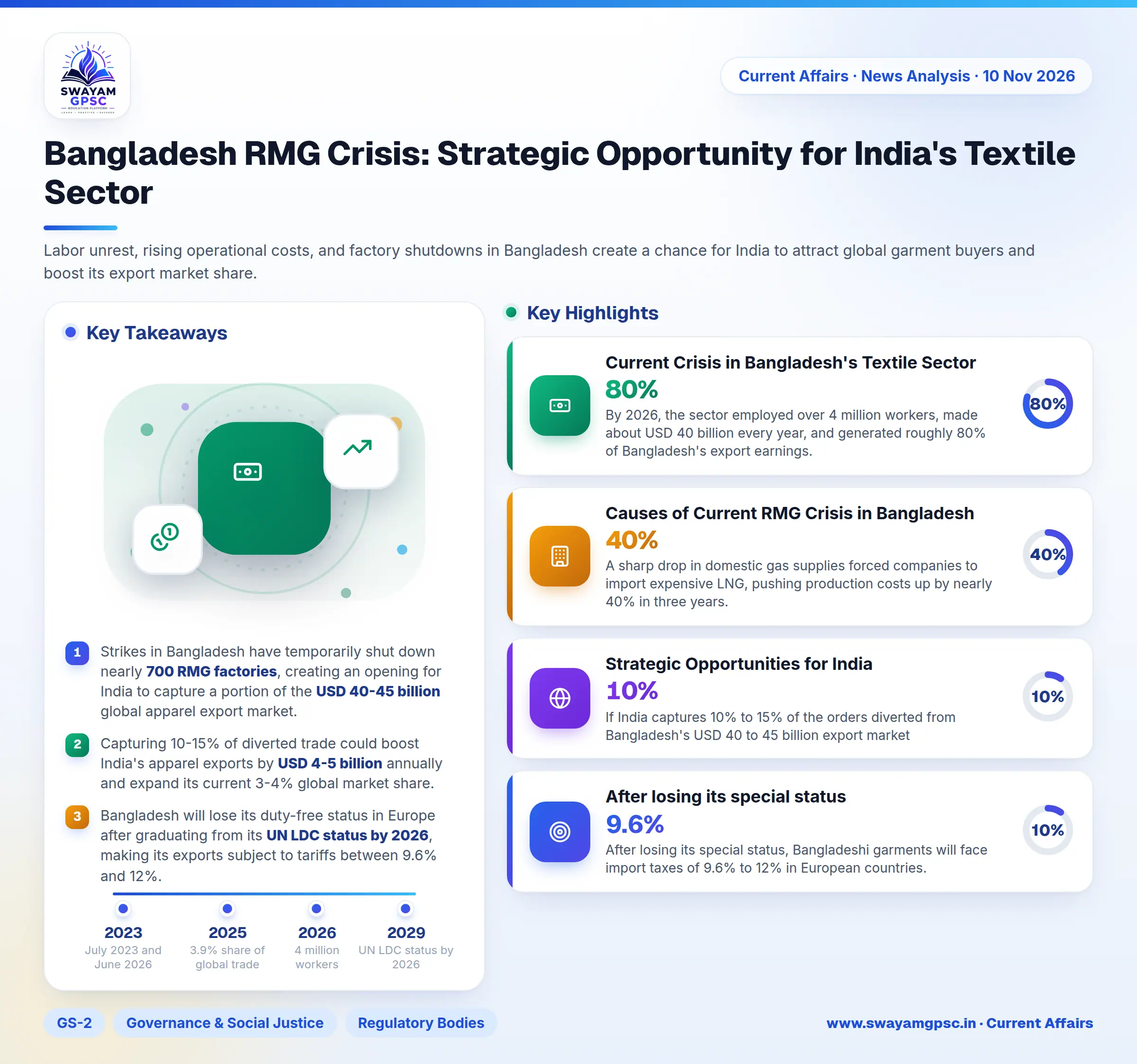
- Strikes in Bangladesh have temporarily shut down nearly 700 RMG factories, creating an opening for India to capture a portion of the USD 40-45 billion global apparel export market.
- Capturing 10-15% of diverted trade could boost India's apparel exports by USD 4-5 billion annually and expand its current 3-4% global market share.
- Bangladesh will lose its duty-free status in Europe after graduating from its UN LDC status by 2026, making its exports subject to tariffs between 9.6% and 12%.
- India textile sector contributes 2% to GDP, 11% to manufacturing GVA, and 8.63% to overall exports, providing employment to over 45 million workers.
- To capture fast-fashion demand, India must address its inverted export balance of 70% cotton to 30% MMF by utilizing the PLI scheme and expanding integrated infrastructure through PM MITRA.
Why in News
- Massive strikes by Ready-Made Garment (RMG) workers have forced nearly 700 factories to close temporarily in industrial hubs like Gazipur, Ashulia, and Dhaka in Bangladesh.
- This labor unrest is happening right during the peak order season for Western markets when fashion brands place large orders.
- The current crisis in Bangladesh opens a strong strategic opportunity for India to expand its own textile and readymade garment sector.
Summary
- Labor unrest, rising operational costs, and factory shutdowns in Bangladesh create a chance for India to attract global garment buyers and boost its export market share.
- India needs to build modern infrastructure under PM MITRA, increase synthetic fabric production using the PLI scheme, cut shipping delays, reform taxes, and train workers to become a top global exporter.
Current Crisis in Bangladesh's Textile Sector
- In 1971, Bangladesh was an agrarian nation focused on jute, but it deliberately shifted focus to garment manufacturing to build an industrial economy.
- Under the Multi-Fibre Arrangement (1974-1994), Western nations restricted exports from major producers like South Korea, which helped Bangladesh grow.
- Bangladesh used its Least Developed Country (LDC) status to get Duty-Free and Quota-Free (DFQF) access to European markets through the Everything But Arms framework.
- Factory owners relied on very low wages and daily inventory management, turning Bangladesh into the world second largest garment exporter right behind China.
- By 2026, the sector employed over 4 million workers, made about USD 40 billion every year, and generated roughly 80% of Bangladesh's export earnings.
Causes of Current RMG Crisis in Bangladesh
- High inflation reduced worker purchasing power, leading to strong demands for higher wages to match rising living costs.
- A sharp drop in domestic gas supplies forced companies to import expensive LNG, pushing production costs up by nearly 40% in three years.
- Between July 2023 and June 2026, more than 400 garment factories closed due to heavy debts, energy shortages, and canceled orders, causing massive job losses.
Strategic Opportunities for India
- Global fashion brands place 40% to 50% of their annual orders between November and February, so supply disruptions in Bangladesh force buyers to seek stable alternatives like India under a Bangladesh Plus One strategy.
- If India captures 10% to 15% of the orders diverted from Bangladesh's USD 40 to 45 billion export market, Indian apparel exports could grow by USD 4 to 5 billion annually and push its global market share past the current 3% to 4%.
- Bangladesh will graduate from UN LDC status by 2026 with a grace period ending in 2029, which means it will lose its duty-free access to European markets under the Everything But Arms scheme.
- After losing its special status, Bangladeshi garments will face import taxes of 9.6% to 12% in European countries.
- India can leverage its Free Trade Agreements (FTAs) with the UK and EU, along with the CEPA with UAE and ECTA with Australia, to lower export costs and compete effectively against Bangladesh.
- Unlike Bangladesh, which imports 90% of its cotton, India is a top producer of cotton and silk, giving it a complete domestic supply chain from raw fiber to finished garments.
- Established manufacturing centers in Tiruppur in Tamil Nadu, Surat in Gujarat, and Gautam Buddha Nagar in Uttar Pradesh can quickly take on extra orders, with Tiruppur knitwear hubs gaining directly.
- India is expanding plug-and-play production parks through the PM MITRA scheme and using the PLI scheme for Textiles to boost output in Man-Made Fibres (MMF) and technical textiles.
- With Bangladesh facing low foreign reserves under USD 20 billion and energy shortages, India provides a stable currency, strong forex reserves over USD 680 billion, and a predictable market for international investors.
Current Status and Importance of India's Textile Sector
- As of February 2026, the Indian textile sector contributes about 2% to national GDP, 11% to manufacturing GVA, and 8.63% to total exports.
- The sector provides direct employment to over 45 million (4.5 crore) people, creating vital job opportunities for women and rural communities.
- In 2025, India ranked as the 6th largest exporter of textiles and apparel globally, holding a 3.9% share of global trade with primary sales to the US, EU, and UAE.
- India holds raw material independence as the world top producer of jute, largest cultivator of cotton, and second largest producer of silk, polyester, viscose, and Man-Made Fibres (MMF) after China.
- The government permits 100% Foreign Direct Investment (FDI) under the automatic route to attract international capital and modernize factories.
Structural Challenges for India
- Countries like Vietnam, Cambodia, and Indonesia compete aggressively with strong factory networks, where Vietnam holds a 6% global market share and benefits directly from China Plus One shift.
- Vietnam processes orders in 15 to 21 days and enjoys zero-duty access to Europe under the EVFTA, while India fragmented supply chains take 45 to 60 days.
- India's garment sector is made up mostly of small MSMEs, unlike the large factories with over 2,000 workers in Bangladesh and Vietnam, making it harder to take massive sudden orders.
- Global demand leans heavily toward synthetic fabrics at a 70% MMF to 30% cotton ratio, whereas India export mix is inverted at 70% cotton to 30% MMF due to high raw material import taxes.
- Since Bangladesh buys 45% of India cotton yarn exports worth over USD 1.5 billion, factory shutdowns in Dhaka hurt Indian spinning mills by causing sudden order cancellations.
- Smaller Indian factories lag in using automated cutting systems, CAD, ERP software, and digital production tools, which hurts efficiency and product consistency.
Way Forward
- Speed up the construction of PM MITRA parks to gather all production steps in one location, reducing shipping costs to the global standard of 8% and shortening delivery times.
- Promote strong environmental policies like zero-liquid discharge and follow democratic labor standards to comply with rules like the EU Carbon Border Adjustment Mechanism (CBAM).
- Use the SAMARTH scheme to train rural female workers, expanding the skilled labor pool and improving the national Female Labor Force Participation (FLFP) rate.
- Fix unequal tax structures and lower tariffs on imported synthetic raw materials to lower prices on Man-Made Fibre garments and match global fast-fashion demand.
- Encourage factory owners to adopt CAD/CAM tools and modern industrial automation through financial support programs to improve product quality and daily output.
Conclusion
- Relying on a neighbor trade crisis is not a long-term economic strategy for India as the world sixth largest garment exporter.
- By building large integrated production parks under PM MITRA, increasing synthetic fabric output, and using strategic FTAs, India can permanently grow its presence as a primary global textile hub.