Bangladesh's New Padma Barrage Project
#GS-2 #Current Events #International #GS-3 #Geography #Resources #India and its Neighbourhood
Key takeaways
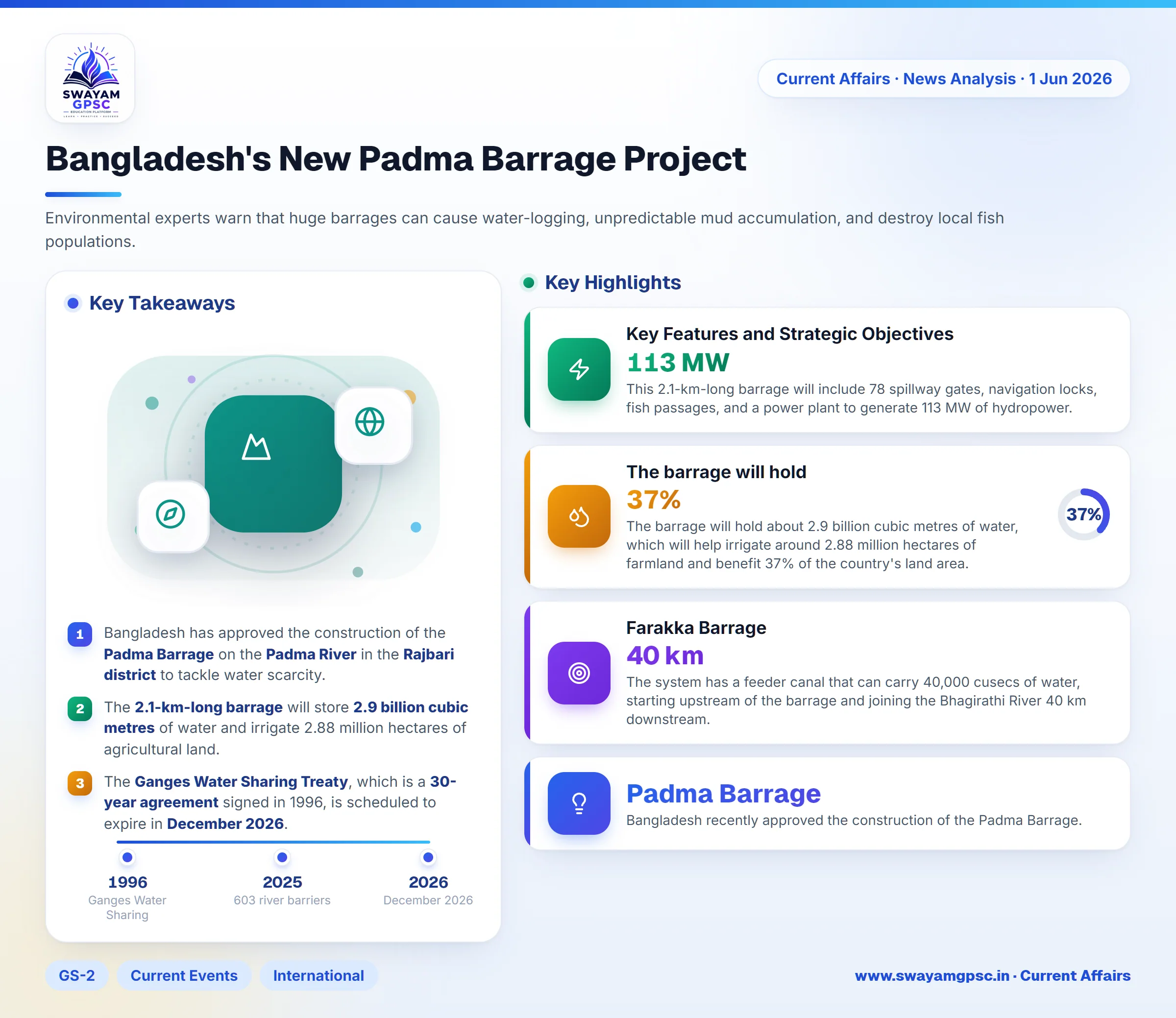
- Bangladesh has approved the construction of the Padma Barrage on the Padma River in the Rajbari district to tackle water scarcity.
- The 2.1-km-long barrage will store 2.9 billion cubic metres of water and irrigate 2.88 million hectares of agricultural land.
- The Ganges Water Sharing Treaty, which is a 30-year agreement signed in 1996, is scheduled to expire in December 2026.
- India's Farakka Barrage features a feeder canal with a capacity of 40,000 cusecs to maintain water levels for Kolkata Port.
Why in News
- Bangladesh recently approved the construction of the Padma Barrage.
- This massive river engineering project aims to improve water flow in the dry southwest region of the country.
Key Features and Strategic Objectives
- The project will be built on the Padma River, which is the name of the Ganga River in Bangladesh, located in the Rajbari district.
- The main goal is to solve the problem of water scarcity caused by lower water flows from India's Farakka Barrage upstream.
- This 2.1-km-long barrage will include 78 spillway gates, navigation locks, fish passages, and a power plant to generate 113 MW of hydropower.
- The barrage will hold about 2.9 billion cubic metres of water, which will help irrigate around 2.88 million hectares of farmland and benefit 37% of the country's land area.
Challenges and Ecological Concerns
- Environmental experts warn that huge barrages can cause water-logging, unpredictable mud accumulation, and destroy local fish populations.
- While South Asia is building more river barriers, Western countries are doing the opposite. For example, Europe removed 603 river barriers in 2025 to restore natural river flows.
- The project highlights the ongoing tension between India and Bangladesh over sharing river waters, especially regarding the impact of the Farakka Barrage.
Ganges Water Sharing Treaty (1996)
- The Ganges Water Sharing Treaty signed in 1996 is a 30-year agreement between India and Bangladesh to share water during the dry season.
- This treaty is set to expire in December 2026, which makes its review and renewal a critical issue for bilateral relations.
Farakka Barrage
- The Farakka Barrage is located on the Ganga River in the Murshidabad and Malda districts of West Bengal.
- India built this barrage to divert water into the Bhagirathi-Hooghly River system to keep the Kolkata Port clear for ships.
- The system has a feeder canal that can carry 40,000 cusecs of water, starting upstream of the barrage and joining the Bhagirathi River 40 km downstream.