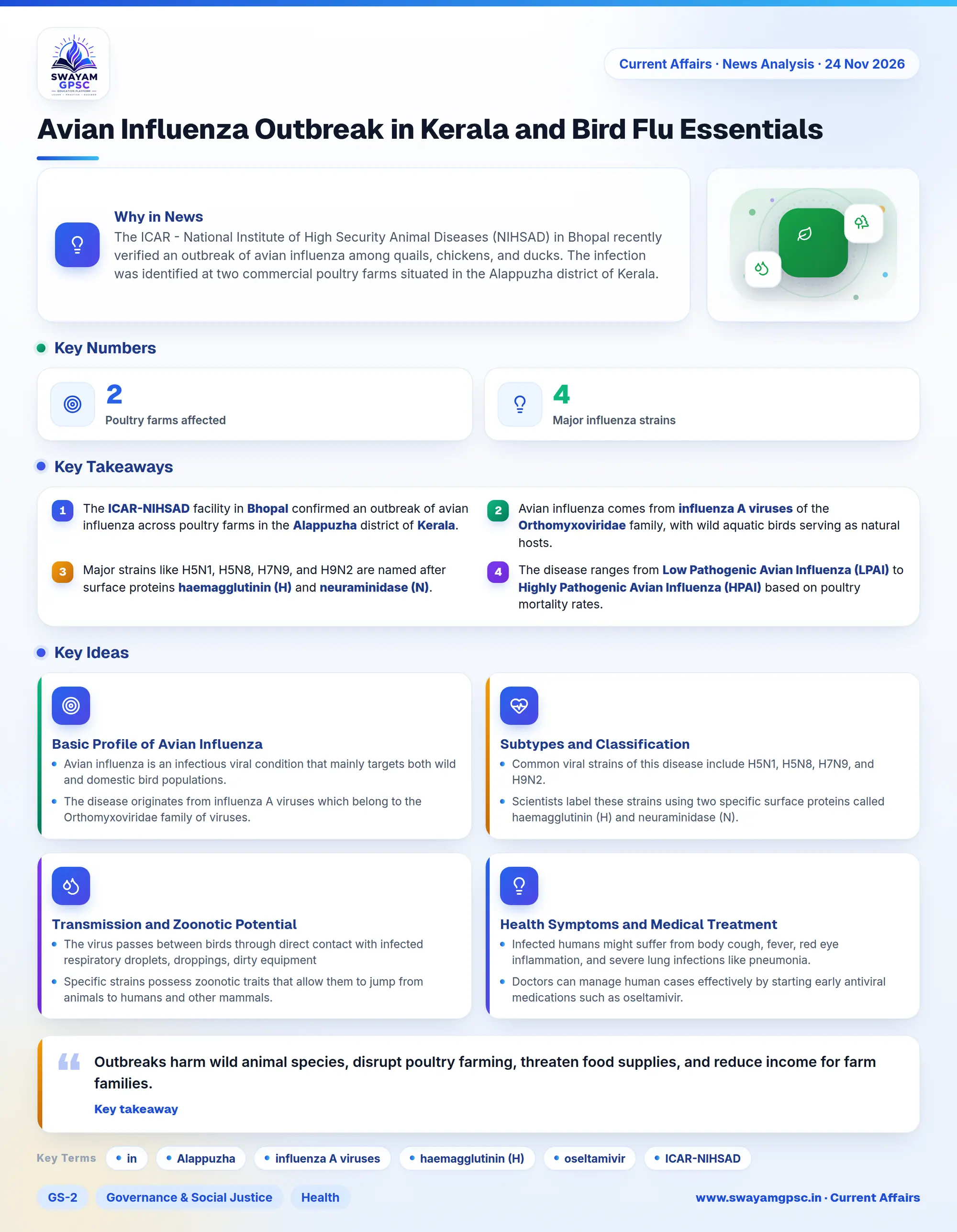
Avian Influenza Outbreak in Kerala and Bird Flu Essentials
#GS-2 #Governance & Social Justice #Health #Current Events #National #GS-3 #Science & Technology #Biotechnology #Environment #Biodiversity #Agriculture #Avian Influenza #Kerala
Key takeaways
- The ICAR-NIHSAD facility in Bhopal confirmed an outbreak of avian influenza across poultry farms in the Alappuzha district of Kerala.
- Avian influenza comes from influenza A viruses of the Orthomyxoviridae family, with wild aquatic birds serving as natural hosts.
- Major strains like H5N1, H5N8, H7N9, and H9N2 are named after surface proteins haemagglutinin (H) and neuraminidase (N).
- The disease ranges from Low Pathogenic Avian Influenza (LPAI) to Highly Pathogenic Avian Influenza (HPAI) based on poultry mortality rates.
- Human infections remain rare with no sustained human-to-human transmission recorded, and cases can be treated using oseltamivir.
Why in News
- The ICAR - National Institute of High Security Animal Diseases (NIHSAD) in Bhopal recently verified an outbreak of avian influenza among quails, chickens, and ducks.
- The infection was identified at two commercial poultry farms situated in the Alappuzha district of Kerala.
- Local authorities quickly started culling domestic birds around the affected zone to stop the virus from spreading further.
Basic Profile of Avian Influenza
- Avian influenza is an infectious viral condition that mainly targets both wild and domestic bird populations.
- The disease originates from influenza A viruses which belong to the Orthomyxoviridae family of viruses.
- Wild aquatic species, especially waterfowl like geese and ducks, act as natural host reservoirs for these viruses.
Subtypes and Classification
- Common viral strains of this disease include H5N1, H5N8, H7N9, and H9N2.
- Scientists label these strains using two specific surface proteins called haemagglutinin (H) and neuraminidase (N).
- Experts divide avian influenza strains into two groups depending on how severely they affect domestic poultry.
- The first group is Low Pathogenic Avian Influenza (LPAI), which typically causes mild symptoms or shows no signs of illness in birds.
- The second group is Highly Pathogenic Avian Influenza (HPAI), which leads to serious sickness and high death rates among infected poultry.
- This domestic poultry rating system does not reflect how severe the disease might be if a human contracts it.
Transmission and Zoonotic Potential
- The virus passes between birds through direct contact with infected respiratory droplets, droppings, dirty equipment, or contaminated water.
- Specific strains possess zoonotic traits that allow them to jump from animals to humans and other mammals.
- People usually catch the virus after direct exposure to sick birds or polluted surroundings.
- Health authorities have not observed any continuous transmission of this virus from one human to another.
Health Symptoms and Medical Treatment
- Infected humans might suffer from body cough, fever, red eye inflammation, and severe lung infections like pneumonia.
- Doctors can manage human cases effectively by starting early antiviral medications such as oseltamivir.
Impact and Prevention Measures
- Outbreaks harm wild animal species, disrupt poultry farming, threaten food supplies, and reduce income for farm families.
- Scientists worry about potential future pandemics because these bird viruses continuously adapt to infect mammal hosts.
- Stopping outbreaks requires fast diagnostic testing, bird movement limits, safe dead bird removal, farm safety rules, protective gear, targeted culling, and vaccines.