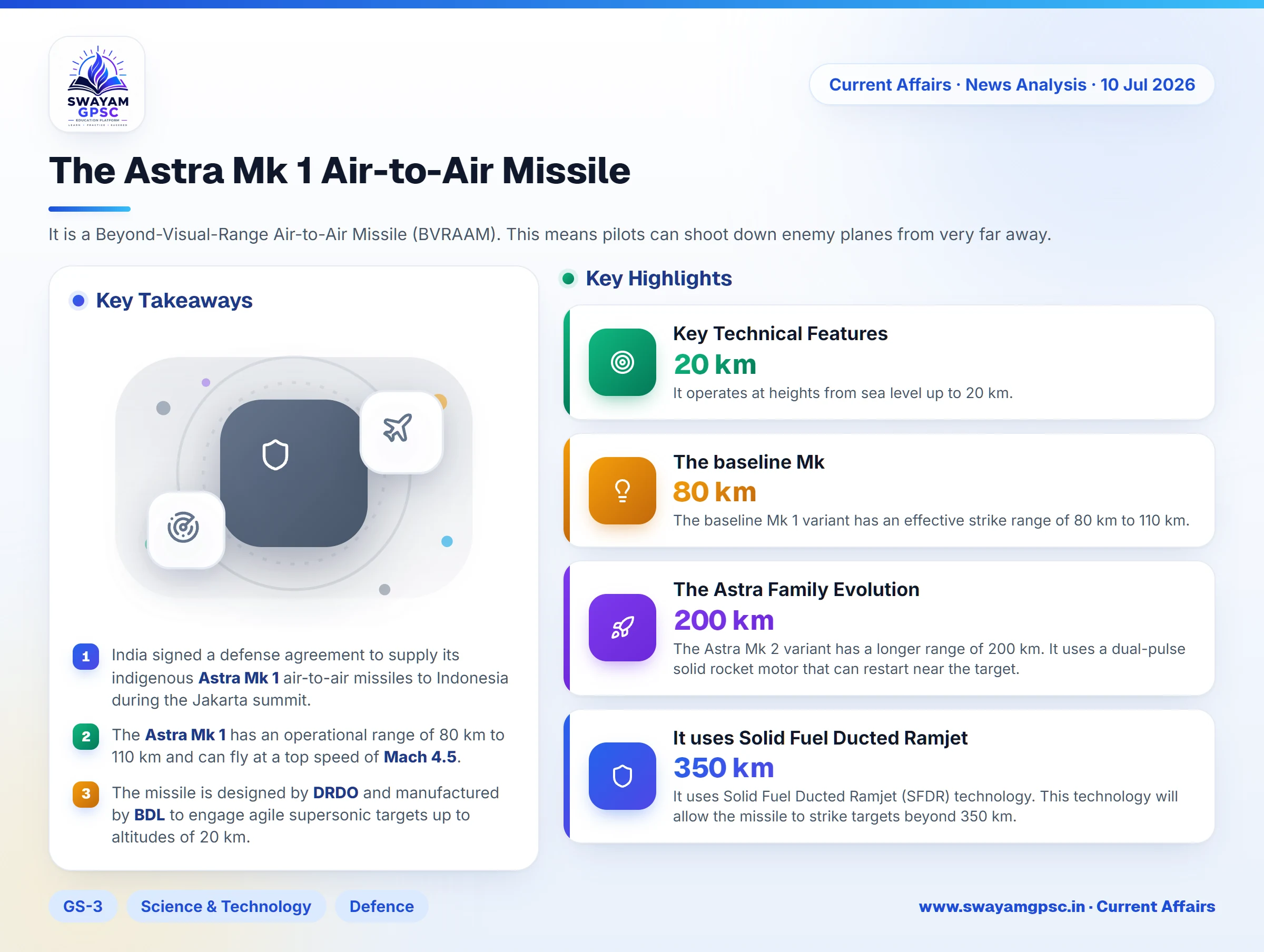
The Astra Mk 1 Air-to-Air Missile
#GS-3 #Science & Technology #Defence #GS-2 #Current Events #National #International #Astra Missile
Key takeaways
- India signed a defense agreement to supply its indigenous Astra Mk 1 air-to-air missiles to Indonesia during the Jakarta summit.
- The Astra Mk 1 has an operational range of 80 km to 110 km and can fly at a top speed of Mach 4.5.
- The missile is designed by DRDO and manufactured by BDL to engage agile supersonic targets up to altitudes of 20 km.
- Future variants include the Astra Mk 2 with a 200 km range and the Astra Mk 3 (Gandiva) with a range exceeding 350 km using SFDR technology.
Why in News
- India and Indonesia signed a historic defense agreement during their bilateral summit in Jakarta.
- Under this deal, India will supply its homegrown Astra Mk 1 missiles to Indonesia.
About The Astra Mk 1 Missile
- The Astra Mk 1 is an advanced air-to-air missile that can fly in any weather.
- It is a Beyond-Visual-Range Air-to-Air Missile (BVRAAM). This means pilots can shoot down enemy planes from very far away.
- The Defence Research and Development Organisation (DRDO) designed this missile. Bharat Dynamics Limited (BDL) manufactures it.
- The missile targets highly agile supersonic aircraft. It destroys them before they can get close enough for a dogfight.
- The main goal of this system is to give Indian pilots long-range strike superiority in the sky.
Key Technical Features
- The missile can fly at an extremely high speed of Mach 4.5. This is four and a half times the speed of sound.
- It operates at heights from sea level up to 20 km.
- The baseline Mk 1 variant has an effective strike range of 80 km to 110 km.
- It uses a single-pulse, smokeless solid-fuel rocket motor. This motor leaves no smoke trail, which keeps the launching fighter jet hidden.
- The missile already works on Sukhoi Su-30 MKI fighter jets. Engineers are currently integrating it with LCA Tejas Mk 1A and Rafale jets.
Three-Phase Guidance System
- In the initial phase, the missile uses its pre-programmed internal systems to navigate right after launch.
- During the mid-course phase, the launch aircraft sends continuous radio data updates to correct the missile's path.
- In the final terminal phase, the missile uses its own Radio Frequency (RF) seeker to lock onto the target.
- This built-in seeker helps the missile ignore enemy electronic jamming attempts.
The Astra Family Evolution
- The Astra Mk 2 variant has a longer range of 200 km. It uses a dual-pulse solid rocket motor that can restart near the target.
- The Astra Mk 3 is also known as Gandiva. DRDO is currently developing this longest-range version.
- It uses Solid Fuel Ducted Ramjet (SFDR) technology. This technology will allow the missile to strike targets beyond 350 km.