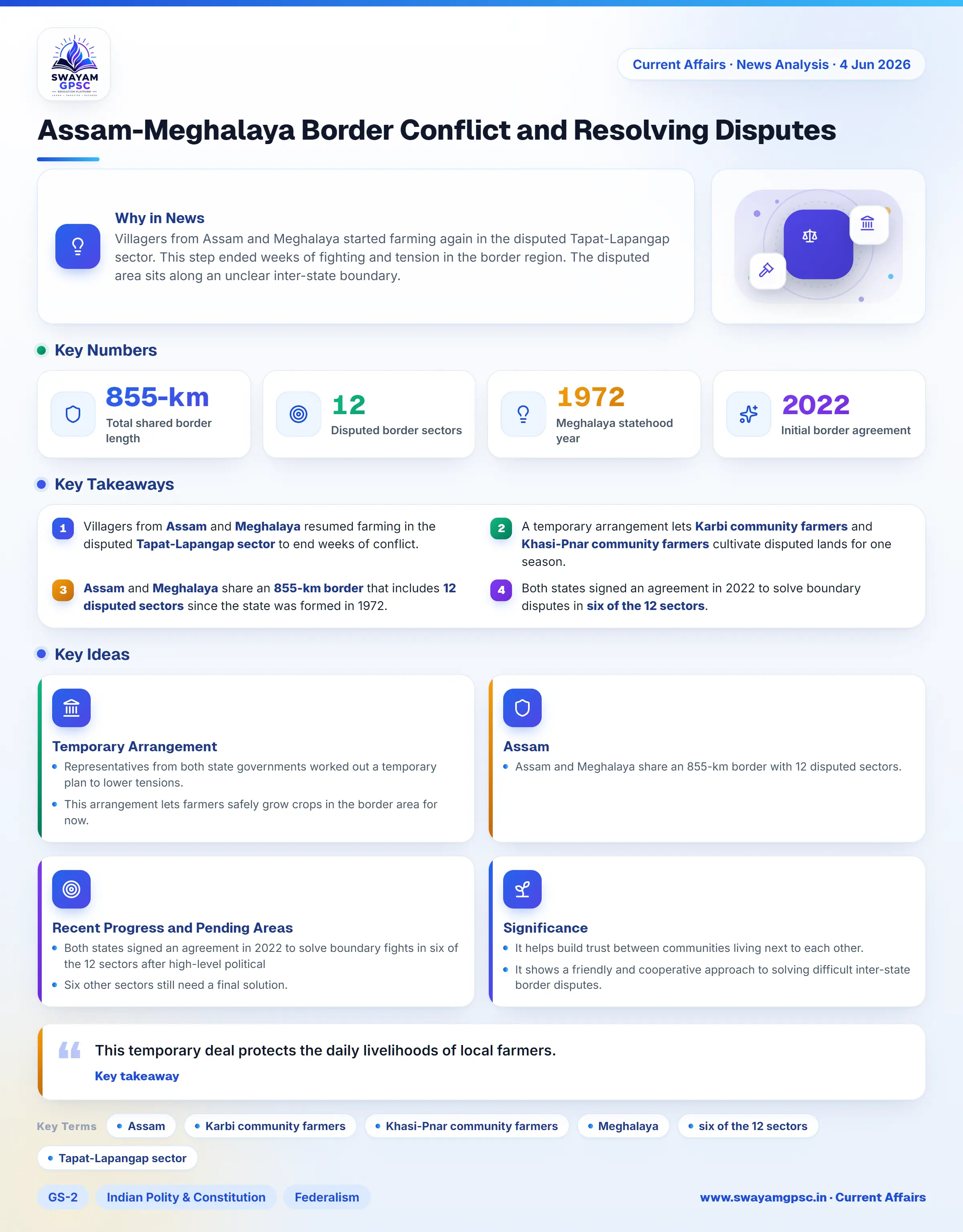
Assam-Meghalaya Border Conflict and Resolving Disputes
#GS-2 #Indian Polity & Constitution #Federalism #Inter-State Relations #Current Events #National #Gujarat #Rapid Fire CA #Quick Facts For Prelims
Key takeaways
- Villagers from Assam and Meghalaya resumed farming in the disputed Tapat-Lapangap sector to end weeks of conflict.
- A temporary arrangement lets Karbi community farmers and Khasi-Pnar community farmers cultivate disputed lands for one season.
- Assam and Meghalaya share an 855-km border that includes 12 disputed sectors since the state was formed in 1972.
- Both states signed an agreement in 2022 to solve boundary disputes in six of the 12 sectors.
Why in News
- Villagers from Assam and Meghalaya started farming again in the disputed Tapat-Lapangap sector.
- This step ended weeks of fighting and tension in the border region.
- The disputed area sits along an unclear inter-state boundary.
- Farmers often fight here because both sides want access to good agricultural land.
Temporary Arrangement
- Representatives from both state governments worked out a temporary plan to lower tensions.
- This arrangement lets farmers safely grow crops in the border area for now.
- Under the new formula, Karbi community farmers from Assam can farm on lands that Meghalaya claims for one full agricultural season.
- In exchange, Khasi-Pnar community farmers from Meghalaya can farm on fields that Assam claims.
Background
- Assam and Meghalaya share an 855-km border with 12 disputed sectors.
- These border disputes started after Meghalaya became a full-fledged state in 1972.
Recent Progress and Pending Areas
- Both states signed an agreement in 2022 to solve boundary fights in six of the 12 sectors after high-level political talks.
- Six other sectors still need a final solution.
- The Tapat-Lapangap sector is one of these pending areas.
- It sits near Assam's West Karbi Anglong district and Meghalaya's West Jaintia Hills district.
Significance
- This temporary deal protects the daily livelihoods of local farmers.
- It helps build trust between communities living next to each other.
- It shows a friendly and cooperative approach to solving difficult inter-state border disputes.