Ashtalakshmi Rising: Transforming the North-East into India's Growth Engine
#GS-2 #GS-3 #Government Policies & Interventions #Growth & Development #Infrastructure #Inclusive Growth #Economy #Current Events #National #Gujarat
Key takeaways
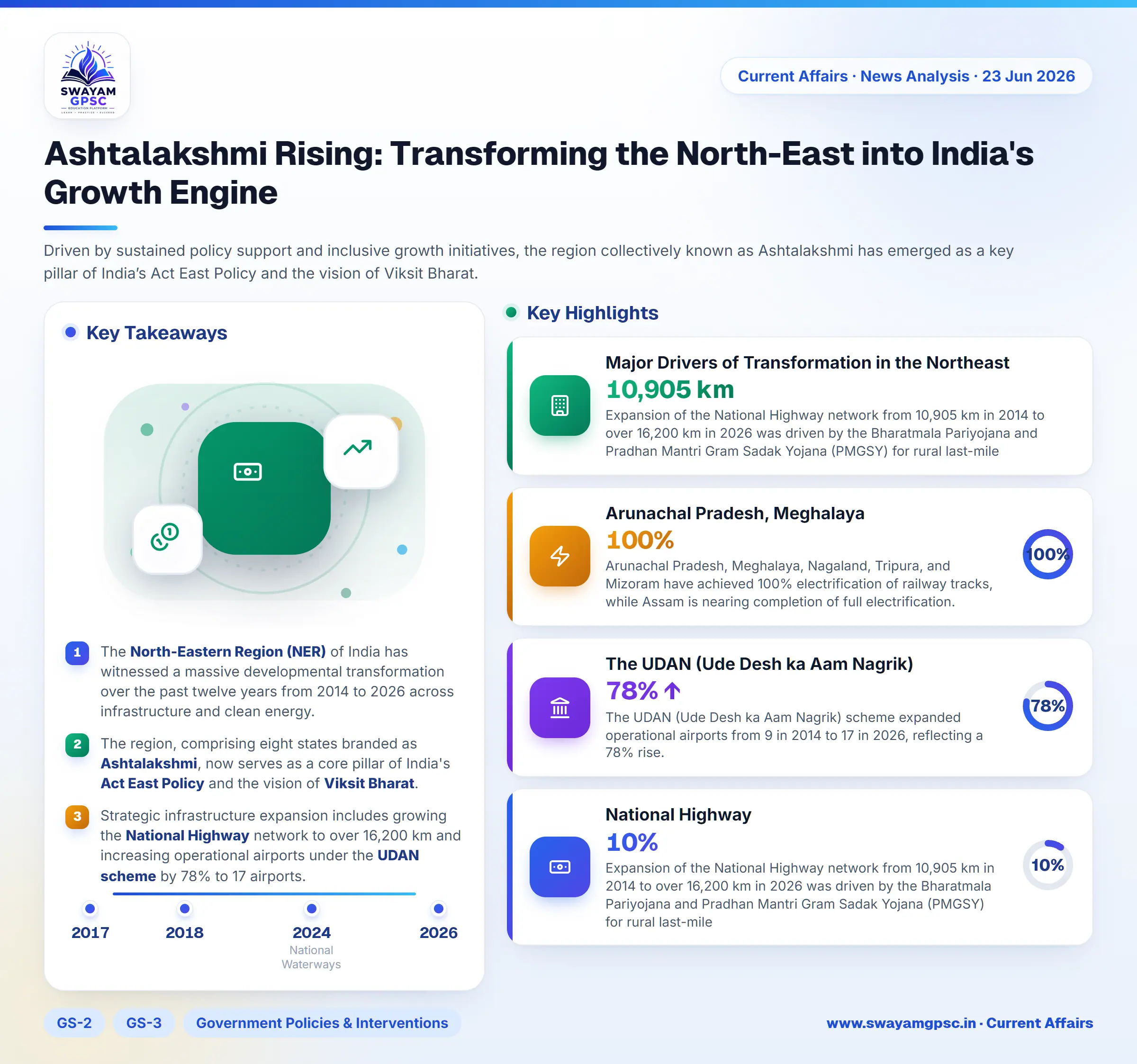
- The North-Eastern Region (NER) of India has witnessed a massive developmental transformation over the past twelve years from 2014 to 2026 across infrastructure and clean energy.
- The region, comprising eight states branded as Ashtalakshmi, now serves as a core pillar of India's Act East Policy and the vision of Viksit Bharat.
- Strategic infrastructure expansion includes growing the National Highway network to over 16,200 km and increasing operational airports under the UDAN scheme by 78% to 17 airports.
- Key financial and structural frameworks like PM-DevINE and mandatory budget allocations by Central Ministries are driving holistic regional growth and economic integration.
Why in News
- The remarkable developmental transformation of India’s North-Eastern Region (NER) over the past twelve years from 2014 to 2026 has come into focus due to significant progress in infrastructure, connectivity, clean energy, and socio-economic development.
- Driven by sustained policy support and inclusive growth initiatives, the region collectively known as Ashtalakshmi has emerged as a key pillar of India’s Act East Policy and the vision of Viksit Bharat.
Why is the North-East Referred to as Ashtalakshmi
- In Indian tradition, Goddess Lakshmi has eight manifestations representing different sources of wealth, happiness, and prosperity.
- Similarly, the NER consists of eight distinct states which include Arunachal Pradesh, Assam, Manipur, Meghalaya, Mizoram, Nagaland, Sikkim, and Tripura.
- The government has branded the eight North-Eastern states as Ashtalakshmi, recognizing their unique cultural, demographic, agricultural, and strategic strengths that collectively contribute to India's growth and development.
- Historically plagued by the tyranny of distance and viewed merely as a frontier, the region is now being mainstreamed as India's gateway to Southeast Asia.
Major Drivers of Transformation in the Northeast
- Expansion of the National Highway network from 10,905 km in 2014 to over 16,200 km in 2026 was driven by the Bharatmala Pariyojana and Pradhan Mantri Gram Sadak Yojana (PMGSY) for rural last-mile access.
- Massive budget hikes and the extension of broad-gauge networks into hill states have driven railway growth.
- Arunachal Pradesh, Meghalaya, Nagaland, Tripura, and Mizoram have achieved 100% electrification of railway tracks, while Assam is nearing completion of full electrification.
- This expansion is improving operational efficiency and reducing dependence on diesel traction across the region.
- Construction of resilient, permanent infrastructure to bypass natural barriers includes the Bogibeel Bridge, Assam, which is India's longest rail-cum-road bridge.
- Other notable marvels include the Noney Bridge, Manipur, which is the world's tallest railway pier bridge, and the Sela Tunnel, Arunachal Pradesh for all-weather strategic access.
- The UDAN (Ude Desh ka Aam Nagrik) scheme expanded operational airports from 9 in 2014 to 17 in 2026, reflecting a 78% rise.
- Simultaneously, National Waterways in the Northeast increased from 1 in 2014 to 20 in 2024, reviving the Brahmaputra and Barak rivers for cargo and river-cruise tourism.
- Over 6,350 Gram Panchayats have been made service-ready for high-speed internet, bringing digital inclusivity to remote communities.
- Under the Act East Policy, the Northeast has transitioned from a peripheral frontier into India's strategic gateway to ASEAN.
- This integration is driven by flagship cross-border infrastructure like the India-Myanmar-Thailand Trilateral Highway from Moreh in India to Mae Sot in Thailand to Bagan in Myanmar.
- The Kaladan Multi-Modal Transit Transport Project from Kolkata in India to Sittwe and Paletwa in Myanmar establishes vital and time-saving land and water corridors for international trade.
- Economic and cultural ties are being strengthened through the development of Integrated Check Posts (ICPs) at strategic locations like Moreh.
- The promotion of Border Haats at places like Kamalasagar and Bholaganj streamlines customs, supports grassroots micro-economies, and fosters strong people-to-people connectivity.
- The PM-DevINE is a 100% centrally funded initiative specifically designed to fund high-impact infrastructure and social development projects.
- Launched in 2017 to 2018 and extended until March 2026, the North East Special Infrastructure Development Scheme (NESIDS) Roads aims to improve connectivity in remote areas and enhance market access.
- The North East Special Infrastructure Development Scheme Other Than Roads Infrastructure (OTRI) provides financial assistance to all eight Northeastern states for infrastructure development across sectors like healthcare, education, and power.
- The North Eastern Council (NEC) drives holistic and region-specific development such as bamboo livelihoods and tourism.
- Special Development Packages for Assam and Tripura specifically target employment and skill development to mainstream marginalized communities and sustain regional peace.
- Guided by the Act East, Act Fast, Act First principle, the government is transforming the North Eastern Region (NER) into a growth engine by mandating that all non-exempted Central Ministries allocate at least 10% of their annual budget specifically for the region's development.
- Mega-projects like the 2,880 MW Dibang Multipurpose Project, Arunachal Pradesh, which is India's tallest dam, are harnessing the region's immense riverine potential.
- The 2,000 MW Subansiri Lower Project along the Assam and Arunachal Pradesh border also contributes to harnessing this potential.
- A 1,656 km pipeline network is integrating all eight states into the national gas grid, featuring Asia's longest underwater hydrocarbon pipeline running beneath the Brahmaputra River.
- States like Arunachal Pradesh and Mizoram have hit 100% tap water coverage under the Jal Jeevan Mission.
- All eight states are fully declared as Open Defecation Free (ODF).
- Over 31 lakh houses have been built across rural and urban sectors under the Pradhan Mantri Awas Yojana, integrating electricity, LPG, and sanitation.
- The operationalization of AIIMS Guwahati, the approval of 12 new medical colleges, and the expansion of national institutes like IITs, NITs, and Eklavya Model Residential Schools have drastically improved local human development indices.
- Inland fish production grew by 68% over the last decade, with Assam contributing 70% of it.
- This growth is supported by the Pradhan Mantri Matsya Sampada Yojana, the distribution of 3,823 Kisan Credit Cards, and the creation of 501 Fish Farmer Producer Organizations.
- Milk and egg production witnessed steady growth, further accelerated by the establishment of the NER’s first cattle IVF Laboratory in Guwahati to improve livestock genetics.
- The NER hosts 90% of India's 150 million agarwood trees.
- Export quotas for chips and oil have surged, with Tripura alone representing a Rs 2,000 crore market potential.
- Budgetary allocations increased significantly to boost local oilseed production under the National Mission on Edible Oils (NMEO) and reduce reliance on imports.
- The region boasts 89 Geographical Indication (GI) tags, including famous products like Lakadong Turmeric and King Chilli.
- The Mission Organic Value Chain Development for North Eastern Region (MOVCDNER) has integrated over 2.36 lakh hectares into organic value chains.
- The Ministry of Development of North Eastern Region’s Brand North East vision aims to transition the regional economy from subsistence production to a high-value export-oriented powerhouse through the Unlocking State-Specific USPs initiative.
- This operational strategy aggressively scales one flagship asset per state via dedicated product missions like the Mizoram Ginger Mission, Nagaland Coffee Mission, Arunachal Kiwi Mission, Tripura Queen Pineapple Mission, Assam Muga Silk Senehjori Mission, Sikkim Organic Food Mission, and Meghalaya Lakadong Turmeric Mission.
Conclusion
- The paradigm shift from a security-centric approach to holistic development has successfully repositioned the North-East as the geopolitical and economic linchpin of India’s Act East policy.
- Sustained infrastructure investments, targeted frameworks like PM-DevINE, and a focus on green energy have effectively bridged historical developmental deficits.
- Moving forward, balancing rapid modernization with ecological sensitivity while fostering private enterprise will be critical to fully unlocking the potential of Ashtalakshmi and realizing the vision of an inclusive Viksit Bharat.