Armed Forces Seek Higher Agniveer Retention
#GS-2 #Government Policies & Interventions #GS-3 #Various Security Forces & Agencies & Their Mandate #National #Economy
Key takeaways
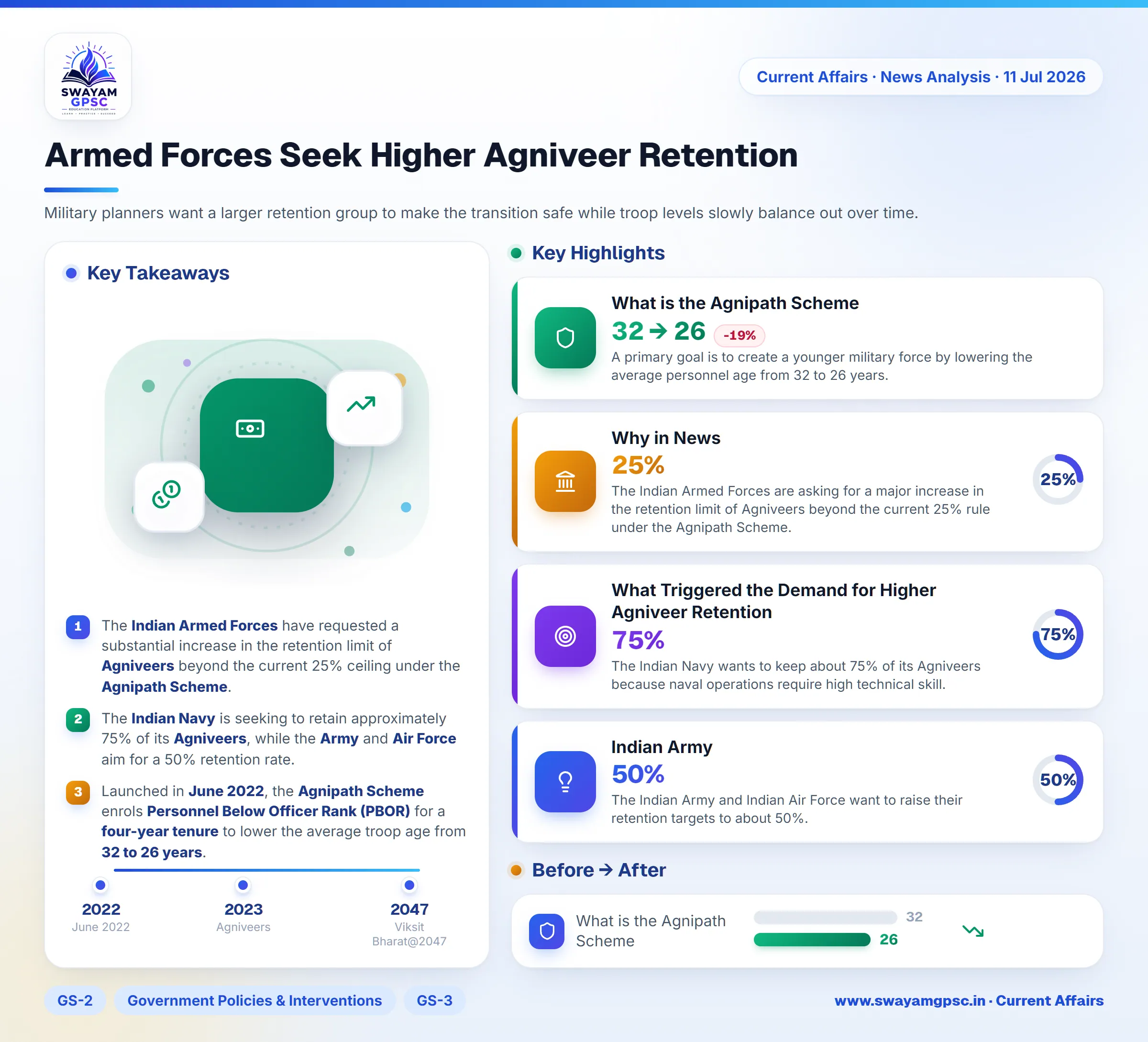
- The Indian Armed Forces have requested a substantial increase in the retention limit of Agniveers beyond the current 25% ceiling under the Agnipath Scheme.
- The Indian Navy is seeking to retain approximately 75% of its Agniveers, while the Army and Air Force aim for a 50% retention rate.
- Launched in June 2022, the Agnipath Scheme enrols Personnel Below Officer Rank (PBOR) for a four-year tenure to lower the average troop age from 32 to 26 years.
- Exiting Agniveers receive a tax-free Seva Nidhi package of approximately Rs 11.71 lakh, a skill certificate, and a non-contributory life insurance cover of Rs 48 lakh.
Why in News
- The Indian Armed Forces are asking for a major increase in the retention limit of Agniveers beyond the current 25% rule under the Agnipath Scheme.
- The first batches of Agniveers who started their training in early 2023 are about to finish their four-year service terms.
- Because of this, the three military services sent new proposals to the Department of Military Affairs (DMA) to keep more experienced soldiers and protect the heavy training investment made in advanced technology platforms.
What Triggered the Demand for Higher Agniveer Retention
- The Indian Navy wants to keep about 75% of its Agniveers because naval operations require high technical skill.
- The Indian Army and Indian Air Force want to raise their retention targets to about 50%.
- Despite these requests, the official retention policy stays capped at 25% across all three military branches.
- A strict 25% retention cap risks causing a sudden shortage of troops because a set number of regular soldiers retire every year.
- Military planners want a larger retention group to make the transition safe while troop levels slowly balance out over time.
- Feedback from Operation Sindoor showed that Agniveers do very well in combat zones, but long-term institutional experience remains vital.
- Seasoned troops bring years of training and multiple field tours that help the forces react much faster during major security crises.
- New weapons and advanced technical equipment bought after Operation Sindoor require long and complex training cycles.
- Because handling these complex technologies takes years of learning, a short four-year exit rule hurts operational efficiency.
- The need for longer service tenures is especially urgent for naval sailors and airmen who operate complex warships, submarines, and aircraft.
What is the Agnipath Scheme
- Launched in June 2022, the Agnipath Scheme is a nationwide recruitment plan to enroll Personnel Below Officer Rank (PBOR) into the military on merit.
- A primary goal is to create a younger military force by lowering the average personnel age from 32 to 26 years.
- Another goal is to cut down pension costs so money can be saved for defence modernisation and indigenous production.
- The scheme also aims to build skills for fighting hybrid warfare, cyber threats, terrorism, and space and electronic warfare.
- It supports national development by producing a disciplined and skilled youth force for Viksit Bharat@2047.
- Recruits known as Agniveers serve for a total duration of four years.
- The eligible age for joining is between 17.5 to 21 years, with a temporary relaxation up to 23 years for the first batch.
- During service, recruits get a monthly pay package and other financial supports.
- The 75% of soldiers who leave after four years get a tax-free Seva Nidhi package of about Rs 11.71 lakh along with a skill certificate and priority jobs in CAPFs and state police.
- They also get a non-contributory life insurance cover worth Rs 48 lakh during their active service.
- The scheme offers Rs 44 lakh for disability compensation and up to Rs 1 crore for death during service.
- Right now, only up to 25% of each batch gets chosen for permanent service based on strict, transparent, and objective rules.
- Soldiers selected for the regular cadre of the Armed Forces must serve for another 15 years under standard military service rules.
What Steps are Needed to Reform the Agnipath Scheme
- The government should link the Agnipath exit process with Defense Industrial Corridors in Uttar Pradesh and Tamil Nadu.
- Trained Agniveers should get direct job openings in private defense manufacturing companies, tech startups, and aviation maintenance units.
- This integration will turn former soldiers into the technical core of India's domestic defense production system.
- Changing the psychological view from a four-year contract to an extended probationary commission will help protect military unit identity and the spirit of Naam, Namak, Nishan.
- Treating the first four years as a strict test period helps new recruits fit smoothly into unit traditions and high-altitude combat teams.
- The government must review the scheme based on real operational feedback, personnel trends, and institutional studies after completing the first full batch cycle.
- The Army, Navy and Air Force should decide their own retention percentages based on their specific technical needs.
- Priority for permanent roles should go to soldiers trained in critical technologies and sensitive military roles.
- The government should set up a regular, mandatory review by the Parliamentary Standing Committee on Defence to keep a transparent check on combat readiness and budget impacts, much like past groups like the Shekatkar Committee (2015).
Conclusion
- Fixing the Agnipath scheme requires moving away from strict budget calculations toward a strategic view of human capital.
- By setting flexible retention rates and better welfare support, India can keep its military young while saving deep technical expertise for modern warfare.