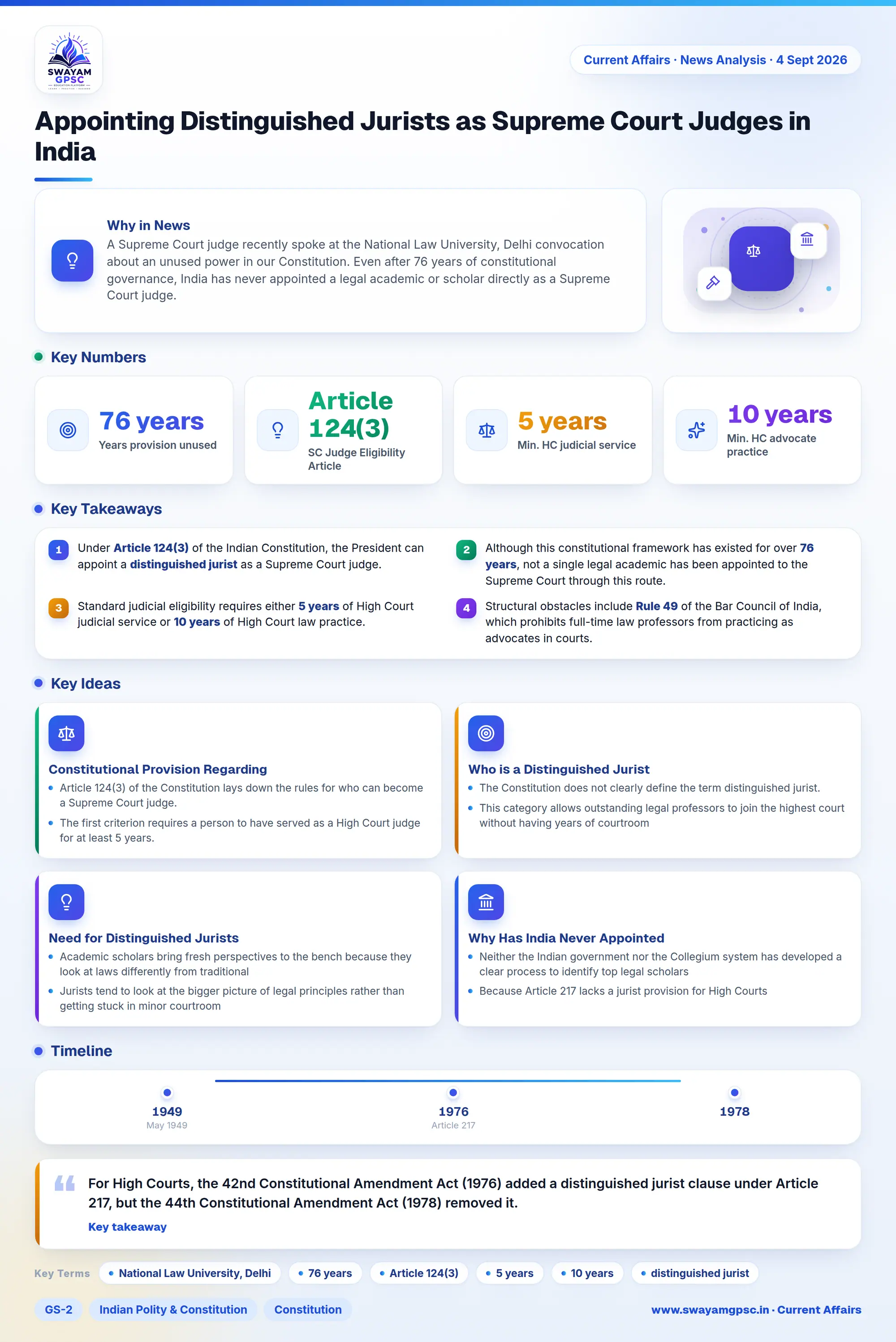
Appointing Distinguished Jurists as Supreme Court Judges in India
#GS-2 #Indian Polity & Constitution #Constitution #Judiciary #Current Events #National #Supreme Court #Distinguished Jurist #Article 124(3) #Collegium System
Key takeaways
- Under Article 124(3) of the Indian Constitution, the President can appoint a distinguished jurist as a Supreme Court judge.
- Although this constitutional framework has existed for over 76 years, not a single legal academic has been appointed to the Supreme Court through this route.
- Standard judicial eligibility requires either 5 years of High Court judicial service or 10 years of High Court law practice.
- Structural obstacles include Rule 49 of the Bar Council of India, which prohibits full-time law professors from practicing as advocates in courts.
Why in News
- A Supreme Court judge recently spoke at the National Law University, Delhi convocation about an unused power in our Constitution.
- Even after 76 years of constitutional governance, India has never appointed a legal academic or scholar directly as a Supreme Court judge.
Constitutional Provision Regarding Distinguished Jurist
- Article 124(3) of the Constitution lays down the rules for who can become a Supreme Court judge.
- The first criterion requires a person to have served as a High Court judge for at least 5 years.
- The second criterion requires a person to have practiced as a High Court advocate for at least 10 years.
- The third criterion allows the President to appoint any person who is a distinguished jurist in their opinion.
- While the judge and lawyer categories are used regularly, the President has never appointed anyone under the distinguished jurist category.
- For High Courts, the 42nd Constitutional Amendment Act (1976) added a distinguished jurist clause under Article 217, but the 44th Constitutional Amendment Act (1978) removed it.
Who is a Distinguished Jurist
- The Constitution does not clearly define the term distinguished jurist. It generally means a scholar with deep knowledge of legal theory, jurisprudence, and constitutional law.
- This category allows outstanding legal professors to join the highest court without having years of courtroom experience.
- In May 1949, H.V. Kamath introduced this clause during the Constituent Assembly debates to ensure the pool of judges was not limited only to practicing lawyers.
- Global judicial bodies like the International Court of Justice (ICJ) and the US Supreme Court have often appointed scholars, such as Harvard professor Felix Frankfurter in 1939.
- Dr. B.R. Ambedkar supported this provision, although he briefly debated whether to use the word eminent instead of distinguished.
Need for Distinguished Jurists in the Supreme Court
- Academic scholars bring fresh perspectives to the bench because they look at laws differently from traditional courtroom lawyers.
- Jurists tend to look at the bigger picture of legal principles rather than getting stuck in minor courtroom procedures.
- Top scholars can bring strong theoretical knowledge, international research, and social science insights to complex constitutional cases.
Why Has India Never Appointed a Distinguished Jurist
- Neither the Indian government nor the Collegium system has developed a clear process to identify top legal scholars for judicial seats.
- Because Article 217 lacks a jurist provision for High Courts, legal academics do not have a lower judicial stepping stone before reaching the Supreme Court.
- The modern Collegium system, which is led by the Chief Justice of India, naturally prefers recommending senior practicing advocates and sitting High Court judges.
- Under Rule 49 of the Bar Council of India (BCI), full-time law professors cannot practice law in court, creating a strict separation between theory and practice.
- Directly appointing a younger academic judge could disrupt the seniority rule that determines who becomes the Chief Justice of India.
- The Supreme Court often uses scholar expertise by appointing legal academics as amicus curiae (friends of the court) in complex cases instead of offering them judgeships.
- Top lawyers and scholars earn high private incomes, so moving to a fixed government judge salary represents a massive pay cut.