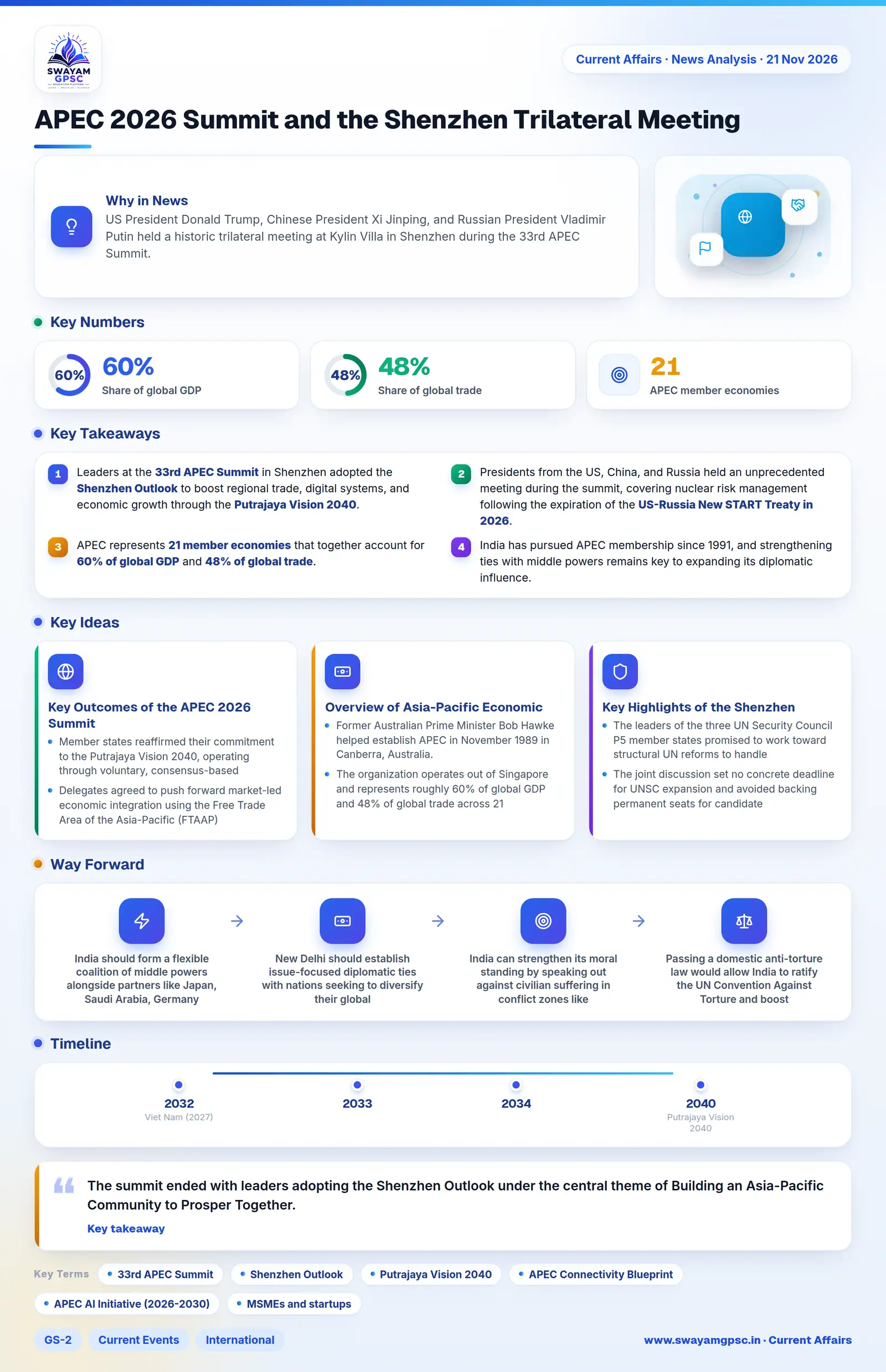
APEC 2026 Summit and the Shenzhen Trilateral Meeting
#GS-2 #Current Events #International #Important International Institutions #Asia-Pacific Economic Cooperation #UN Security Council #India Foreign Policy
Key takeaways
- Leaders at the 33rd APEC Summit in Shenzhen adopted the Shenzhen Outlook to boost regional trade, digital systems, and economic growth through the Putrajaya Vision 2040.
- Presidents from the US, China, and Russia held an unprecedented meeting during the summit, covering nuclear risk management following the expiration of the US-Russia New START Treaty in 2026.
- APEC represents 21 member economies that together account for 60% of global GDP and 48% of global trade.
- India has pursued APEC membership since 1991, and strengthening ties with middle powers remains key to expanding its diplomatic influence.
Why in News
- US President Donald Trump, Chinese President Xi Jinping, and Russian President Vladimir Putin held a historic trilateral meeting at Kylin Villa in Shenzhen during the 33rd APEC Summit.
- This meeting sparked intense strategic discussions in New Delhi regarding how a potential US-China-Russia tri-polar great-power alliance might affect India's goal of a multipolar world.
Key Outcomes of the APEC 2026 Summit
- The summit ended with leaders adopting the Shenzhen Outlook under the central theme of Building an Asia-Pacific Community to Prosper Together.
- Member states reaffirmed their commitment to the Putrajaya Vision 2040, operating through voluntary, consensus-based, and non-binding principles.
- Delegates agreed to push forward market-led economic integration using the Free Trade Area of the Asia-Pacific (FTAAP) roadmap while supporting Cultural and Creative Industries (CCIs).
- Participants endorsed the APEC Trade Digitalization Cooperation Framework (2027-2030) to expand paperless trading and streamline international customs processes.
- Leaders approved the APEC Connectivity Blueprint to build stronger physical, institutional, and human links across member economies.
- The forum established the APEC AI Initiative (2026-2030) to encourage safe cross-border data movement while fighting cyber scams and data leaks.
- Governments resolved to integrate MSMEs and startups into global supply chains while stepping up joint anti-corruption and asset recovery efforts.
- China highlighted its high-tech industrial strength by holding the summit in Shenzhen, a major city in the Guangdong-Hong Kong-Macao Greater Bay Area.
- The forum confirmed a lineup of future host nations, including Viet Nam (2027), Mexico (2028), Singapore (2030), Japan (2031), Chile (2032), Papua New Guinea (2033), and Peru (2034).
Overview of Asia-Pacific Economic Cooperation
- Former Australian Prime Minister Bob Hawke helped establish APEC in November 1989 in Canberra, Australia.
- The organization operates out of Singapore and represents roughly 60% of global GDP and 48% of global trade across 21 member economies.
- To include entities like China, Hong Kong, and Chinese Taipei, the forum refers to its members as economies rather than sovereign states.
- China previously hosted APEC gatherings in Shanghai (2001) and Beijing (2014) before organizing the 2026 event in Shenzhen.
- The forum structures its work around trade liberalization, business facilitation, and technical cooperation through its ECOTECH framework.
- The Putrajaya Vision 2040 replaced the older 1994 Bogor Goals to guide regional economic priorities over the coming decades.
- India has sought APEC membership since 1991, but remains outside the group despite its close ties with key member states.
Key Highlights of the Shenzhen Trilateral Summit
- The leaders of the three UN Security Council P5 member states promised to work toward structural UN reforms to handle modern security threats.
- The joint discussion set no concrete deadline for UNSC expansion and avoided backing permanent seats for candidate nations like India.
- The three nations agreed to step up production and distribution of refined oil products to keep energy markets stable despite tensions near the Strait of Hormuz.
- The leaders highlighted official state immunity and warned that bodies like the International Criminal Court (ICC) must not misuse their authority.
- This joint stance offered diplomatic backing to President Putin, who faced an ICC arrest warrant in 2023, while noting neither the US nor China signed the Rome Statute.
- Following the expiration of the US-Russia New START Treaty in 2026, the leaders held talks on nuclear risk reduction but signed no new formal reduction treaty.
- The meeting served as an important platform for big-power dialogue, but it stopped short of creating a formal strategic alliance or binding decision body.
Challenges to India's Emergence as a Fourth Pole
- While India maintains a large national economy, its low per-capita income limits its ability to fund extensive foreign aid or security packages.
- Without complete self-reliance in advanced military hardware, India faces supply-chain risks for high-tech components during global crises.
- Private strategic talks among major nuclear powers risk sidelining other nuclear nations, including India, from central global stability discussions.
- Groupings like the G20 and BRICS offer valuable coordination, but India's G4 bid for a permanent UNSC seat faces ongoing opposition from the Uniting for Consensus group.
- Adopting human-rights frameworks like the 1951 Refugee Convention could limit India's internal policy choices regarding border control and deportations.
- Ongoing global disputes leave India exposed to economic fallout, including potential US secondary tariffs on foreign purchases of Russian energy.
Way Forward
- India should form a flexible coalition of middle powers alongside partners like Japan, Saudi Arabia, Germany, Brazil, and the Philippines to balance big-power dominance.
- New Delhi should establish issue-focused diplomatic ties with nations seeking to diversify their global economic and strategic partnerships.
- India can strengthen its moral standing by speaking out against civilian suffering in conflict zones like Sudan, Yemen, Gaza, and Nagorno-Karabakh.
- Passing a domestic anti-torture law would allow India to ratify the UN Convention Against Torture and boost its legal standing.
- Defense planners should focus military research efforts on critical technology chokepoints like jet engines and advanced semiconductor production.
- India should use forums like the Quad alongside traditional UN channels to secure critical mineral supply chains and build regional maritime security.