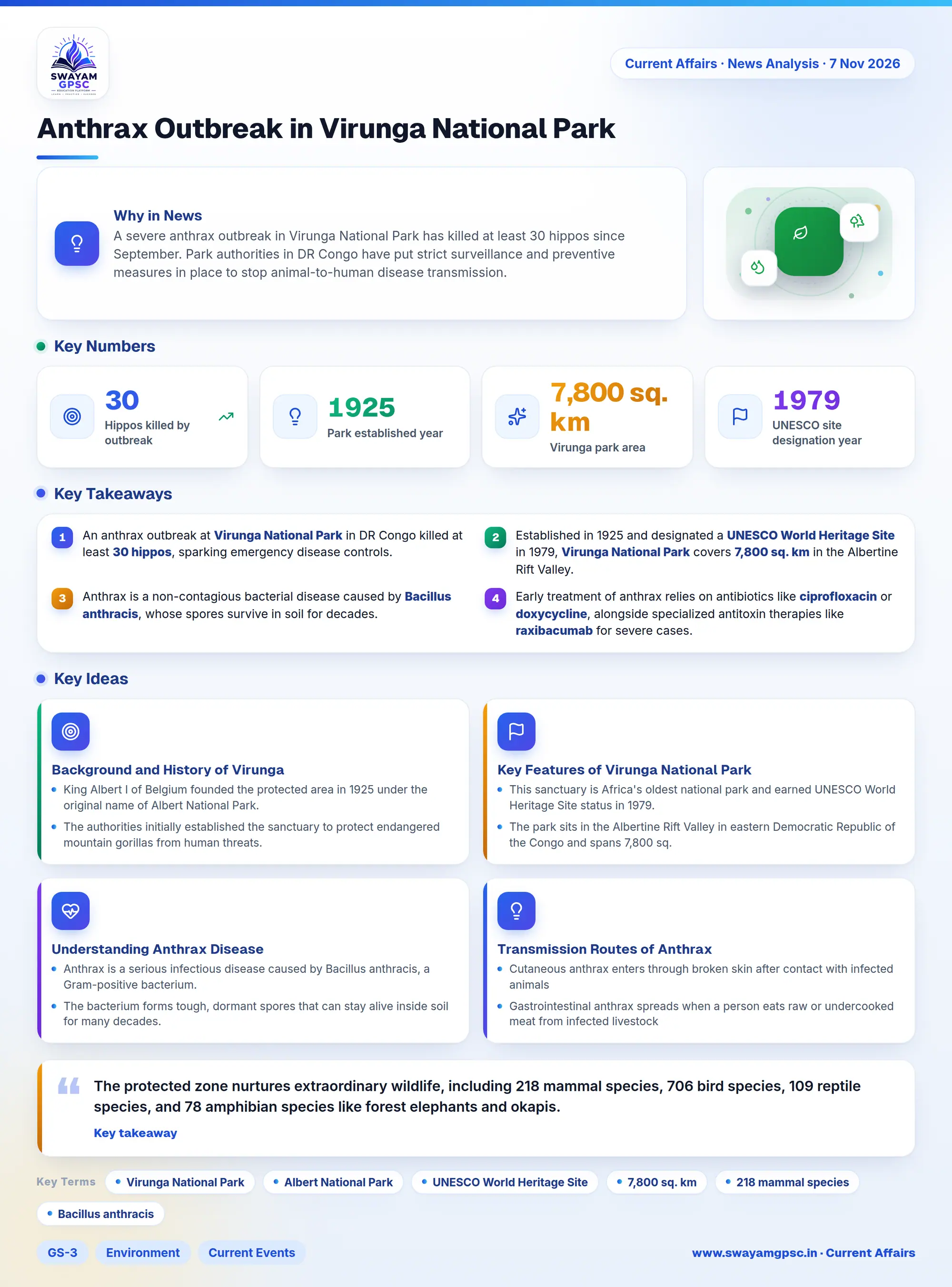
Anthrax Outbreak in Virunga National Park
#GS-3 #Environment #Current Events #Wildlife #Biodiversity #National #International
Key takeaways
- An anthrax outbreak at Virunga National Park in DR Congo killed at least 30 hippos, sparking emergency disease controls.
- Established in 1925 and designated a UNESCO World Heritage Site in 1979, Virunga National Park covers 7,800 sq. km in the Albertine Rift Valley.
- Anthrax is a non-contagious bacterial disease caused by Bacillus anthracis, whose spores survive in soil for decades.
- Early treatment of anthrax relies on antibiotics like ciprofloxacin or doxycycline, alongside specialized antitoxin therapies like raxibacumab for severe cases.
Why in News
- A severe anthrax outbreak in Virunga National Park has killed at least 30 hippos since September.
- Park authorities in DR Congo have put strict surveillance and preventive measures in place to stop animal-to-human disease transmission.
Background and History of Virunga National Park
- King Albert I of Belgium founded the protected area in 1925 under the original name of Albert National Park.
- The authorities initially established the sanctuary to protect endangered mountain gorillas from human threats.
- Over time, officials expanded the park boundaries to cover Lake Edward, the Rwindi plains, and the Rwenzori Mountains.
- The reserve took its current name of Virunga National Park in 1969.
- Today, the Congolese Institute for the Conservation of Nature works together with the Virunga Foundation to manage the park.
Key Features of Virunga National Park
- This sanctuary is Africa's oldest national park and earned UNESCO World Heritage Site status in 1979.
- The park sits in the Albertine Rift Valley in eastern Democratic Republic of the Congo and spans 7,800 sq. km along the borders of Uganda and Rwanda.
- Its rich landscape changes from lowland savannas, wetlands, and tropical forests to the glacier-covered peaks of the Rwenzori Mountains.
- The park hosts two of Africa's most active volcanoes, Mount Nyiragongo and Mount Nyamuragira, inside the Virunga volcanic chain.
- It acts as a key refuge for endangered great apes, including mountain gorillas, eastern lowland gorillas, and eastern chimpanzees.
- The protected zone nurtures extraordinary wildlife, including 218 mammal species, 706 bird species, 109 reptile species, and 78 amphibian species like forest elephants and okapis.
Understanding Anthrax Disease
- Anthrax is a serious infectious disease caused by Bacillus anthracis, a Gram-positive bacterium.
- The bacterium forms tough, dormant spores that can stay alive inside soil for many decades.
- Extreme weather events like heavy rainfall or severe droughts expose these buried soil spores to grazing animals.
Transmission Routes of Anthrax
- Cutaneous anthrax enters through broken skin after contact with infected animals, forming a painless sore with a distinctive black center.
- Gastrointestinal anthrax spreads when a person eats raw or undercooked meat from infected livestock, causing internal bleeding and severe stomach pain.
- Inhalation anthrax happens when someone breathes in airborne spores, leading to severe breathing difficulties and life-threatening bloodstream infections.
- The disease is non-contagious between people because humans almost always catch it directly from contaminated soil or infected animal products.
Treatment Options for Anthrax
- Doctors treat patients early using standard antibiotics like ciprofloxacin or doxycycline to stop the bacterial growth.
- Hospital care for severe cases involves giving a combination of intravenous antibiotics directly into the patient's bloodstream.
- Medical teams also use specialized antitoxin therapies like raxibacumab or anthrax immunoglobulin to neutralize dangerous bacterial toxins in the body.