Anemia Mukt Bharat Abhiyaan Operational Guidelines
#GS-2 #Health #Government Policies & Interventions #Governance & Social Justice #Quick Facts For Prelims
Key takeaways
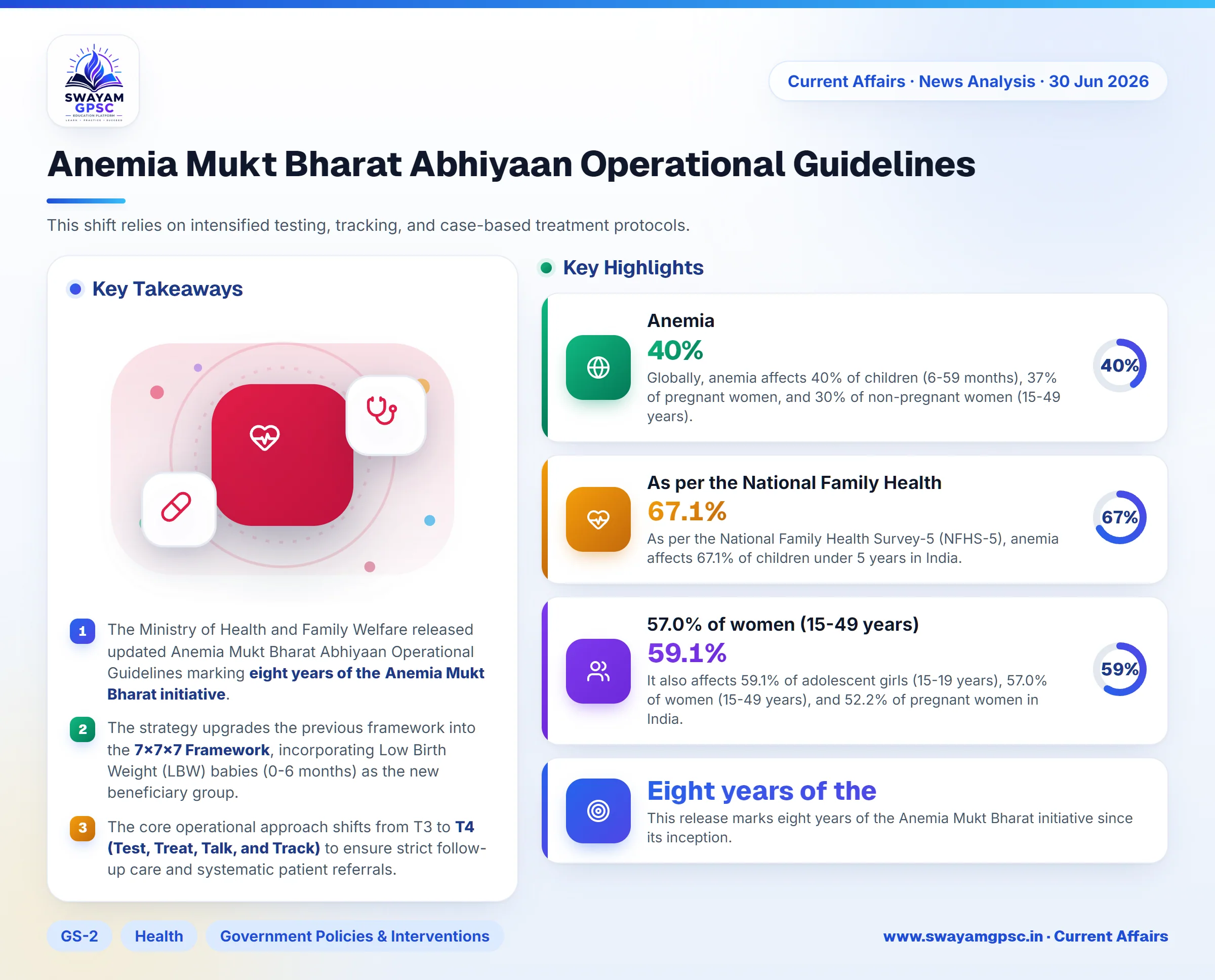
- The Ministry of Health and Family Welfare released updated Anemia Mukt Bharat Abhiyaan Operational Guidelines marking eight years of the Anemia Mukt Bharat initiative.
- The strategy upgrades the previous framework into the 7x7x7 Framework, incorporating Low Birth Weight (LBW) babies (0-6 months) as the new beneficiary group.
- The core operational approach shifts from T3 to T4 (Test, Treat, Talk, and Track) to ensure strict follow-up care and systematic patient referrals.
- According to National Family Health Survey-5 (NFHS-5), anemia impacts 67.1% of children under 5 years and 52.2% of pregnant women in India.
Why in News
- The Union Ministry of Health and Family Welfare released the Anemia Mukt Bharat Abhiyaan Operational Guidelines recently.
- This release marks eight years of the Anemia Mukt Bharat initiative since its inception.
- The new guidelines outline a strengthened strategy to accelerate India's fight against anemia across all vulnerable groups.
What are the Key Highlights of the Anemia Mukt Bharat Abhiyaan Operational Guidelines
- The revised framework shifts India's anemia management from prophylactic care (preventive) to therapeutic care (treatment and active management).
- This shift relies on intensified testing, tracking, and case-based treatment protocols.
- The legacy 6x6x6 strategy has been upgraded by adding critical structural layers to form the new 7x7x7 Framework.
- The framework adds Low Birth Weight (LBW) babies (0-6 months) as the 7 th Beneficiary Group to fight the intergenerational cycle of anemia early.
- It introduces the 7 th Intervention known as the "Eating Right" approach, which promotes daily consumption of diversified and iron-rich foods.
- It establishes the 7 th Institutional Mechanism through a digitally integrated Monitoring and Evaluation framework for end-to-end accountability.
- The core operational anchor shifts from T3 (Test, Treat, Talk) to T4 (Test, Treat, Talk, and Track) to ensure strict follow-up care and systematic referrals.
- For severe cases among pregnant and lactating women, Intravenous Iron Therapy using Ferric Carboxymaltose (FCM) and Iron Sucrose is now a vital clinical standard.
- A centralized Anemia Mukt Bharat Abhiyaan Portal achieves intra-departmental data convergence by connecting real-time records from multiple portals.
- The connected portals include the JANANI Portal for maternal screening, the RBSK Portal for child screening, and the U-WIN Portal for universal immunization tracking.
- The mission adopts a 'Whole of Government' approach for inter-ministerial convergence alongside 'Jan Bhagidari' (community mobilization) and 'Jan Chetna' campaigns.
- These targeted socio-health interventions map directly to drive down the Infant Mortality Rate (IMR) and Maternal Mortality Ratio (MMR) while improving overall health lifecycle outcomes.
What is Anemia Mukt Bharat (AMB)
- Launched in 2018, Anemia Mukt Bharat (AMB) is the flagship program operating under the National Health Mission (NHM).
- It shifted the country toward a comprehensive life cycle approach to combat both nutritional and non-nutritional causes of anemia.
- Crucial interventions include Prophylactic IFA Supplementation through customized and color-coded Iron-Folic Acid (IFA) tablets for different age groups.
- The program organizes Biannual Deworming under the National Deworming Day (NDD) on 10th February and 10th August to eliminate parasitic infections in children and adolescents aged 1-19.
- Pregnant women receive deworming during the second trimester through routine antenatal care (ANC) services.
- Food fortification mandates the integration of IFA-fortified foods across government-funded public health programs.
- The mission also screens and treats endemic non-nutritional causes of anemia, specifically malaria, haemoglobinopathies (like Sickle Cell Disease), and fluorosis.
- Digital integration supports the implementation of digital point-of-care testing and treatment tracking.
Anemia
- Anemia is primarily caused by iron deficiency, but it also results from shortages of folate, vitamin B12, and vitamin A.
- It leads to low haemoglobin levels, which reduces oxygen transport to vital organs in the body.
- According to the WHO, women of reproductive age with haemoglobin levels below 12 grams per decilitre (g / dL) are considered anaemic.
- Similarly, children under 5 with haemoglobin levels lower than 11.0 g / dL are classified as anaemic.
- Health impacts include severe fatigue, poor cognitive development, and impaired motor skills in children.
- For pregnant women, it creates high risks of perinatal loss, prematurity, and low birth weight (LBW) babies.
- The burden falls most heavily on children under 5 years, menstruating adolescent girls, and pregnant and postpartum women.
- Globally, anemia affects 40% of children (6-59 months), 37% of pregnant women, and 30% of non-pregnant women (15-49 years).
- As per the National Family Health Survey-5 (NFHS-5), anemia affects 67.1% of children under 5 years in India.
- It also affects 59.1% of adolescent girls (15-19 years), 57.0% of women (15-49 years), and 52.2% of pregnant women in India.
- More than half of pregnant women in India suffer from anemia defined as a hemoglobin level of <11 g/dl at any time during pregnancy.
Frequently Asked Questions
- The revised guidelines upgrade the 6×6×6 strategy to 7×7×7, shift from preventive to therapeutic care, adopt the T4 (Test, Treat, Talk, Track) approach, and strengthen digital monitoring.
- The 7×7×7 Strategy adds Low Birth Weight (LBW) babies as the seventh beneficiary, introduces the "Eating Right" intervention, and establishes a digitally integrated monitoring framework.
- AMB focuses on Iron-Folic Acid supplementation, biannual deworming, food fortification, behaviour change communication, digital testing, and management of non-nutritional causes like malaria.
- Anemia remains a major public health challenge because it affects 67.1% of children under five, 59.1% of adolescent girls, 57% of women, and 52.2% of pregnant women (NFHS-5).