Amazon Rainforest Turns Into a Net Carbon Emitter
#GS-3 #Environment #Climate Change #Pollution #Rapid Fire CA #Quick Facts For Prelims #Conservation #Environmental Pollution & Degradation
Key takeaways
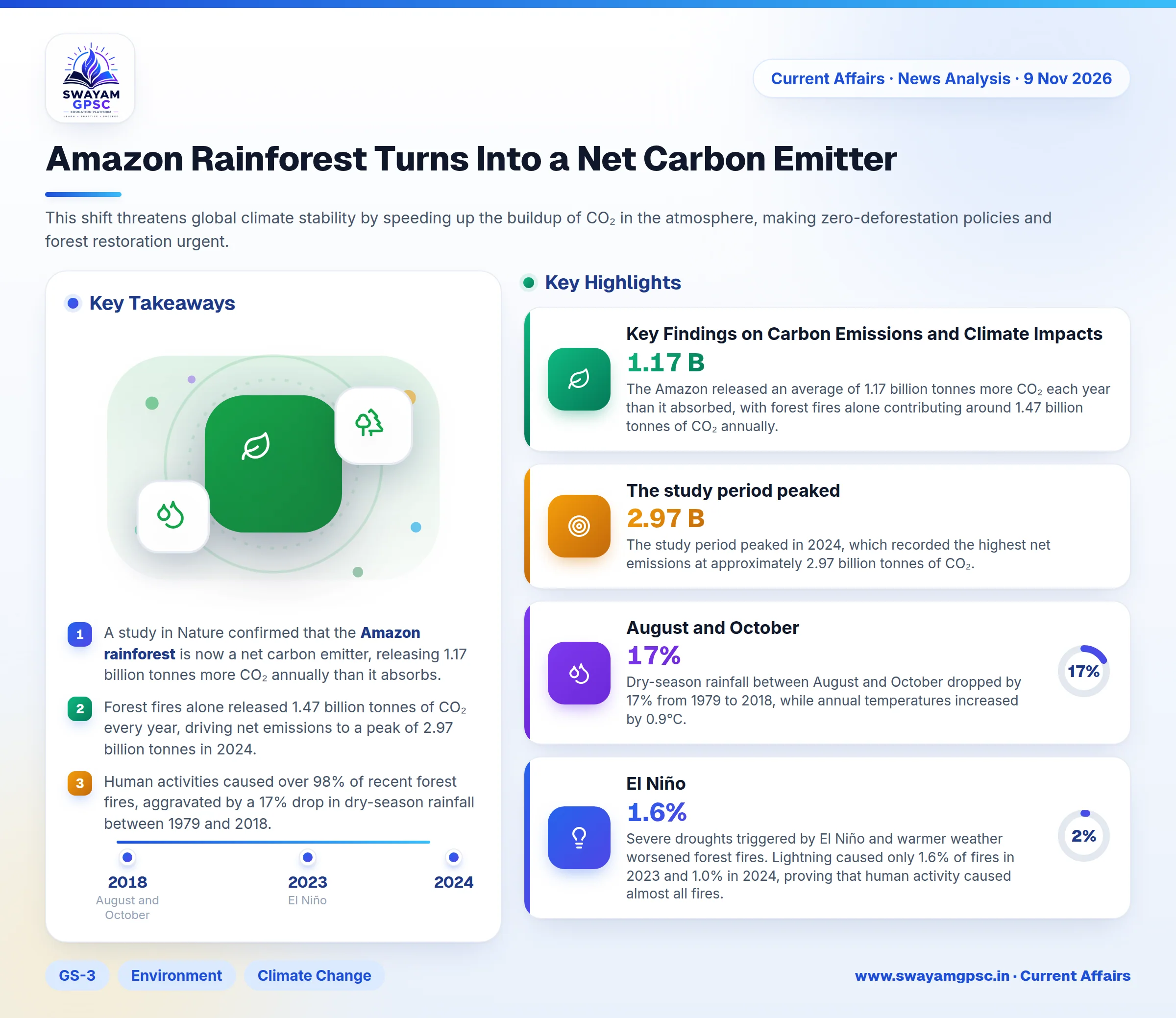
- A study in Nature confirmed that the Amazon rainforest is now a net carbon emitter, releasing 1.17 billion tonnes more CO₂ annually than it absorbs.
- Forest fires alone released 1.47 billion tonnes of CO₂ every year, driving net emissions to a peak of 2.97 billion tonnes in 2024.
- Human activities caused over 98% of recent forest fires, aggravated by a 17% drop in dry-season rainfall between 1979 and 2018.
- The Amazon spans 5.5 million sq. km across eight countries and French Guiana, harboring 10% of known global biodiversity.
Why in News
- A recent study in the journal Nature revealed that the Amazon rainforest now releases more carbon than it absorbs.
- Widespread deforestation, frequent forest fires, and escalating temperatures have severely damaged the rainforest's ability to act as a carbon sink.
Key Findings on Carbon Emissions and Climate Impacts
- The Amazon released an average of 1.17 billion tonnes more CO₂ each year than it absorbed, with forest fires alone contributing around 1.47 billion tonnes of CO₂ annually.
- The study period peaked in 2024, which recorded the highest net emissions at approximately 2.97 billion tonnes of CO₂.
- Dry-season rainfall between August and October dropped by 17% from 1979 to 2018, while annual temperatures increased by 0.9°C.
- Severe droughts triggered by El Niño and warmer weather worsened forest fires. Lightning caused only 1.6% of fires in 2023 and 1.0% in 2024, proving that human activity caused almost all fires.
- The expansion of soybean farming, cattle ranching, and mining drives forest destruction alongside deliberate biomass burning.
- This shift threatens global climate stability by speeding up the buildup of CO₂ in the atmosphere, making zero-deforestation policies and forest restoration urgent.
Overview of the Amazon Rainforest
- The rainforest covers around 5.5 million sq. km across eight South American nations and French Guiana, with Brazil holding the largest share.
- It shelters roughly 10% of all known species on Earth and plays a critical role in global weather patterns and carbon storage.
- The Amazon River delivers the largest water discharge of any river on Earth, while the surrounding region supports over 40 million people, including many Indigenous communities.