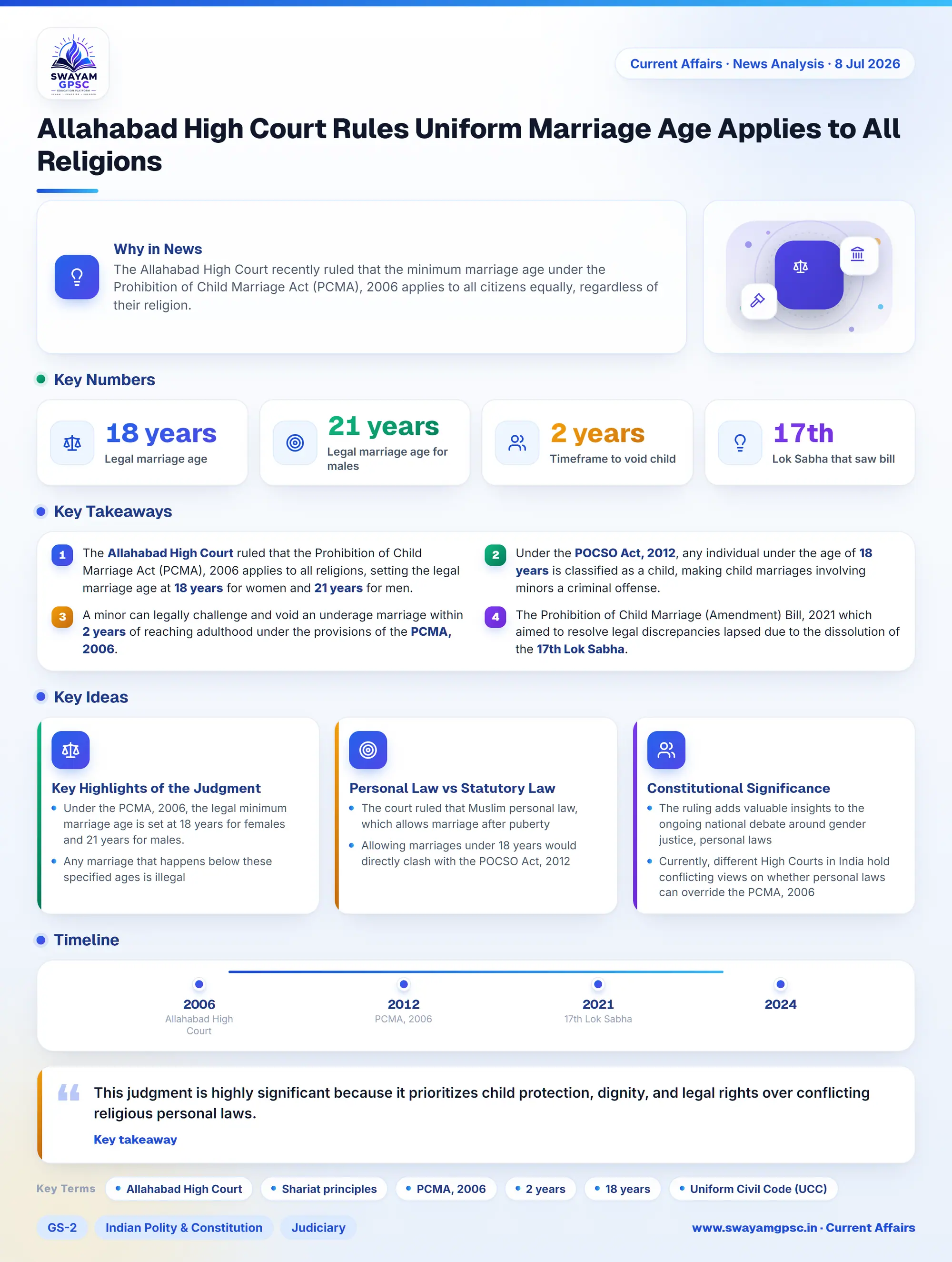
Allahabad High Court Rules Uniform Marriage Age Applies to All Religions
#GS-2 #Indian Polity & Constitution #Judiciary #GS-1 #Indian Society #Women #Social Justice #Current Events #National
Key takeaways
- The Allahabad High Court ruled that the Prohibition of Child Marriage Act (PCMA), 2006 applies to all religions, setting the legal marriage age at 18 years for women and 21 years for men.
- Under the POCSO Act, 2012, any individual under the age of 18 years is classified as a child, making child marriages involving minors a criminal offense.
- A minor can legally challenge and void an underage marriage within 2 years of reaching adulthood under the provisions of the PCMA, 2006.
- The Prohibition of Child Marriage (Amendment) Bill, 2021 which aimed to resolve legal discrepancies lapsed due to the dissolution of the 17th Lok Sabha.
Why in News
- The Allahabad High Court recently ruled that the minimum marriage age under the Prohibition of Child Marriage Act (PCMA), 2006 applies to all citizens equally, regardless of their religion.
- The court made it clear that personal laws, including Shariat principles, cannot override secular child-protection laws passed by Parliament.
Key Highlights of the Judgment
- Under the PCMA, 2006, the legal minimum marriage age is set at 18 years for females and 21 years for males.
- Any marriage that happens below these specified ages is illegal, and the minor can legally declare it void within 2 years of becoming an adult.
- The court emphasized that both the PCMA, 2006 and the POCSO Act, 2012 are welfare laws designed to protect public health and children's rights.
Personal Law vs Statutory Law
- The court ruled that Muslim personal law, which allows marriage after puberty, cannot bypass the strict prohibitions in the PCMA, 2006 and the POCSO Act, 2012.
- Allowing marriages under 18 years would directly clash with the POCSO Act, 2012, which defines any person below 18 years as a child and criminalizes sexual acts with minors.
- The Bench relied on a previous judgment by the Kerala High Court in the case of Moidutty Musliyar v. Sub Inspector, Vadakkencherry Police Station (2024), which stated that personal laws cannot dilute child protection laws.
Constitutional Significance and Challenges
- This judgment is highly significant because it prioritizes child protection, dignity, and legal rights over conflicting religious personal laws.
- The ruling adds valuable insights to the ongoing national debate around gender justice, personal laws, and the implementation of a Uniform Civil Code (UCC).
- Currently, different High Courts in India hold conflicting views on whether personal laws can override the PCMA, 2006, creating legal confusion.
- To resolve this, the Supreme Court has not yet given a final, binding decision on the matter.
- Additionally, the Prohibition of Child Marriage (Amendment) Bill, 2021, which aimed to fix these gaps, lapsed when the 17th Lok Sabha dissolved.