All India Survey on Higher Education Reports 2022-23 and 2023-24
#GS-2 #Governance & Social Justice #Education #GS-3 #Economy #Employment #Current Events #National
Key takeaways
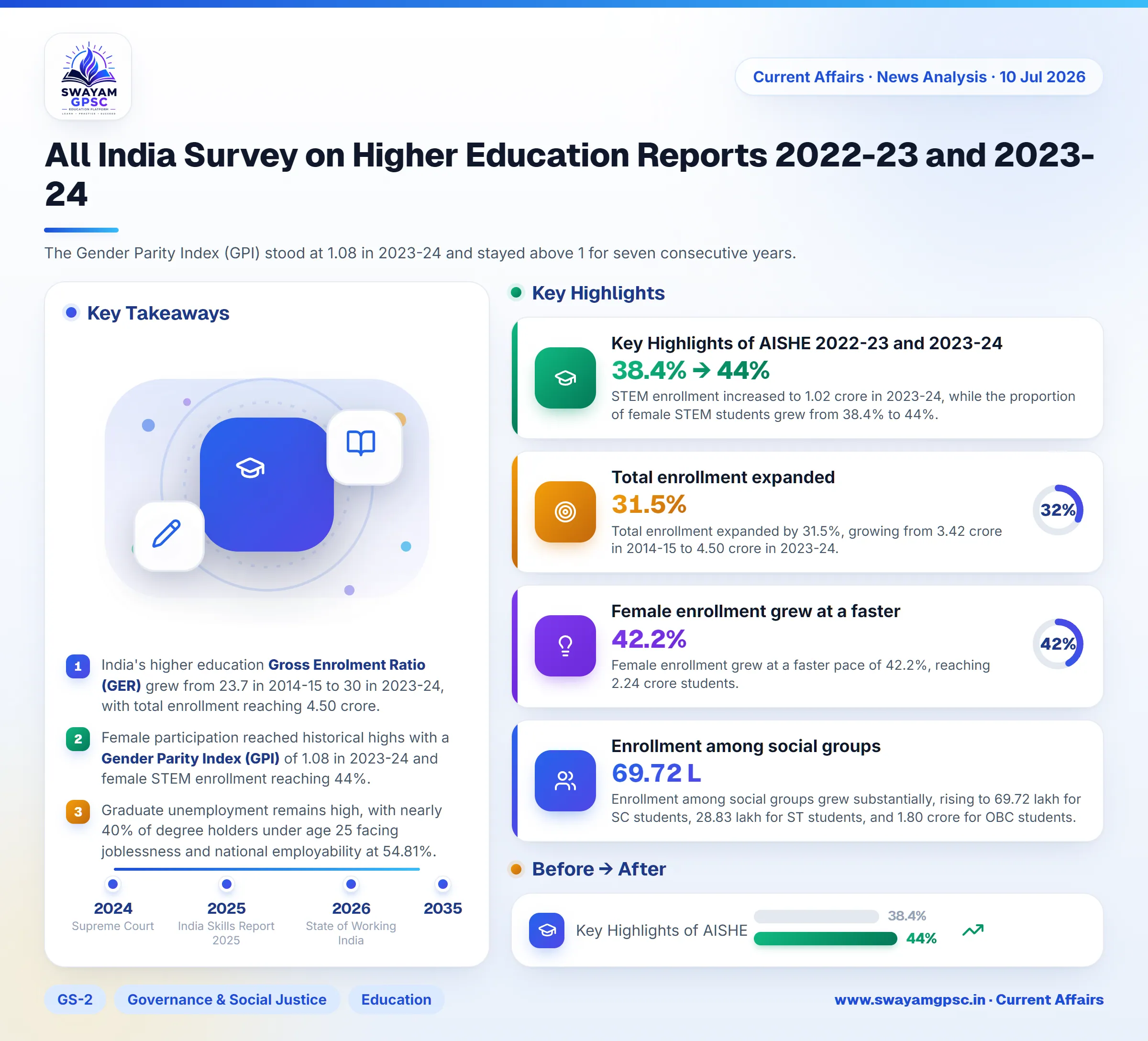
- India's higher education Gross Enrolment Ratio (GER) grew from 23.7 in 2014-15 to 30 in 2023-24, with total enrollment reaching 4.50 crore.
- Female participation reached historical highs with a Gender Parity Index (GPI) of 1.08 in 2023-24 and female STEM enrollment reaching 44%.
- Graduate unemployment remains high, with nearly 40% of degree holders under age 25 facing joblessness and national employability at 54.81%.
- Achieving the National Education Policy (NEP) 2020 goal of 50% GER by 2035 requires increasing public spending on education to 6% of GDP.
Why in News
- The Ministry of Education released the All India Survey on Higher Education (AISHE) reports for 2022-23 and 2023-24. The latest findings show significant growth in student enrollment and social inclusion across colleges.
Key Highlights of AISHE 2022-23 and 2023-24
- The Gross Enrolment Ratio (GER) measures the proportion of youth aged 18 to 23 enrolled in higher education.
- The overall Gross Enrolment Ratio (GER) rose from 23.7 in 2014-15 to 30 in 2023-24. Female GER increased to 31.2, while SC student GER reached 27.8 and ST student GER reached 22.8.
- The Gender Parity Index (GPI) stood at 1.08 in 2023-24 and stayed above 1 for seven consecutive years.
- Total enrollment expanded by 31.5%, growing from 3.42 crore in 2014-15 to 4.50 crore in 2023-24.
- Female enrollment grew at a faster pace of 42.2%, reaching 2.24 crore students.
- Enrollment among social groups grew substantially, rising to 69.72 lakh for SC students, 28.83 lakh for ST students, and 1.80 crore for OBC students.
- STEM enrollment increased to 1.02 crore in 2023-24, while the proportion of female STEM students grew from 38.4% to 44%.
- Total faculty count reached 17.32 lakh in 2023-24, with female teachers increasing from 5.69 lakh in 2014-15 to 7.78 lakh.
About All India Survey on Higher Education
- The Ministry of Education launched the annual AISHE survey in 2010-11 to collect official higher education statistics.
- It acts as the primary data source for formulating education policy and allocating government funding.
- Institutions submit data online regarding student enrollment, faculty, facilities, and exam results through the Data Capture Format (DCF).
- Participation remains voluntary, so overall data quality depends on accurate self-reporting by colleges.
Challenges
- The State of Working India 2026 report shows that unemployment stands near 40% among graduates under age 25.
- The India Skills Report 2025 indicates that national employability is only 54.81%, showing a severe skill mismatch.
- Although 128 Indian universities appeared in the Times Higher Education Asia Rankings 2026, none reached the top 40 list.
- The Economic Survey 2025-26 notes that urban areas hold 38.1% of secondary schools, leaving rural students with fewer local options.
- A March 2025 parliamentary report revealed that 28% of teaching posts and 48% of non-teaching posts in central universities remain vacant.
- Competitive entrance tests like NEET and JEE cause severe mental stress, with 70% of students reporting anxiety.
- India spends only 0.6% to 0.7% of GDP on research and development, which is well below the global average.
- Private colleges make up over 35% of institutions in 2024, but low quality led the Supreme Court to order a nationwide audit in November 2025.
- State public universities educate over 85% of higher education students but face serious financial shortages.
- Research stays isolated in separate institutes like CSIR, ICAR, and DRDO, leaving university campuses disconnected from discovery.
- Strict regulatory oversight by the UGC and AICTE restricts campus freedom, while 32.5% of rural students lack broadband access.
- High fees at private institutions force families into heavy debt, raising the risk of non-performing loans when graduates fail to find good jobs.
Way Forward
- India needs to raise public education spending toward 6% of GDP to meet the National Education Policy (NEP) 2020 target of 50% GER by 2035.
- Colleges must implement the Academic Bank of Credits (ABC) to allow flexible subject choices and entry-exit options.
- The Anusandhan National Research Foundation (ANRF) should act as an active equity partner to fund deep-tech university startups.
- Regulators must offer tiered administrative freedom linked directly to NAAC accreditation grades and NIRF rankings.
- Universities should include industry leaders on governing boards to design practical, job-oriented courses.
- A National Faculty Exchange (NFE) program should invite corporate professionals to teach in university classrooms.
- E-learning portals like SWAYAM and DIKSHA should use artificial intelligence to translate research into 22 local languages.
- Institutions must introduce foundational courses in design thinking and digital skills across all degree streams.
Conclusion
- India must reform its higher education system to turn its demographic dividend into economic growth through skill building and innovation.