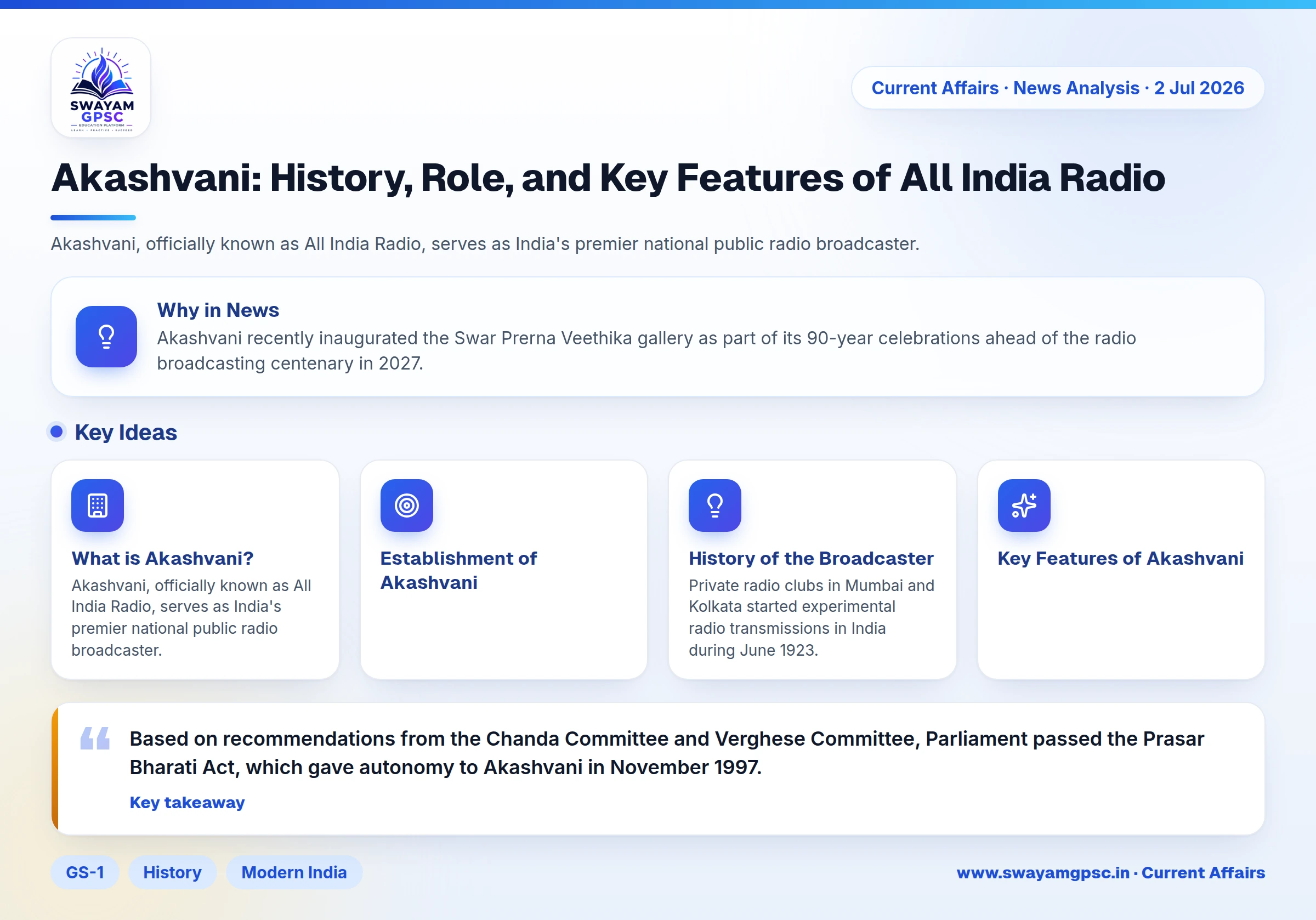
Akashvani: History, Role, and Key Features of All India Radio
#GS-1 #History #Modern India #Culture #Heritage #GS-3 #Economy #Infrastructure #Science & Technology #ICT #Current Events #National #Akashvani #Prasar Bharati
Why in News
- Akashvani recently inaugurated the Swar Prerna Veethika gallery as part of its 90-year celebrations ahead of the radio broadcasting centenary in 2027.
What is Akashvani?
- Akashvani, officially known as All India Radio, serves as India's premier national public radio broadcaster.
- It operates as an autonomous wing under Prasar Bharati alongside Doordarshan, forming one of the largest public broadcasting networks globally.
Establishment of Akashvani
- The network began as the Indian State Broadcasting Service (ISBS) on April 1, 1930, and became All India Radio on June 8, 1936.
- The broadcaster officially adopted the name Akashvani in 1956, taking inspiration from a 1938 poem by Nobel laureate Rabindranath Tagore.
History of the Broadcaster
- Private radio clubs in Mumbai and Kolkata started experimental radio transmissions in India during June 1923.
- The private Indian Broadcasting Company (IBC) formed in 1927 went bankrupt by 1930, leading the British colonial government to create the ISBS.
- In August 1935, BBC producer Lionel Fielden became India's first Controller of Broadcasting to build a formal network structure.
- At independence in 1947, India possessed only 6 radio stations, covering barely 2.5% of the land area and 11% of the population.
- In 1952, Information Minister B. V. Keskar prioritized Indian classical music, creating the annual Akashvani Sangeet Sammelan in 1954.
- Based on recommendations from the Chanda Committee and Verghese Committee, Parliament passed the Prasar Bharati Act, which gave autonomy to Akashvani in November 1997.
Key Features of Akashvani
- Today, Akashvani operates over 460 radio stations, covering 92% of India's land area and reaching almost the entire population.
- The network broadcasts programs in 23 official languages and 146 native dialects to serve diverse cultural communities.
- Its News Services Division (NSD) runs 46 Regional News Units that broadcast over 600 daily news bulletins around the clock.
- Launched in 1957, the Vividh Bharati service offers commercial music and entertainment across specialized FM Gold and FM Rainbow channels.
- The External Services Division (ESD) broadcasts daily in 27 languages across more than 100 countries, supporting India's public diplomacy.