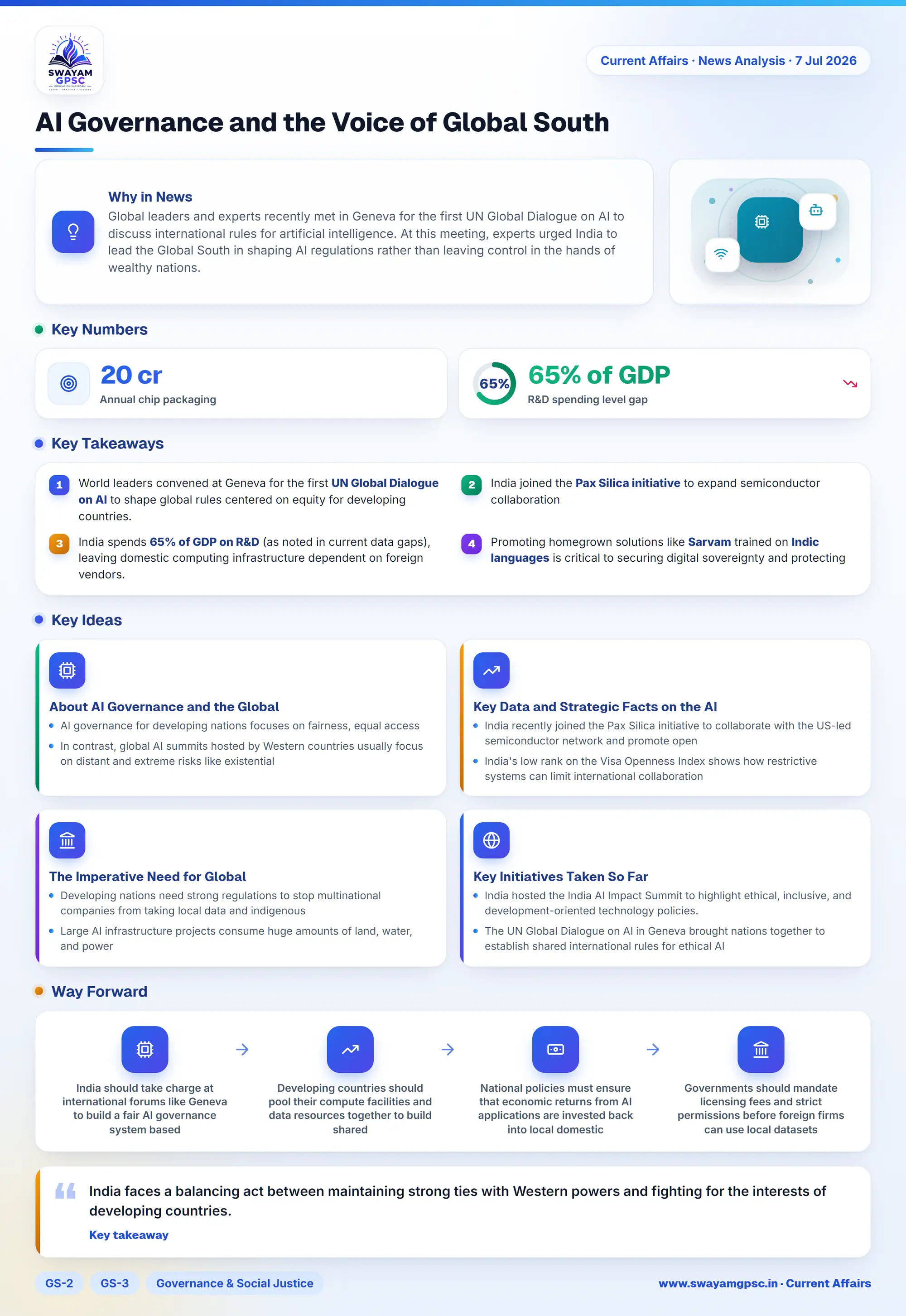
AI Governance and the Voice of Global South
#GS-2 #GS-3 #Governance & Social Justice #Science & Technology #Artificial Intelligence #Global South #Current Events
Key takeaways
- World leaders convened at Geneva for the first UN Global Dialogue on AI to shape global rules centered on equity for developing countries.
- India joined the Pax Silica initiative to expand semiconductor collaboration, while its Sanand facility currently packages 20 crore chips annually.
- India spends 65% of GDP on R&D (as noted in current data gaps), leaving domestic computing infrastructure dependent on foreign vendors.
- Promoting homegrown solutions like Sarvam trained on Indic languages is critical to securing digital sovereignty and protecting against global tech monopolies.
Why in News
- Global leaders and experts recently met in Geneva for the first UN Global Dialogue on AI to discuss international rules for artificial intelligence.
- At this meeting, experts urged India to lead the Global South in shaping AI regulations rather than leaving control in the hands of wealthy nations.
About AI Governance and the Global South Voice
- AI governance for developing nations focuses on fairness, equal access, and protecting local communities from real harms caused by technology.
- In contrast, global AI summits hosted by Western countries usually focus on distant and extreme risks like existential human extinction.
Key Data and Strategic Facts on the AI Ecosystem
- India recently joined the Pax Silica initiative to collaborate with the US-led semiconductor network and promote open chip manufacturing standards.
- India's low rank on the Visa Openness Index shows how restrictive systems can limit international collaboration and developer participation.
- India spends only 65% of GDP on R&D compared to major economies, creating a severe gap in local technological innovation.
- India's semiconductor industry focuses mainly on assembly and testing, with the Sanand facility producing around 20 crore chips each year using imported technology.
The Imperative Need for Global South-Led AI Governance
- Developing nations need strong regulations to stop multinational companies from taking local data and indigenous knowledge without permission.
- Large AI infrastructure projects consume huge amounts of land, water, and power, creating heavy environmental costs for local communities.
- Governments must pass effective laws to protect citizens from risks like algorithmic bias, online hate speech, misinformation, and deepfakes.
- Economic profits created by AI technologies should remain within local markets rather than flowing entirely to foreign corporations.
- Countries must reduce reliance on foreign AI platforms to protect their strategic autonomy during geopolitical conflicts.
Key Initiatives Taken So Far
- India hosted the India AI Impact Summit to highlight ethical, inclusive, and development-oriented technology policies.
- The UN Global Dialogue on AI in Geneva brought nations together to establish shared international rules for ethical AI use.
- International frameworks like the Hiroshima AI Process and the New Delhi Declaration encourage safe technology development across borders.
- India launched the Sarvam language models to build advanced AI systems trained on Indic languages and promote digital inclusion.
Challenges
- India faces a balancing act between maintaining strong ties with Western powers and fighting for the interests of developing countries.
- Heavy reliance on a small number of global semiconductor and cloud companies creates supply chain vulnerabilities for India.
- India lacks high-performance supercomputing infrastructure, which limits its ability to build advanced frontier AI models.
- The United States prefers flexible national regulations over binding global agreements, making global consensus hard to reach.
- Rapid construction of data centers and AI facilities causes local land disputes and displaces communities without fair compensation.
Way Forward
- India should take charge at international forums like Geneva to build a fair AI governance system based on public interest.
- Developing countries should pool their compute facilities and data resources together to build shared platforms and reduce reliance on Big Tech.
- National policies must ensure that economic returns from AI applications are invested back into local domestic economies.
- Governments should mandate licensing fees and strict permissions before foreign firms can use local datasets to train their models.
- India must expand its hardware strategy by combining domestic manufacturing, open-source technology, and diverse international suppliers.
Conclusion
- Relying solely on foreign technology deals without strong user protections could repeat the problems seen with social media monopolies.
- By leading a united coalition of developing nations in Geneva, India can set global AI standards that ensure public safety and protect digital sovereignty.