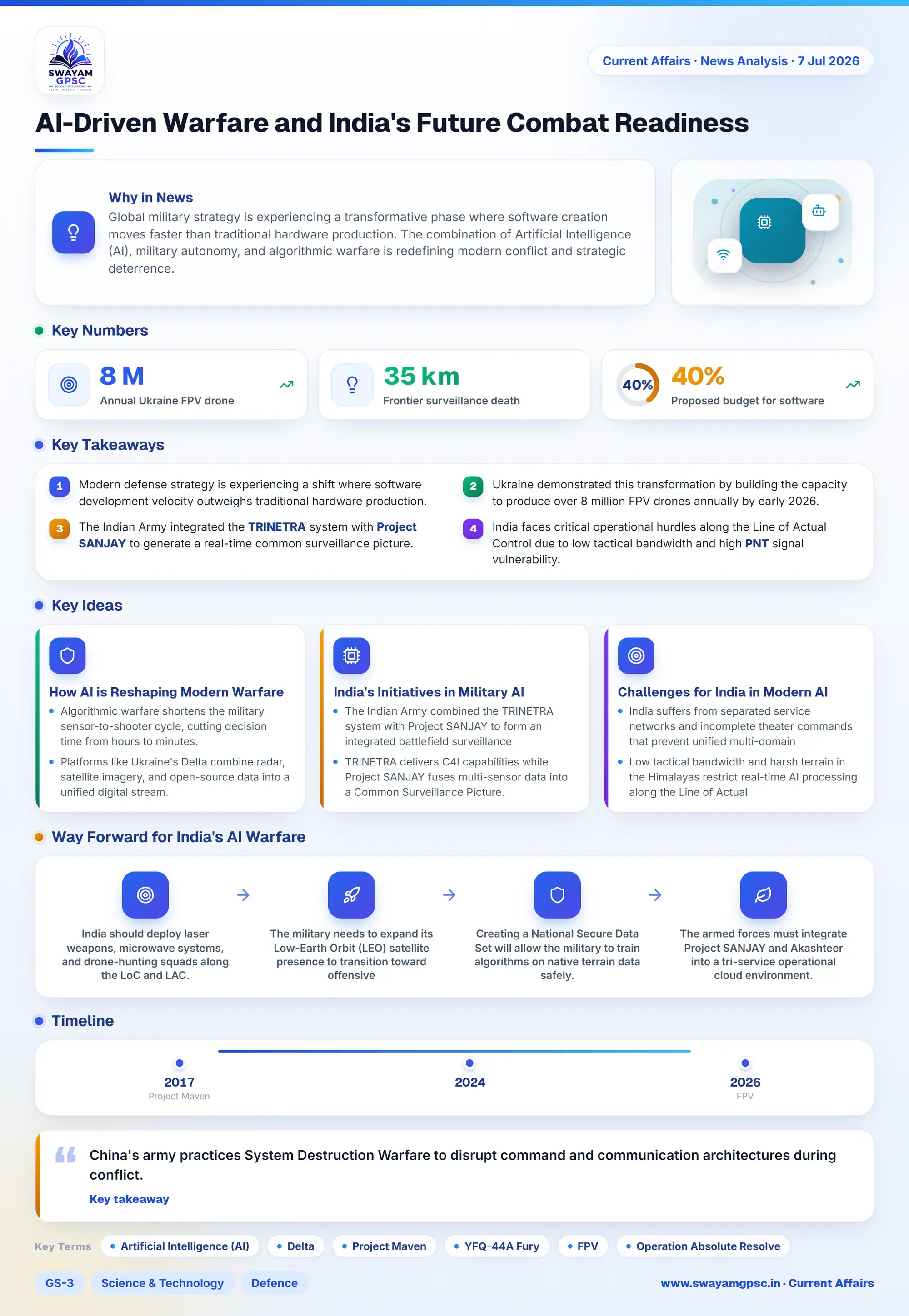
AI-Driven Warfare and India's Future Combat Readiness
#GS-3 #Science & Technology #Defence #Artificial Intelligence #Cyber Security #Current Events #National #Security Challenges & their Management in Border Areas #Challenges to Internal Security Through Communication Networks
Key takeaways
- Modern defense strategy is experiencing a shift where software development velocity outweighs traditional hardware production.
- Ukraine demonstrated this transformation by building the capacity to produce over 8 million FPV drones annually by early 2026.
- The Indian Army integrated the TRINETRA system with Project SANJAY to generate a real-time common surveillance picture.
- India faces critical operational hurdles along the Line of Actual Control due to low tactical bandwidth and high PNT signal vulnerability.
- Defense experts recommend allocating up to 40% of capital acquisition funds toward deep-tech software solutions and AI capabilities.
Why in News
- Global military strategy is experiencing a transformative phase where software creation moves faster than traditional hardware production.
- The combination of Artificial Intelligence (AI), military autonomy, and algorithmic warfare is redefining modern conflict and strategic deterrence.
- India must urgently adapt its defense sector to autonomous systems to preserve national sovereignty and future combat readiness.
How AI is Reshaping Modern Warfare
- Algorithmic warfare shortens the military sensor-to-shooter cycle, cutting decision time from hours to minutes.
- Platforms like Ukraine's Delta combine radar, satellite imagery, and open-source data into a unified digital stream.
- These systems create digital kill webs that instantly assign appropriate drones to neutralize specific targets.
- The United States launched Project Maven in 2017 to accelerate target identification using computer vision.
- Autonomous platforms are replacing humans in high-risk combat, scouting, and supply missions across air, land, and sea.
- Defense startups are building AI aircraft like the YFQ-44A Fury, signaling a shift toward crewed-uncrewed teaming.
- Naval commanders in future maritime combat will increasingly consist of autonomous software systems rather than human captains.
- Massive drone deployment has created a 35-km death zone along the Russia-Ukraine border where heavy armor cannot operate safely.
- Ukraine expanded its production capacity to build over 8 million First-Person View (FPV) drones per year by early 2026.
- Unmanned aircraft and High Altitude Pseudo Satellites (HAPS) enable continuous reconnaissance without risking human pilots.
- During Operation Absolute Resolve in 2026, the US utilized Claude AI by Anthropic to track target movements and plan operations.
- AI now powers cognitive electronic warfare and directed energy lasers to disable incoming enemy drone swarms effectively.
- Cyber technology has introduced advanced digital weapons while AI improves military supply chains and predicts equipment maintenance.
India's Initiatives in Military AI
- The Indian Army combined the TRINETRA system with Project SANJAY to form an integrated battlefield surveillance system.
- TRINETRA delivers C4I capabilities while Project SANJAY fuses multi-sensor data into a Common Surveillance Picture.
- In 2024, DRDO and the Chief of Defence Staff launched the Evaluating Trustworthy Artificial Intelligence (ETAI) framework.
- The ADITI scheme under iDEX funds critical technologies like sovereign quantum radar and AI modules for uncrewed systems.
- At the AI Impact Summit 2026, the Army displayed its Driver Fatigue Detection system and the Prakshepan disaster prediction tool.
- The military raised specialized Baaz Battalions for long-range drone strikes and acquired fixed-wing HAPS platforms.
Challenges for India in Modern AI Warfare
- China's army practices System Destruction Warfare to disrupt command and communication architectures during conflict.
- India suffers from separated service networks and incomplete theater commands that prevent unified multi-domain operations.
- Low tactical bandwidth and harsh terrain in the Himalayas restrict real-time AI processing along the Line of Actual Control.
- Imported AI models risk Out-of-Distribution operational failures when exposed to extreme weather and reflective snow in Ladakh.
- Military drones rely on Position, Navigation, and Timing (PNT) systems that remain vulnerable to electronic jamming.
- India's traditional defense procurement processes move too slowly for rapid software updates and algorithmic improvements.
- Heavy reliance on foreign semiconductors, GPUs, and hardware creates supply chain risks and potential cyber backdoors.
- Removing human supervision speeds up combat actions but raises severe ethical concerns under International Humanitarian Law.
- Adversaries utilize deepfakes and algorithmic propaganda to conduct grey-zone tactics below the threshold of open war.
- An innovation-absorption gap prevents promising domestic defense laboratory prototypes from reaching active military units quickly.
Way Forward for India's AI Warfare Preparedness
- India should deploy laser weapons, microwave systems, and drone-hunting squads along the LoC and LAC.
- The military needs to expand its Low-Earth Orbit (LEO) satellite presence to transition toward offensive reconnaissance.
- Creating a National Secure Data Set will allow the military to train algorithms on native terrain data safely.
- The armed forces must integrate Project SANJAY and Akashteer into a tri-service operational cloud environment.
- India should adopt All Realm All Domain Operations (ARADO) under the proposed MITRA defense doctrine.
- The government must shift defense spending by reserving up to 40% of capital acquisition funds for AI software.
Conclusion
- Future global power will divide nations into those empowered by AI and those dependent on external technology.
- Achieving true strategic autonomy requires India to master software data fusion and rapid decision-making alongside hardware acquisition.