AI Data Centres and Environmental Sustainability Concerns
#GS-3 #Science & Technology #Artificial Intelligence #Environment #Climate Change #Economy #Infrastructure #IT & Computers
Key takeaways
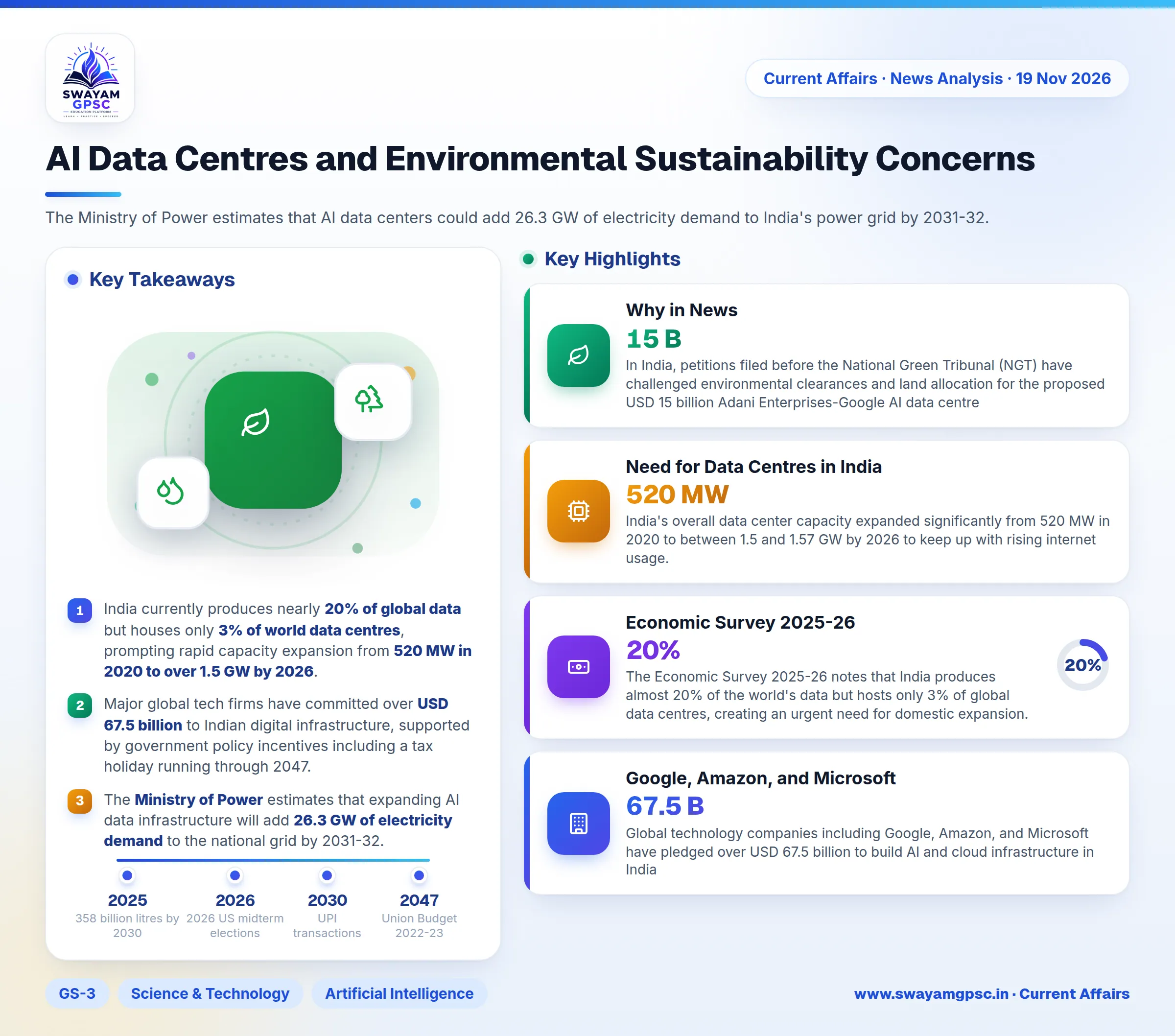
- India currently produces nearly 20% of global data but houses only 3% of world data centres, prompting rapid capacity expansion from 520 MW in 2020 to over 1.5 GW by 2026.
- Major global tech firms have committed over USD 67.5 billion to Indian digital infrastructure, supported by government policy incentives including a tax holiday running through 2047.
- The Ministry of Power estimates that expanding AI data infrastructure will add 26.3 GW of electricity demand to the national grid by 2031-32.
- Data center water consumption in India reached 150 billion litres in 2025 and is projected to climb to 358 billion litres by 2030, according to the Council on Energy, Environment and Water (CEEW).
- Legal challenges before the National Green Tribunal (NGT) over the USD 15 billion Adani Enterprises-Google facility in Visakhapatnam highlight growing public scrutiny near sensitive areas like the Kambalakonda Wildlife Sanctuary.
Why in News
- The rapid expansion of Artificial Intelligence (AI) data centres across the globe faces growing legal and public opposition regarding environmental impacts, land allocation, and local community rights.
- Opposition to uncontrolled data center growth became a prominent campaign issue during the 2026 US midterm elections, with similar local resistance emerging in countries like Finland and Kenya.
- In India, petitions filed before the National Green Tribunal (NGT) have challenged environmental clearances and land allocation for the proposed USD 15 billion Adani Enterprises-Google AI data centre campus located in Visakhapatnam, Andhra Pradesh.
Summary
- The fast pace of AI data center construction raises significant concerns about heavy energy consumption, water stress, ecological damage, and community rights.
- India needs a comprehensive national policy framework that promotes green technologies, renewable power, and local community benefits while maintaining progress toward its Net Zero 2070 target.
What is a Data Centre?
- A data center is a physical facility that houses computer servers, data storage drives, networking gear, and cooling systems needed to process and manage digital data for the internet and cloud services.
- Modern AI facilities rely heavily on dense clusters of Graphics Processing Units (GPUs) to train Large Language Models (LLMs) and manage real-time inference tasks, which consumes far more power, water, and space than traditional CPU-based setups.
- Operators build these facilities close to major population centers to reduce latency, which is the processing delay digital signals experience over long distances.
Need for Data Centres in India
- India's overall data center capacity expanded significantly from 520 MW in 2020 to between 1.5 and 1.57 GW by 2026 to keep up with rising internet usage.
- The Economic Survey 2025-26 notes that India produces almost 20% of the world's data but hosts only 3% of global data centres, creating an urgent need for domestic expansion.
- Establishing local facilities protects data sovereignty, strengthens national security, and helps companies comply with the rules set out under the Digital Personal Data Protection Act, 2023.
- These facilities support essential public services like real-time UPI transactions, cloud platforms like MeghRaj, and online governance for over a billion citizens, helping power a digital economy expected to deliver 20% of national income by 2030.
- Building local computing power for training and real-time inference directly supports key government initiatives like the IndiaAI Mission and the Semicon India Programme 2.0.
- The Union Budget 2022-23 gave data centers official infrastructure status, while the Union Budget 2026-27 offered a tax holiday until 2047 for eligible foreign cloud providers operating in India.
- Global technology companies including Google, Amazon, and Microsoft have pledged over USD 67.5 billion to build AI and cloud infrastructure in India, helping turn the country into an international hub for cloud computing.
Challenges
- The Ministry of Power estimates that AI data centers could add 26.3 GW of electricity demand to India's power grid by 2031-32.
- The International Energy Agency (IEA) reports that a single large AI data center can consume as much electricity as 100,000 households, while the largest upcoming facilities could consume 20 times as much.
- Continuous high power demands from data centers risk pushing grid operating costs up, which could lead to higher electricity bills for regular households.
- Nearly all electricity used by servers turns into heat, meaning a 1-GW data centre produces almost 1 GW of thermal load that requires constant cooling.
- High-density server racks generating 120 to 150 kW of heat hit a physical cooling limit known as the Thermal Wall, forcing operators to switch from air cooling to liquid cooling.
- Cooling fans and chillers consume substantial amounts of electricity, increasing operational expenditures and greenhouse gas emissions.
- Evaporative cooling systems consume large amounts of fresh drinking water, draining local groundwater supplies even though direct-to-chip liquid systems help lower water usage.
- The Council on Energy, Environment and Water (CEEW) reports that Indian data centers consumed 150 billion litres of water in 2025, with usage projected to reach 358 billion litres by 2030.
- Heavy water use by data centers threatens to create local supply conflicts with farmers and residents in drought-prone areas.
- Mechanical cooling systems for a large facility generate continuous low-frequency noise of up to 100 decibels, which can disturb residents living several kilometers away.
- Concentrating half of India's capacity in areas like Mumbai and Navi Mumbai, alongside hubs in Chennai, Hyderabad, Bengaluru, Delhi-NCR, and Jamnagar, releases heat that worsens the Urban Heat Island (UHI) effect.
- If renewable energy production fails to match data center growth, utilities may burn more coal, increasing emissions and hurting India's Net Zero 2070 target.
- Constructing a large 150 MW facility creates thousands of short-term building jobs, but automated operations require very few permanent maintenance workers once running.
- Local communities often adopt a NIMBY ("Not In My Backyard") attitude because they face land loss, noise, heat, and water scarcity while digital benefits go to distant users.
- India currently lacks a binding national data centre policy, causing states to compete for investments by offering subsidies and fast-track approvals that skip environmental checks.
- Under the Environmental Impact Assessment (EIA) Notification, 2006, data centers lack a dedicated regulatory category, allowing some projects to avoid detailed public consultations.
- Fast-tracked approvals for the Visakhapatnam project raised public concern due to potential environmental impacts on the nearby Mudasarlova reservoir catchment and the Kambalakonda Wildlife Sanctuary.
Way Forward
- India should establish a binding national policy framework based on NITI Aayog's Data Centre Evaluation Framework (2026) to link project approvals directly to power availability, water access, and environmental safety.
- Following the suggestions in the Economic Survey 2025-26, India should encourage smaller, task-specific AI models and decentralized computing networks to reduce reliance on giant facilities.
- Operators should adopt 100% additional renewable energy, closed-loop liquid cooling systems, and water recycling tools to cut down on fossil fuels and freshwater consumption.
- Project developers must offer clear benefits to local communities, including local electrical grid upgrades, groundwater recharge systems, skill development, and fair land payouts.
- Authorities must enforce strict rules for e-waste recycling, safe disposal of cooling fluids, and regular monitoring of backup diesel generator emissions.
- Regulators should require operators to publish audited reports detailing their Power Usage Effectiveness (PUE) and Water Usage Effectiveness (WUE) metrics.
Conclusion
- To become a leader in artificial intelligence, India must build an environmentally sustainable data center network that supports digital growth while protecting local communities and staying on track for its Net Zero 2070 target.