AI Data Centers and Environmental Friction
#GS-3 #Economy #Infrastructure #Science & Technology #Environment #Climate Change #Sustainable Development #Energy
Key takeaways
- Localized resistance in the United States successfully blocked data center projects worth up to $152 billion in 2025 alone.
- The Adani Group announced a $100 billion investment to build a 5-GW AI infrastructure platform across India by 2035.
- Google partnered with the Adani Group to construct a 2 GW data center in Visakhapatnam across 480 acres of land.
- State governments in India are offering a 20-year tax holiday along with a 25% discount on land prices to attract investments.
Why in News
- Global resistance against the environmental toll of Artificial Intelligence (AI) data centers has intensified significantly.
- Communities and activists across the US, Europe, Latin America, and Southeast Asia are increasingly opposing these mega-infrastructure projects.
About AI Data Centers
- AI data centers are massive, hyper-scale facilities that function as specialized supercomputers designed to train, deploy, and run complex machine learning models.
- Unlike traditional data centers that primarily act as static storage warehouses for digital records, generative AI infrastructure requires continuous, high-performance computational power to process billions of operations every second.
Key Data and Statistics On Global and Indian Data Centers
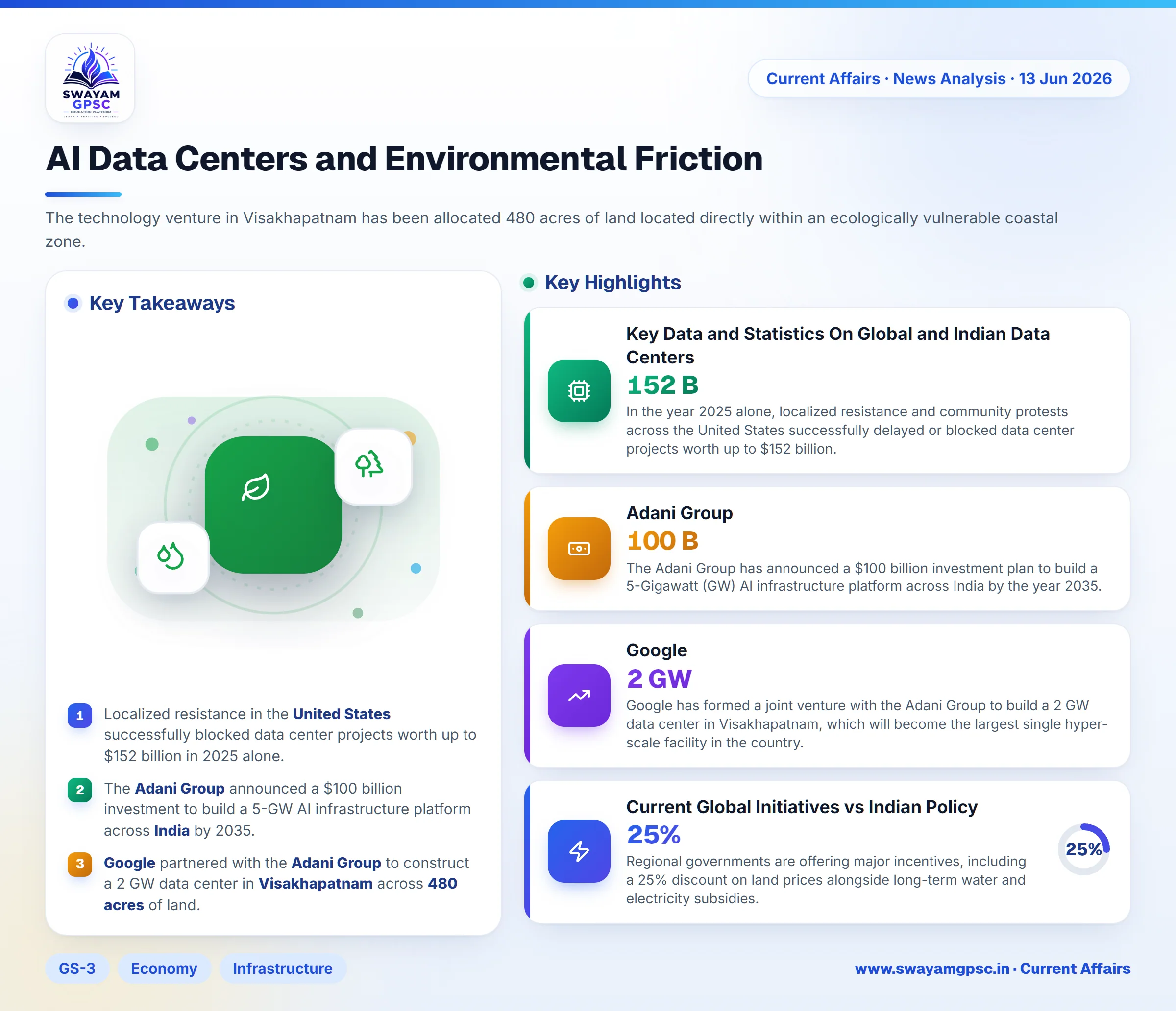
- In the year 2025 alone, localized resistance and community protests across the United States successfully delayed or blocked data center projects worth up to $152 billion.
- The Adani Group has announced a $100 billion investment plan to build a 5-Gigawatt (GW) AI infrastructure platform across India by the year 2035.
- Google has formed a joint venture with the Adani Group to build a 2 GW data center in Visakhapatnam, which will become the largest single hyper-scale facility in the country.
- The technology venture in Visakhapatnam has been allocated 480 acres of land located directly within an ecologically vulnerable coastal zone.
The Imperative Need for Strict Environmental Regulation
- Hyper-scale server farms put immense strain on energy grids and water tables, which can threaten the basic drinking water and power needs of local communities.
- The Andhra Pradesh government has granted 15-year power and 10-year water subsidies to massive tech projects, pulling resources from already over-allocated networks.
- Constructing large industrial complexes in delicate ecological areas increases the risk of soil degradation, light and noise pollution, and damage to local aquifers.
- Massive projects are being built on lush orchards, farmlands, and coastal strips that experts warn are already facing severe environmental challenges.
- Governments often promote these projects as major employment engines for the community, but the long-term domestic hiring potential is actually quite low.
- Giving large corporate subsidies can force ordinary citizens to pay higher electricity and water rates to offset the heavy usage of tech companies.
- Ordinary consumers face rising utility bills and water cutbacks while highly profitable tech giants receive deeply discounted resources.
- Waiving crucial environmental checks allows large tech infrastructure projects to bypass necessary safety and sustainability reviews.
- Major developments, like Google’s joint facility, have had their mandatory Environmental Impact Assessments completely waived.
Current Global Initiatives vs Indian Policy
- The European Union has started canceling major hyper-scale projects, shifting instead toward smaller regional data hubs that focus on green energy and heat recovery.
- In the US, lawmakers from both major political parties are passing moratoriums that require strict resource impact assessments before data centers can be approved.
- Data center sustainability has become a key election issue in US states like Virginia and Georgia, forcing stricter environmental scrutiny.
- The central government has introduced a 20-year tax holiday along with various import concessions to attract international data center investments.
- State administrations are clearing large land parcels, sometimes cutting through orchards and farmlands, to provide sites for tech companies and local conglomerates.
- Regional governments are offering major incentives, including a 25% discount on land prices alongside long-term water and electricity subsidies.
Key Institutional Challenges in India
- Waiving key environmental impact evaluations for massive server projects sets a concerning precedent for domestic eco-governance.
- India is already highly water-stressed and experiences chronic electricity deficits, making the high resource demands of data centers difficult to sustain.
- Because hyper-scale data centers focus on running pre-trained AI models rather than developing new tech, they do not create the large-scale local employment or training hubs that justified their subsidies.
- Unlike Western nations, no major political leaders in India have raised concerns about the high environmental costs of unchecked tech expansion.
Way Forward
- End the practice of fast-tracking tech infrastructure and mandate comprehensive environmental impact reviews for any data center project exceeding a certain power threshold.
- Require data centers to use closed-loop liquid cooling systems or recycled industrial water instead of tapping into scarce local public drinking water supplies.
- Replace long-term water and power subsidies with market-rate utility pricing, ensuring tech companies pay their fair share to support the local grid.
- Follow global sustainability models by shifting away from massive, resource-heavy coastal hyper-scale projects toward smaller regional facilities that reuse waste heat.
- Indian climate activists should engage with local leaders across political lines to push for strict state-level resource audits on energy and land use.
Conclusion
- India’s aggressive push to become a global hub for AI data centers overlooks the heavy environmental costs that are fueling protests worldwide.
- Granting extensive tax holidays and utility subsidies to hyper-scale server farms places a severe burden on the nation’s already strained water tables and electricity grids.