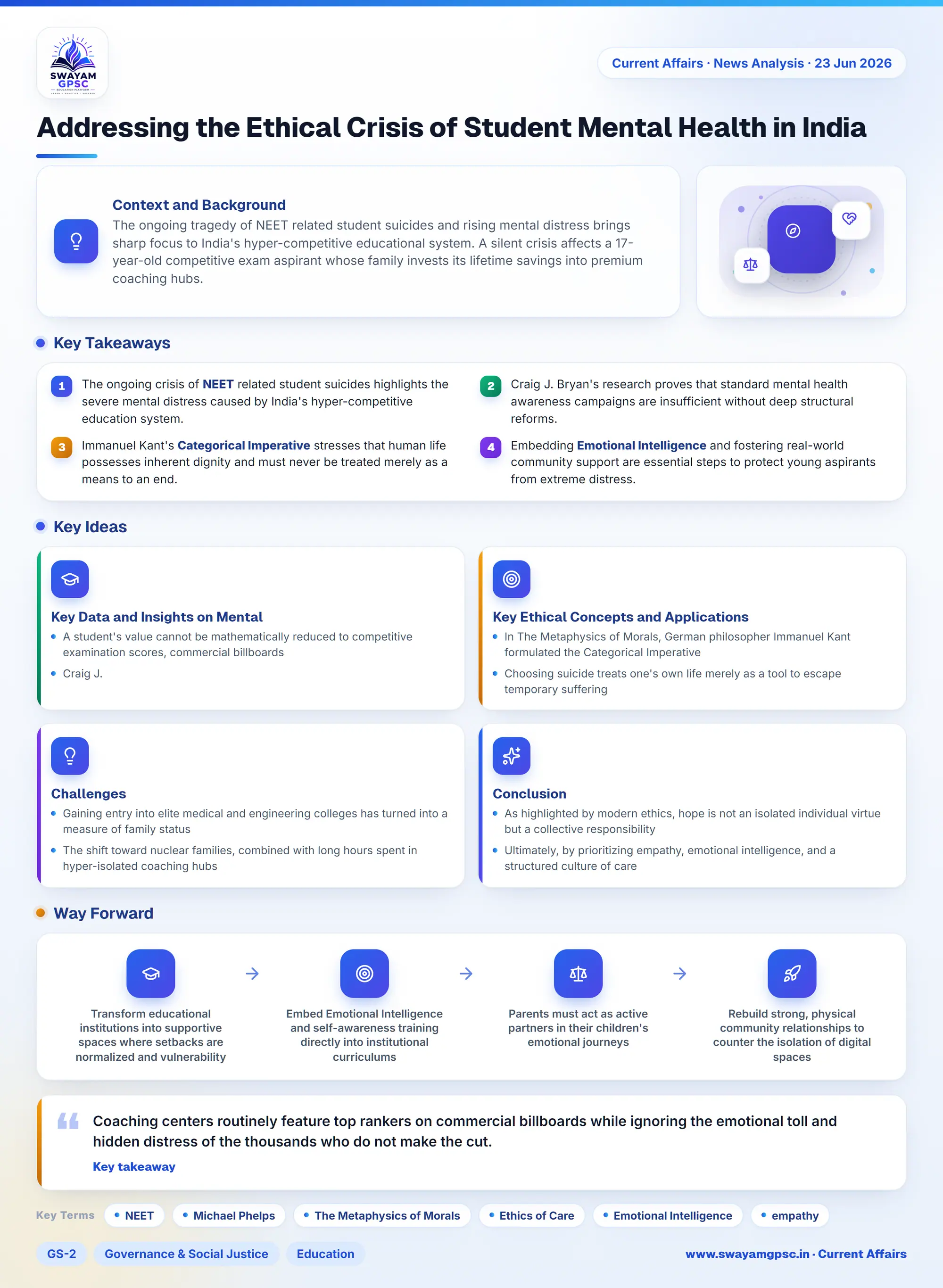
Addressing the Ethical Crisis of Student Mental Health in India
#GS-2 #Governance & Social Justice #Education #Health #GS-4 #Ethics #Current Events #National
Key takeaways
- The ongoing crisis of NEET related student suicides highlights the severe mental distress caused by India's hyper-competitive education system.
- Craig J. Bryan's research proves that standard mental health awareness campaigns are insufficient without deep structural reforms.
- Immanuel Kant's Categorical Imperative stresses that human life possesses inherent dignity and must never be treated merely as a means to an end.
- Embedding Emotional Intelligence and fostering real-world community support are essential steps to protect young aspirants from extreme distress.
Context and Background
- The ongoing tragedy of NEET related student suicides and rising mental distress brings sharp focus to India's hyper-competitive educational system.
- A silent crisis affects a 17-year-old competitive exam aspirant whose family invests its lifetime savings into premium coaching hubs.
- Intense parental expectations, social comparisons, and aggressive marketing trap the student in a high pressure environment where exam failure feels like total personal ruin.
Key Data and Insights on Mental Distress
- A student's value cannot be mathematically reduced to competitive examination scores, commercial billboards, or social prestige.
- Craig J. Bryan's research highlights that suicide rates have not declined proportionately despite widespread mental health awareness campaigns, indicating that awareness alone is insufficient without deep structural changes.
- Inner despair affects individuals regardless of external success, as seen when Olympic swimmer Michael Phelps detailed battling severe depression after winning global accolades, proving that external achievements do not guarantee emotional well-being.
- The decline of joint family structures has pushed young people to seek validation in digital spaces, resulting in high digital connectivity but a severe lack of genuine emotional connection.
Key Ethical Concepts and Applications
- In The Metaphysics of Morals, German philosopher Immanuel Kant formulated the Categorical Imperative, arguing that human beings possess inherent dignity and must always be treated as ends in themselves, never merely as a means to an end.
- Choosing suicide treats one's own life merely as a tool to escape temporary suffering, which violates this core moral law.
- From an administrative lens, the state and society have a clear duty to uphold human dignity, ensuring that no young citizen's life is reduced to mere economic utility or performance rankings.
- The Ethics of Care emphasizes that human flourishing does not depend solely on individual grit, but on supportive, compassionate relationships and interconnected communities.
- Individuals thrive when they feel valued, understood, and structurally protected, requiring educational institutions to shift from treating students as numbers in a marketplace to protecting them as vulnerable human entities.
- Emotional Intelligence is a vital attribute in both personal and public life, equipping individuals to recognize, understand, and regulate intense emotions to prevent temporary defeats from defining their entire identity.
- Cultivating Emotional Intelligence builds personal resilience, allowing students to navigate setbacks with balanced perspective.
- While sympathy involves merely feeling pity for another's misfortune, empathy demands actively sharing and understanding another person's internal suffering.
- Ethical parenting and administration require proactive empathy, listening to unspoken struggles, and understanding the silent pressures that children are often unable to express.
Challenges
- Coaching centers routinely feature top rankers on commercial billboards while ignoring the emotional toll and hidden distress of the thousands who do not make the cut.
- Gaining entry into elite medical and engineering colleges has turned into a measure of family status, magnifying the perceived cost of failure for young minds.
- The shift toward nuclear families, combined with long hours spent in hyper-isolated coaching hubs, cuts students off from traditional community safety nets.
- The current educational setup lacks institutional spaces that normalize setbacks, framing highly competitive entrance exams as a high-stakes, zero-sum game.
Way Forward
- Transform educational institutions into supportive spaces where setbacks are normalized and vulnerability is not viewed as weakness.
- Embed Emotional Intelligence and self-awareness training directly into institutional curriculums, drawing on philosophical traditions to build resilience.
- Parents must act as active partners in their children's emotional journeys, decoupling personal affection from academic performance.
- Rebuild strong, physical community relationships to counter the isolation of digital spaces, providing youth with a genuine sense of belonging.
- Encourage students to step back and reflect on life-affirming questions about meaning, care, and responsibilities connecting them to the world.
Conclusion
- As highlighted by modern ethics, hope is not an isolated individual virtue but a collective responsibility that families, schools, and communities must actively nurture.
- Ultimately, by prioritizing empathy, emotional intelligence, and a structured culture of care, society can ensure that every young person finds the meaning and support needed to choose life, even in moments of defeat.