Abu Dhabi Dialogue: Managing Labour Migration
#GS-2 #Current Events #International #Governance & Social Justice #Important International Institutions #Rapid Fire CA #Quick Facts For Prelims
Key takeaways
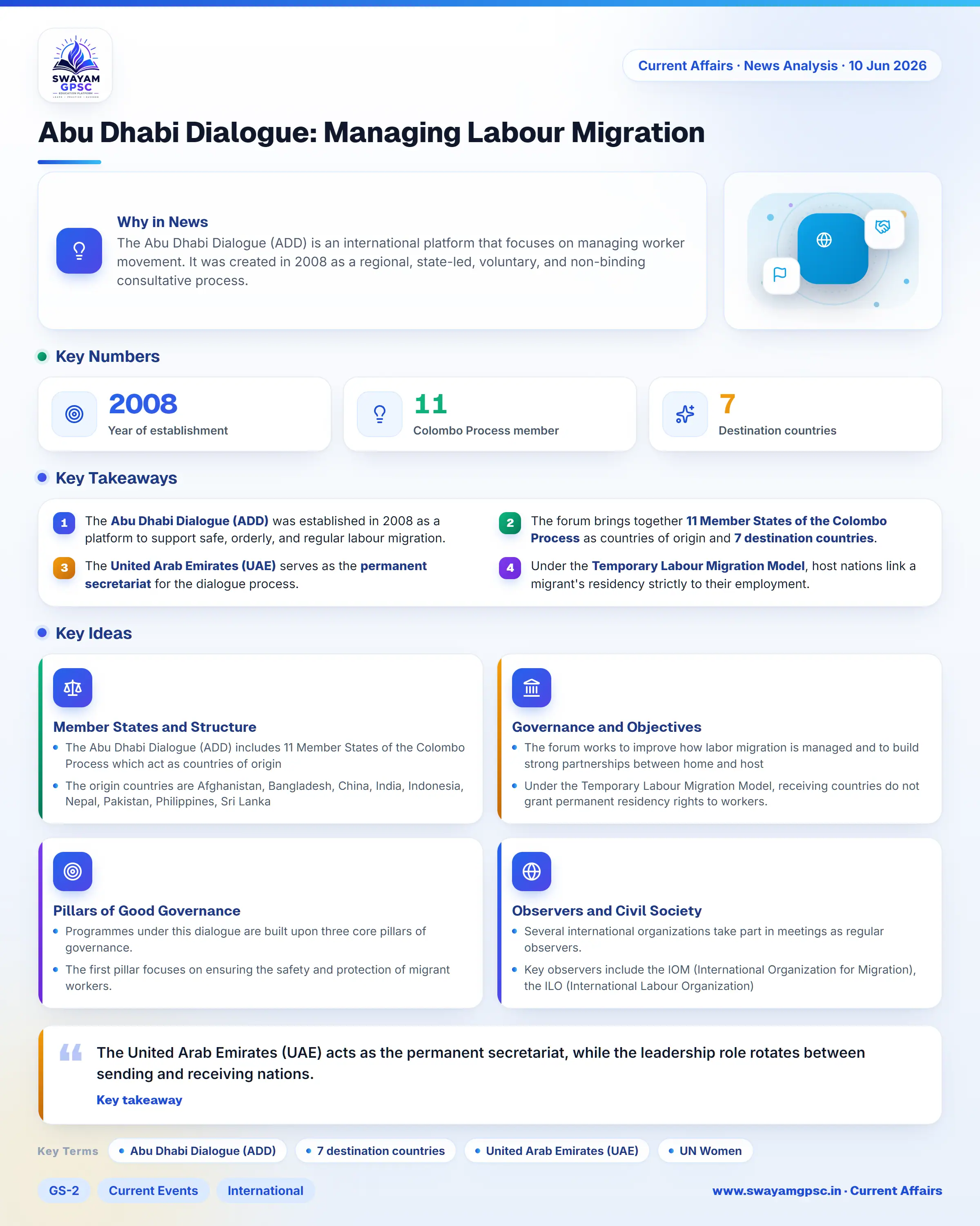
- The Abu Dhabi Dialogue (ADD) was established in 2008 as a platform to support safe, orderly, and regular labour migration.
- The forum brings together 11 Member States of the Colombo Process as countries of origin and 7 destination countries.
- The United Arab Emirates (UAE) serves as the permanent secretariat for the dialogue process.
- Under the Temporary Labour Migration Model, host nations link a migrant's residency strictly to their employment.
Why in News
- The Abu Dhabi Dialogue (ADD) is an international platform that focuses on managing worker movement. It was created in 2008 as a regional, state-led, voluntary, and non-binding consultative process.
- The main goal of this forum is to promote safe, orderly, and regular labour migration through better policy coordination and shared best practices.
Member States and Structure
- The Abu Dhabi Dialogue (ADD) includes 11 Member States of the Colombo Process which act as countries of origin for workers.
- The origin countries are Afghanistan, Bangladesh, China, India, Indonesia, Nepal, Pakistan, Philippines, Sri Lanka, Thailand, and Vietnam.
- It also includes 7 destination countries, with 6 of them located in the Gulf region along with Malaysia.
- The specific destination countries are Bahrain, Kuwait, Oman, Qatar, Saudi Arabia, the United Arab Emirates (UAE), and Malaysia.
- The United Arab Emirates (UAE) acts as the permanent secretariat, while the leadership role rotates between sending and receiving nations.
Governance and Objectives
- The forum works to improve how labor migration is managed and to build strong partnerships between home and host nations.
- Under the Temporary Labour Migration Model, receiving countries do not grant permanent residency rights to workers.
- A migrant's residency is strictly tied to their employment, which helps host nations handle economic changes easily.
Pillars of Good Governance
- Programmes under this dialogue are built upon three core pillars of governance.
- The first pillar focuses on ensuring the safety and protection of migrant workers.
- The second pillar aims at empowering workers so they can reach their personal goals.
- The third pillar gives workers a fair chance to benefit from temporary migration.
Observers and Civil Society
- Several international organizations take part in meetings as regular observers.
- Key observers include the IOM (International Organization for Migration), the ILO (International Labour Organization), UN Women, and the OECD.
- Representatives from civil society also join these discussions to support migrant welfare.