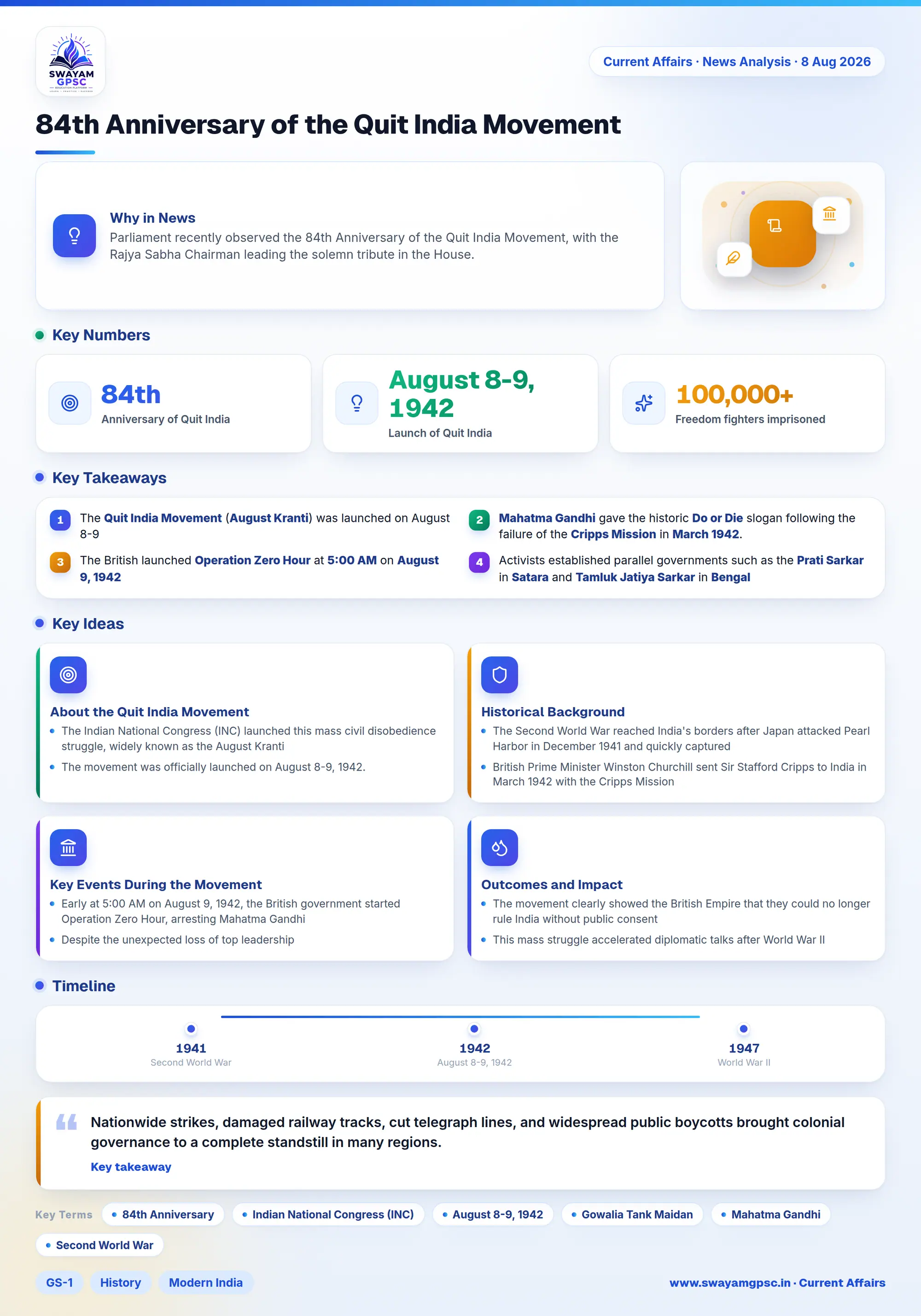
84th Anniversary of the Quit India Movement
#GS-1 #History #Modern India #Freedom Struggle #Quit India Movement #August Kranti #Mahatma Gandhi
Key takeaways
- The Quit India Movement (August Kranti) was launched on August 8-9, 1942 at Gowalia Tank Maidan in Bombay under the leadership of Mahatma Gandhi.
- Mahatma Gandhi gave the historic Do or Die slogan following the failure of the Cripps Mission in March 1942.
- The British launched Operation Zero Hour at 5:00 AM on August 9, 1942, arresting top leadership and eventually detaining over 100,000 citizens nationwide.
- Activists established parallel governments such as the Prati Sarkar in Satara and Tamluk Jatiya Sarkar in Bengal, while Usha Mehta operated the clandestine Congress Radio.
Why in News
- Parliament recently observed the 84th Anniversary of the Quit India Movement, with the Rajya Sabha Chairman leading the solemn tribute in the House.
About the Quit India Movement
- The Indian National Congress (INC) launched this mass civil disobedience struggle, widely known as the August Kranti, to demand an immediate end to British colonial rule in India.
- The movement was officially launched on August 8-9, 1942.
- The historic launch took place at Gowalia Tank Maidan in Bombay, which is today remembered as August Kranti Maidan in Mumbai.
- Prominent national figures led the movement, including Mahatma Gandhi, Jawaharlal Nehru, Sardar Vallabhbhai Patel, Maulana Abul Kalam Azad, and Aruna Asaf Ali.
- During this historic event, Mahatma Gandhi gave the iconic slogan Do or Die (Karo ya Maro) to inspire the nation.
Historical Background
- The Second World War reached India's borders after Japan attacked Pearl Harbor in December 1941 and quickly captured key Southeast Asian territories like Singapore and Rangoon.
- British Prime Minister Winston Churchill sent Sir Stafford Cripps to India in March 1942 with the Cripps Mission, offering Dominion Status after the war instead of immediate independence, which Indian leaders rejected.
- The failure of these talks caused widespread public anger, leading Mahatma Gandhi to realize that British rule had to leave immediately so India could defend itself against foreign invasion.
- The Congress Working Committee approved the initial Quit India draft at Wardha in July 1942, and the All India Congress Committee (AICC) officially passed it in Bombay on August 8, 1942.
Key Events During the Movement
- Early at 5:00 AM on August 9, 1942, the British government started Operation Zero Hour, arresting Mahatma Gandhi, Jawaharlal Nehru, Sardar Patel, and other primary leaders before the campaign could start.
- Despite the unexpected loss of top leadership, a massive spontaneous revolution broke out across urban and rural centers like Bombay, Ahmedabad, Delhi, Bihar, Bengal, Karnataka, and Uttar Pradesh.
- Local patriots created self-governing parallel regimes (Prati Sarkar) in key areas, such as the Tamluk Jatiya Sarkar in Bengal, Nana Patil's Prati Sarkar in Satara, and Chittu Pandey's administration in Ballia.
- Freedom fighters maintained secret coordination channels as Aruna Asaf Ali unfurled the tricolor flag at Gowalia Tank Maidan, while Usha Mehta managed the clandestine Congress Radio.
- Colonial authorities used violent tactics to crush the uprising, ordering police firings, imposing heavy monetary penalties, and arresting over 100,000 citizens.
Outcomes and Impact
- Nationwide strikes, damaged railway tracks, cut telegraph lines, and widespread public boycotts brought colonial governance to a complete standstill in many regions.
- The movement clearly showed the British Empire that they could no longer rule India without public consent, despite using immense armed force.
- This mass struggle accelerated diplomatic talks after World War II, ensuring that full Indian independence became inescapable by 1947.