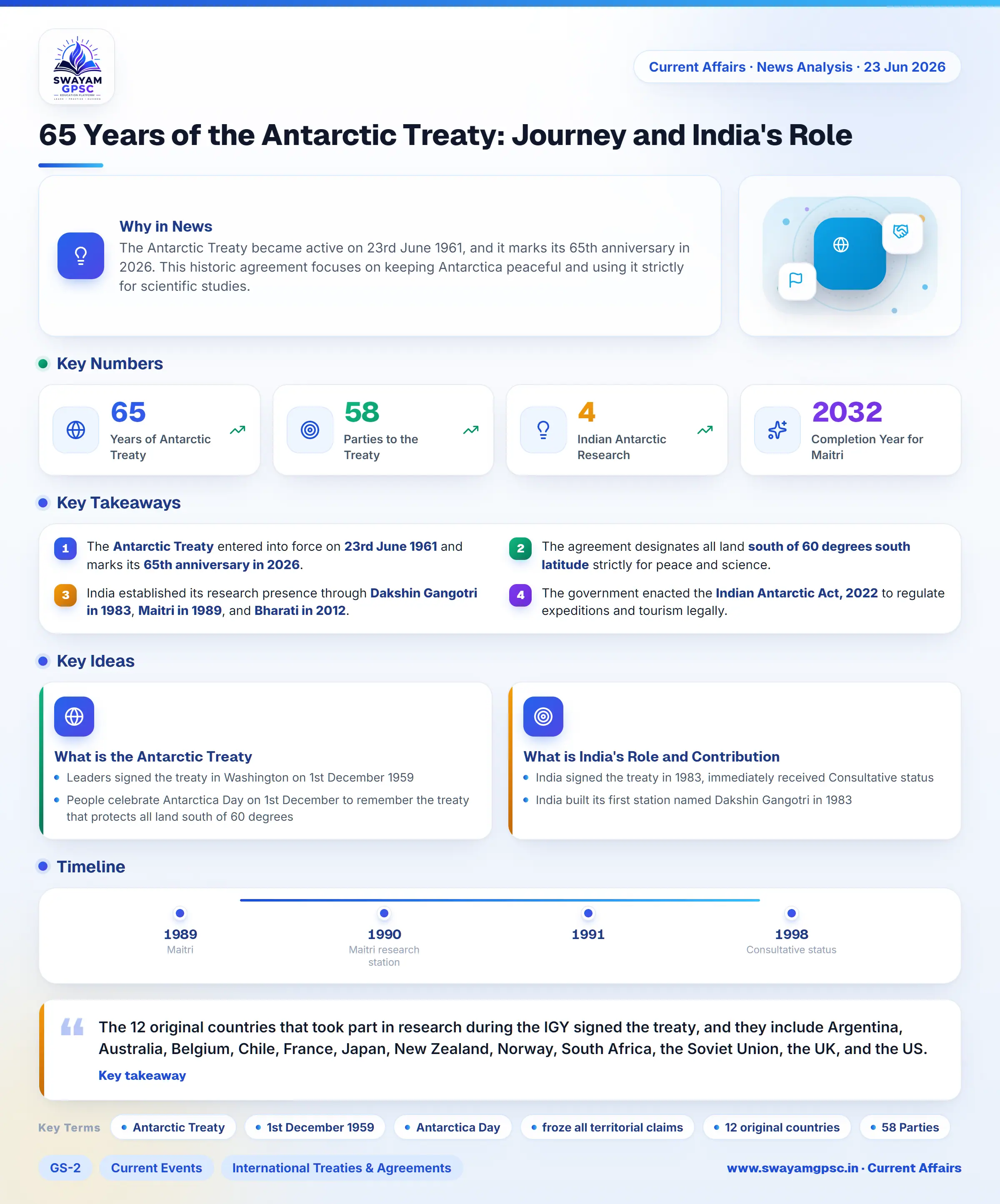
65 Years of the Antarctic Treaty: Journey and India's Role
#GS-2 #Current Events #International Treaties & Agreements #Quick Facts For Prelims #National #Economy #Science & Technology #Environment
Key takeaways
- The Antarctic Treaty entered into force on 23rd June 1961 and marks its 65th anniversary in 2026.
- The agreement designates all land south of 60 degrees south latitude strictly for peace and science.
- India established its research presence through Dakshin Gangotri in 1983, Maitri in 1989, and Bharati in 2012.
- The government enacted the Indian Antarctic Act, 2022 to regulate expeditions and tourism legally.
Why in News
- The Antarctic Treaty became active on 23rd June 1961, and it marks its 65th anniversary in 2026.
- This historic agreement focuses on keeping Antarctica peaceful and using it strictly for scientific studies.
- Geopolitical rivalry, climate change, and growing interest in the resources of the region are creating new pressures on the treaty today.
What is the Antarctic Treaty
- Leaders signed the treaty in Washington on 1st December 1959, and it took effect on 23rd June 1961 after the success of the International Geophysical Year (IGY) of 1957 to 1958.
- People celebrate Antarctica Day on 1st December to remember the treaty that protects all land south of 60 degrees south latitude, which covers about 10% of the Earth.
- The agreement successfully froze all territorial claims, banned nuclear weapons, and stopped the dumping of radioactive waste.
- The 12 original countries that took part in research during the IGY signed the treaty, and they include Argentina, Australia, Belgium, Chile, France, Japan, New Zealand, Norway, South Africa, the Soviet Union, the UK, and the US.
- The treaty now has 58 Parties, divided into Consultative voting members who do heavy research and Non-Consultative members who do not have a vote.
- Article I states that Antarctica must be used for peaceful purposes only, banning military bases and weapons testing completely.
- Articles II and III protect the freedom of science, making it mandatory for countries to share their study results openly.
- Article IV freezes all territorial claims, meaning seven nations with historical claims cannot push their ownership while the treaty is active.
- Article V creates a nuclear-free zone by banning atomic explosions and radioactive waste disposal.
- The Antarctic Treaty System (ATS) includes extra rules like the Convention for the Conservation of Antarctic Seals (CCAS, 1972) to manage seal hunting.
- The Convention on the Conservation of Antarctic Marine Living Resources (CCAMLR, 1980) protects sea life like krill by using an ecosystem-friendly fishing approach.
- The Madrid Protocol (Protocol on Environmental Protection, 1991) turns Antarctica into a natural reserve, devoted to peace and science.
- Most importantly, the Madrid Protocol completely bans all commercial mineral resource extraction.
What is India's Role and Contribution
- India signed the treaty in 1983, immediately received Consultative status, and later ratified the Madrid Protocol in 1998.
- India built its first station named Dakshin Gangotri in 1983, which now serves as a supply base after getting retired from research.
- India opened its first post office at Dakshin Gangotri in 1984.
- The second station named Maitri was set up in the Schirmacher Oasis in 1989, and it continues to operate today.
- Scientists created a nearby freshwater body called Lake Priyadarshini close to the Maitri station.
- India opened a second post office at the Maitri research station on 26th January 1990, with mail routed through the National Centre for Polar and Ocean Research (NCPOR) in Goa.
- The third station named Bharati opened in 2012, sitting about 3,000 km east of Maitri between Thala Fjord and Quilty Bay under the Indian Antarctic Program.
- The Department of Posts opened a new post office branch at the Bharati research station.
- The Ministry of Finance approved Maitri II, which will become India's fourth station and is planned for completion in East Antarctica by 2032.
- Led by the National Centre for Polar and Ocean Research (NCPOR), Maitri II will replace the old Maitri station to boost India's long-term research work.
- The green research base Maitri II will run entirely on solar and wind energy and use smart instruments to send data back to mainland India automatically.
- The National Centre for Polar and Ocean Research (NCPOR) was set up in Goa in 1998 under the Ministry of Earth Sciences (MoES) to handle Indian polar missions.
- NCPOR also looks after research stations in the Arctic and Himansh in the Himalayas.
- The agency supports Ph.D. studies and drives India's Deep Ocean Mission to connect polar science with national security and growth.
- India passed the Indian Antarctic Act, 2022 to give solid legal backing to the treaty, the Madrid Protocol, and CCAMLR rules inside the country.
- This law gives Indian courts the power to punish crimes committed by citizens or foreigners during Indian expeditions and controls tourism.
- During the 46th Antarctic Treaty Consultative Meeting (ATCM) held in Kochi in 2024, India led the first working group talks focused on managing Antarctic tourism.