3rd National Conference of Anti-Narcotics Task Force
#GS-3 #Economy #Infrastructure #Security #Current Events #National
Key takeaways
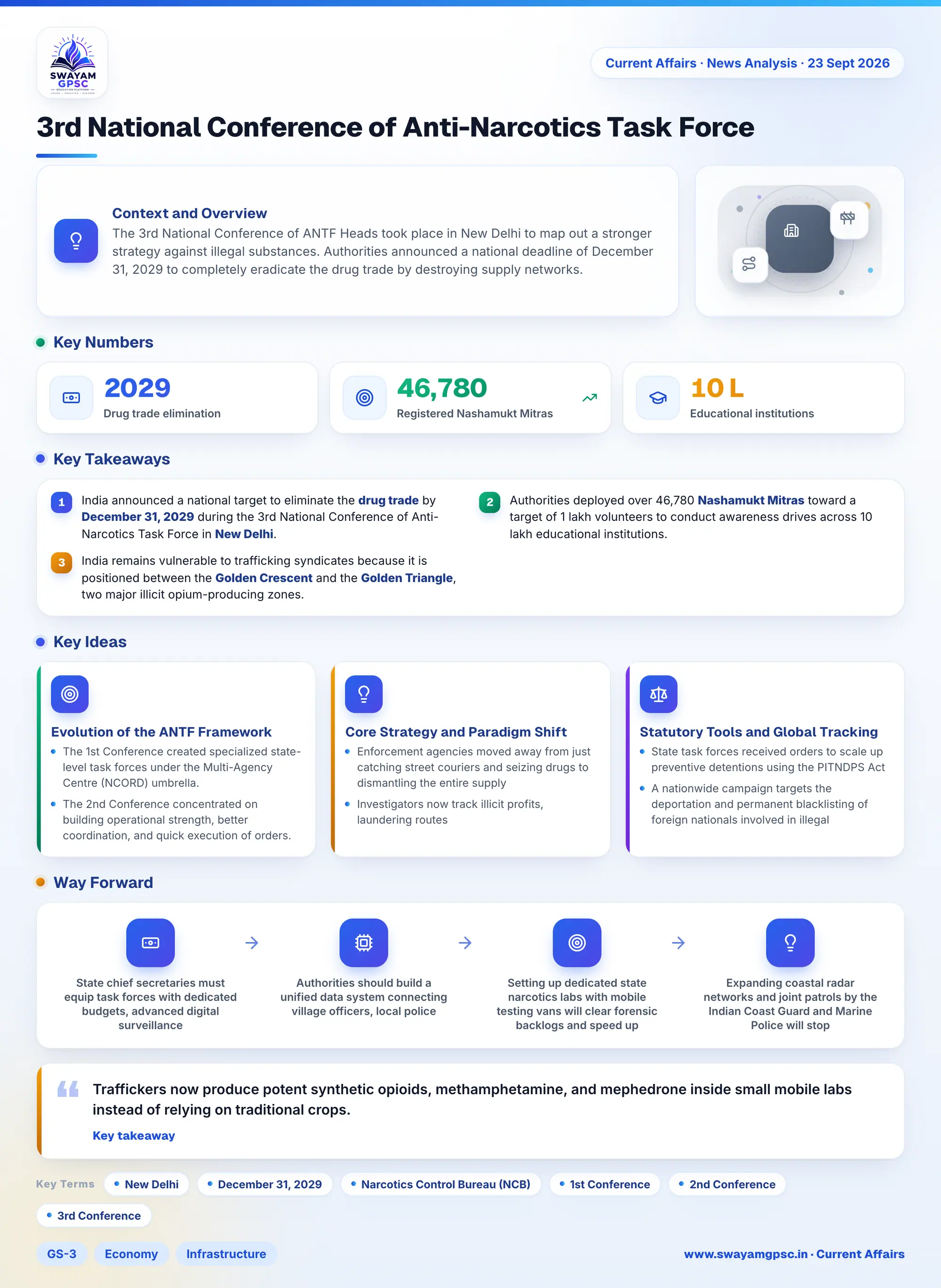
- India announced a national target to eliminate the drug trade by December 31, 2029 during the 3rd National Conference of Anti-Narcotics Task Force in New Delhi.
- Authorities deployed over 46,780 Nashamukt Mitras toward a target of 1 lakh volunteers to conduct awareness drives across 10 lakh educational institutions.
- India remains vulnerable to trafficking syndicates because it is positioned between the Golden Crescent and the Golden Triangle, two major illicit opium-producing zones.
Context and Overview
- The 3rd National Conference of ANTF Heads took place in New Delhi to map out a stronger strategy against illegal substances.
- Authorities announced a national deadline of December 31, 2029 to completely eradicate the drug trade by destroying supply networks.
- The Narcotics Control Bureau (NCB) serves as the biennial organizer, bringing together state task forces, central intelligence, and public prosecutors.
- The event operated under the theme of United Resolve, Shared Responsibility to foster better cooperation among agencies.
Evolution of the ANTF Framework
- The 1st Conference created specialized state-level task forces under the Multi-Agency Centre (NCORD) umbrella.
- The 2nd Conference concentrated on building operational strength, better coordination, and quick execution of orders.
- The 3rd Conference shifted the focus from simple meetings to active missions, moving beyond mere seizures to dismantling entire syndicates.
- The newly released Vision Document on Narcotics Control (2026-2029) sets strict targets, clear timelines, and direct accountability for forces.
Core Strategy and Paradigm Shift
- Enforcement agencies moved away from just catching street couriers and seizing drugs to dismantling the entire supply chain.
- Investigators now track illicit profits, laundering routes, and crypto payments by using the Prevention of Money Laundering Act (PMLA) and the NDPS framework.
- A Three-Tier Operational Attack targets cartels at entry points, inter-state distribution routes, and local retail sales networks simultaneously.
- Authorities classify districts into manufacturing zones, transit corridors, and consumption hubs to ensure precise and targeted policing.
Statutory Tools and Global Tracking
- State task forces received orders to scale up preventive detentions using the PITNDPS Act, 1988 against repeat kingpins.
- A nationwide campaign targets the deportation and permanent blacklisting of foreign nationals involved in illegal trafficking.
- Central agencies coordinate with Interpol and foreign law enforcement to apprehend and extradite fugitive cartel heads.
- State police chiefs must build solid prosecution roadmaps alongside public prosecutors to improve conviction rates in specialized courts.
Infrastructure and Grassroots Outreach
- Leaders laid foundational stones for new NCB Zonal Complexes in Lucknow and Dehradun.
- The Telangana ANTF received recognition as the best-performing state task force in the country.
- Authorities deployed over 46,780 registered Nashamukt Mitras out of a target of 1 lakh volunteers.
- These volunteers run awareness campaigns across 10 lakh educational institutions throughout the country.
Challenges
- Traffickers now produce potent synthetic opioids, methamphetamine, and mephedrone inside small mobile labs instead of relying on traditional crops.
- Regulating industrial precursor chemicals without harming genuine pharmaceutical and chemical manufacturing remains a difficult task.
- Criminals use darknet marketplaces, dead-drop parcel systems, and privacy-coin payments to coordinate shipments without getting caught.
- India lies directly between the Golden Crescent to the west and the Golden Triangle to the east, exposing its borders to continuous cartel pressure.
- Delays in chemical testing, improper evidence handling, and procedural lapses under Section 50 of the NDPS Act often lead to prolonged trials.
Way Forward
- State chief secretaries must equip task forces with dedicated budgets, advanced digital surveillance, and specialized manpower.
- Authorities should build a unified data system connecting village officers, local police, the Financial Intelligence Unit, and the CBIC.
- Setting up dedicated state narcotics labs with mobile testing vans will clear forensic backlogs and speed up chargesheet filings.
- Expanding coastal radar networks and joint patrols by the Indian Coast Guard and Marine Police will stop seaborne shipments.
- Combining enforcement with affordable de-addiction centers and psychiatric support ensures that victims receive rehabilitation instead of punishment.