3rd India-Australia Leaders Summit 2026 Key Highlights and Bilateral Ties
#GS-2 #Current Events #International #Groupings & Agreements Involving India #India-Australia Relations #GS-3 #Economy #Energy #Defense & Maritime Security
Key takeaways
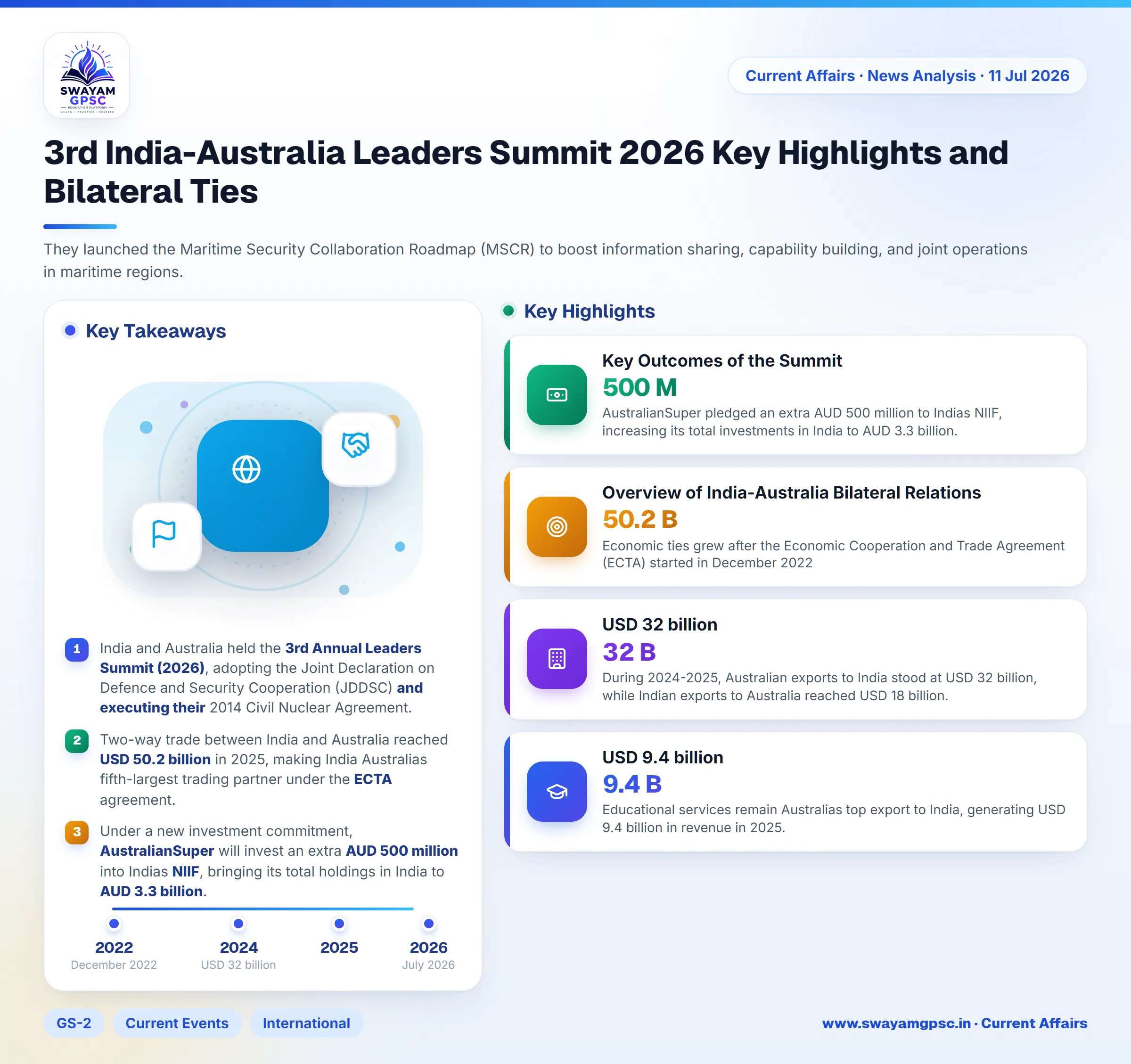
- India and Australia held the 3rd Annual Leaders Summit (2026), adopting the Joint Declaration on Defence and Security Cooperation (JDDSC) and executing their 2014 Civil Nuclear Agreement.
- Two-way trade between India and Australia reached USD 50.2 billion in 2025, making India Australias fifth-largest trading partner under the ECTA agreement.
- Under a new investment commitment, AustralianSuper will invest an extra AUD 500 million into Indias NIIF, bringing its total holdings in India to AUD 3.3 billion.
- Educational exports from Australia to India reached USD 9.4 billion in 2025, supported by nearly 976,000 residents of Indian heritage living in Australia.
Why in News
- In July 2026, the Prime Minister of India visited Australia to attend the 3rd India-Australia Annual Leaders Summit.
- The summit focused on strengthening cooperation in the Indo-Pacific region, securing supply chains for energy and critical technology, enhancing defense ties, and building a long-lasting strategic partnership.
- Both nations expanded their Comprehensive Strategic Partnership across key sectors, including civil nuclear energy, defense, critical technologies, space, education, and social connectivity.
- Even with strong alignment in the Indo-Pacific, the partnership faces hurdles like slow trade talks, trade gaps, China-controlled mineral processing, and diaspora issues.
Key Outcomes of the Summit
- Both countries adopted the Joint Declaration on Defence and Security Cooperation (JDDSC), updating the 2009 framework to improve cybersecurity, military teamwork, and shared goals in UNCLOS, ASEAN, and IORA.
- They launched the Maritime Security Collaboration Roadmap (MSCR) to boost information sharing, capability building, and joint operations in maritime regions.
- The Indian Coast Guard (ICG) signed an agreement with Australias Maritime Border Command (MBC) to improve border protection and maritime law enforcement.
- Both sides put the 2014 India-Australia Civil Nuclear Agreement into action, ensuring a steady supply of Australian uranium for peaceful nuclear energy in India under IAEA supervision.
- They issued the India-Australia Joint Statement on Energy Security to protect energy supply chains from global geopolitical shocks.
- The Rooftop Solar Training Academy was set up at PDEU in Gandhinagar to train 2,000 women and youth as technicians for the PM Surya Ghar Yojana.
- They launched the Australia-India Partnership for Cyber, Critical Technologies, Supply Chains (PACTS) to strengthen digital security and critical supply chains.
- India, Australia, and Canada signed a trilateral agreement under the ACITI Partnership to advance work on emerging technologies.
- AustralianSuper pledged an extra AUD 500 million to Indias NIIF, increasing its total investments in India to AUD 3.3 billion.
- Flinders University in Bengaluru and Victoria University in Gurugram received approval to build and run university campuses in India.
- IP Australia gained access to Indias Traditional Knowledge Digital Library (TKDL) to stop unfair patent claims on traditional Indian knowledge.
- Australia agreed to support Indias Gaganyaan Mission by hosting a temporary space-tracking station on the Cocos (Keeling) Islands.
- Australia agreed to return three historical 11th-12th century artifacts to India, including a stone Nandi, a Bhadrakali trident, and a Skanda sculpture.
- Both nations unveiled the India-Australia Sports Collaboration Roadmap to build high-performance sports facilities and share training methods for the Olympics and Para sports.
- The Indian Prime Minister praised Australia for taking action to ban social media access for young minors.
Overview of India-Australia Bilateral Relations
- Australia is one of only two countries, alongside Japan, with which India holds annual summit talks, maintains an active free trade agreement, and conducts a 2+2 ministerial dialogue.
- Economic ties grew after the Economic Cooperation and Trade Agreement (ECTA) started in December 2022, making India Australias fifth-largest trading partner with total trade reaching USD 50.2 billion in 2025.
- During 2024-2025, Australian exports to India stood at USD 32 billion, while Indian exports to Australia reached USD 18 billion.
- In February 2025, Australia introduced A New Roadmap for Australias Economic Engagement with India, focusing on clean energy, education, agribusiness, and tourism.
- Both nations are moving quickly to expand ECTA into a broader agreement called the Comprehensive Economic Cooperation Agreement (CECA).
- Defense cooperation includes joint military drills like Malabar, AUSINDEX, and Pitch Black, along with Indias participation in exercise Talisman Sabre 2025.
- Both countries work closely through groups like the Quad and the Supply Chain Resilience Initiative (SCRI) to maintain a free and open Indo-Pacific region.
- The India-Australia Renewable Energy Partnership (REP) was established in 2024 to focus on solar energy, green hydrogen, battery storage, and recycling.
- Nearly 976,000 people of Indian heritage live in Australia, making them the largest group of foreign-born residents in the country.
- Educational services remain Australias top export to India, generating USD 9.4 billion in revenue in 2025.
Challenges
- Australia relies on its defense pact with the United States and AUKUS, whereas India maintains strategic autonomy and avoids binding military alliances.
- Australia focuses mainly on naval threats in the Western Pacific, while India must manage border tensions along the Line of Actual Control (LAC) and security in the Indian Ocean.
- Australia depends heavily on trade with China, which creates hurdles for deeper strategic alignment with India.
- Progress on CECA is slow because Australia demands greater access to Indias sensitive farming and dairy markets, while strict Australian SPS rules restrict Indian goods.
- India runs a persistent trade deficit with Australia due to heavy imports of Australian coking coal and natural gas.
- Although Australia holds large reserves of lithium, cobalt, and rare earth minerals, most processing still relies on facilities linked to China.
- Local incidents of temple vandalism and activities by Khalistani separatist groups in Australia cause periodic diplomatic friction between the two nations.
Way Forward
- Both countries must finalize a balanced CECA by creating Mutual Recognition Agreements (MRAs) for health standards while using protective tariffs to safeguard Indian farmers.
- They should invest jointly in mineral processing centers through the Quad Critical Minerals Initiative (2026) and PACTS (2026) to break Chinas monopoly on critical minerals.
- They need to execute the JDDSC and MSCR (2026) agreements by sharing underwater surveillance data, conducting joint deployments, and co-producing military hardware.
- Both sides should turn the 2014 India-Australia Civil Nuclear Agreement into long-term uranium purchase contracts to support Indias clean energy goals.
- Both governments should boost intelligence sharing and police collaboration to stop extremist actions, protect diplomatic properties, and address security threats.
Conclusion
- India and Australia must go beyond standard tariff cuts by removing non-tariff barriers and investing directly in mineral refining facilities.
- By sharing maritime defense duties while respecting Indias strategic autonomy, both countries can build a stable and secure Indo-Pacific region.