31st UNFCCC Conference of the Parties (COP 31)
#GS-2 #GS-3 #Current Events #International #Environment #Climate Change #Pollution #Groupings & Agreements Involving India and/or Affecting India's Interests #Effect of Policies & Politics of Countries on India's Interests #International Treaties & Agreements #Environmental Pollution & Degradation
Key takeaways
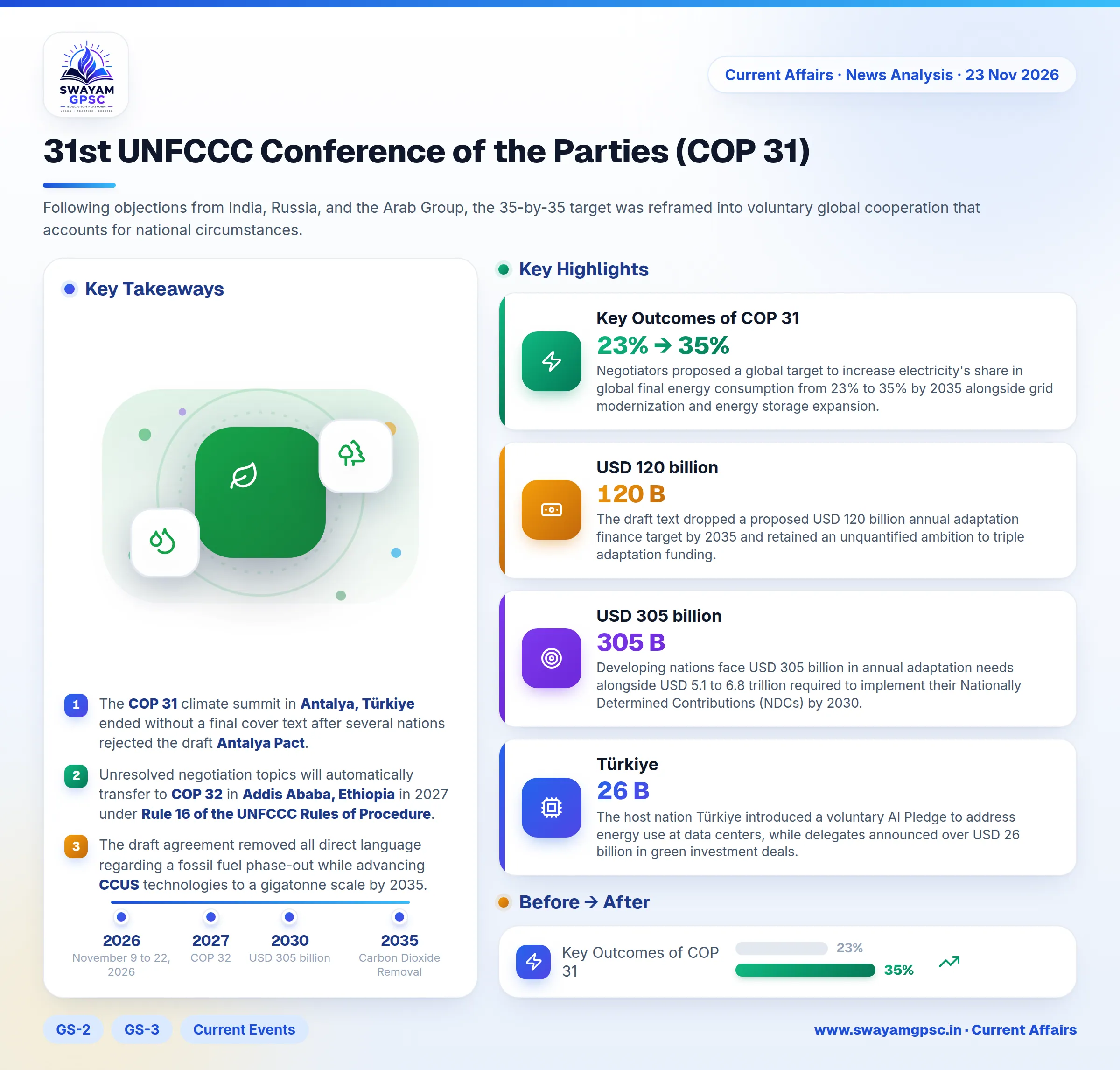
- The COP 31 climate summit in Antalya, Türkiye ended without a final cover text after several nations rejected the draft Antalya Pact.
- Unresolved negotiation topics will automatically transfer to COP 32 in Addis Ababa, Ethiopia in 2027 under Rule 16 of the UNFCCC Rules of Procedure.
- The draft agreement removed all direct language regarding a fossil fuel phase-out while advancing CCUS technologies to a gigatonne scale by 2035.
- Developing countries require USD 305 billion annually for climate adaptation, yet delegates dropped the proposed USD 120 billion annual target by 2035.
- India defended the CBDR-RC principle and highlighted its domestic clean energy achievements, including reaching over 170 GW of solar capacity.
Why in News
- The 31st Conference of the Parties (COP 31) to the UNFCCC concluded in Antalya, Türkiye without adopting its proposed final cover text called the Antalya Pact.
- The summit was held from November 9 to 22, 2026, under a co-presidency arrangement featuring Turkish Environment Minister Murat Kurum as COP 31 President and Australian Climate Change Minister Chris Bowen as President of Negotiations.
Key Outcomes of COP 31
- The overarching cover decision known as the Antalya Pact collapsed after the European Union, UK, Norway, Vanuatu, Marshall Islands, Panama, and Belize formally rejected the final draft during the closing plenary.
- Under Rule 16 of the UNFCCC Rules of Procedure, all unresolved negotiation agenda items will automatically carry forward to COP 32 in Addis Ababa, Ethiopia in November 2027.
- The draft text completely removed all direct references to coal, oil, natural gas, and transitioning away from fossil fuels (TAFF) due to strong pushback from major oil-producing countries.
- The text substituted fossil fuel phase-out language with a general phrasing focused on an irreversible global transition toward low greenhouse gas emissions.
- The draft supported expanding Carbon Capture, Utilisation and Storage (CCUS) and Carbon Dioxide Removal (CDR) to a gigatonne scale by 2035, stating these tools should complement rather than replace emission cuts.
- Negotiators proposed a global target to increase electricity's share in global final energy consumption from 23% to 35% by 2035 alongside grid modernization and energy storage expansion.
- Following objections from India, Russia, and the Arab Group, the 35-by-35 target was reframed into voluntary global cooperation that accounts for national circumstances.
- The draft text dropped a proposed USD 120 billion annual adaptation finance target by 2035 and retained an unquantified ambition to triple adaptation funding.
- Developing nations face USD 305 billion in annual adaptation needs alongside USD 5.1 to 6.8 trillion required to implement their Nationally Determined Contributions (NDCs) by 2030.
- The Antalya-Addis Ababa Roadmap, a joint initiative between Türkiye and Ethiopia to mobilize adaptation funding, was abandoned along with the main pact.
- Delegates formally recognized for the first time in a COP cover decision that global temperatures are set to overshoot the 1.5°C warming threshold established under the Paris Agreement.
- Parties adopted separate functional decisions regarding the Global Goal on Adaptation (GGA), the Adaptation Fund, and the Just Transition Work Programme.
- A total of 25 countries endorsed the non-binding Wildlife for Climate Declaration to integrate wildlife conservation into NDCs and National Adaptation Plans (NAPs).
- The host nation Türkiye introduced a voluntary AI Pledge to address energy use at data centers, while delegates announced over USD 26 billion in green investment deals.
- Negotiators established a dedicated two-year work programme on mountains and climate change to help protect communities reliant on glaciers.
- The text explicitly recalled developed countries' legal financial obligations under Article 9.1 of the Paris Agreement and called for reliable resources for the Fund for Responding to Loss and Damage.
- The draft text retained dialogue language to prevent unilateral green trade measures, such as the EU's Carbon Border Adjustment Mechanism (CBAM), from creating trade barriers against developing economies.
India's Stance at COP 31
- India represented the Global South in coordination with the G77+China, BASIC, and Like-Minded Developing Countries (LMDC) groupings around the summit theme of Dialogue, Consensus and Action.
- India noted that historical industrialization by developed countries consumed more than 80% of the remaining 1.5°C carbon budget.
- India insisted that all international climate agreements must follow the principles of Equity and Common But Differentiated Responsibilities and Respective Capabilities (CBDR-RC).
- India advocated for a country-driven Just Transition framework backed by concessional finance and technology transfer rather than rigid global mandates.
- India and the LMDC bloc opposed top-down targets like the 35-by-35 electrification goal unless backed by guaranteed financial and grid-investment support.
- India raised strong concerns regarding unilateral trade-restrictive measures such as the EU's CBAM.
- India urged developed nations to fulfill their obligations under Article 9 of the Paris Agreement, replenish the Green Climate Fund (GCF), and keep the Global Stocktake (GST) Party-driven.
- India reaffirmed its commitment to domestic clean energy goals, highlighting that it has already surpassed 170 GW of solar capacity.
Overview of UNFCCC COP
- The COP acts as the supreme decision-making authority for the UNFCCC, meeting every year to evaluate global progress and update climate targets.
- The UNFCCC was adopted in May 1992 in New York, opened for signatures at the Rio Earth Summit in June 1992, and entered into force in 1994.
- The 1985 Villach Conference helped establish early scientific consensus on climate risks, leading to the creation of the IPCC in 1988 by the WMO and UNEP.
- The treaty expanded from COP 1 in Berlin in 1995 to include 198 Parties today under the United Nations framework.
- The COP operates with support from two permanent technical bodies: the Subsidiary Body for Implementation (SBI) and the Subsidiary Body for Scientific and Technological Advice (SBSTA).
- The main COP oversees the core treaty, while the CMP governs the Kyoto Protocol and the CMA governs the Paris Agreement.
- Host nations rotate among five UN regional groups: Africa, Asia-Pacific, Eastern Europe, Latin America and the Caribbean, and Western Europe and Others (WEOG).
- Following COP 30 in Belém, Brazil in 2025, Antalya, Türkiye hosted COP 31 in 2026, while Ethiopia will host COP 32 in Addis Ababa in 2027.
Challenges in Global Climate Negotiations
- Removing explicit fossil fuel commitments while promoting CCUS risks undermining the agreements made during the COP 28 UAE Consensus.
- Developing nations face a severe funding deficit because developed countries refused to set a fixed minimum baseline for adaptation finance.
- The UNFCCC requirement for total consensus allowed a small number of countries to block progress, leading nations like Panama to call for majority voting rules.
- Global political tensions, energy market volatility, and operational friction within the Türkiye-Australia joint presidency slowed diplomatic progress.
Way Forward
- Negotiators must establish concrete funding targets and revive the Antalya-Addis Ababa Roadmap before COP 32.
- Countries should restore explicit commitments to transition away from fossil fuels and restrict CCUS strictly to hard-to-abate industrial sectors.
- International financial institutions must reform Multilateral Development Banks (MDBs) to reduce capital costs and provide concessional blended finance for developing countries.
- Governments need to address intellectual property barriers to expand access to energy storage, green hydrogen, and clean cooling technologies.
- Diplomats should coordinate efforts across the three Rio Conventions (UNFCCC, CBD, and UNCCD) to enhance nature-based climate solutions.
- Nations must replace unilateral border carbon adjustments with cooperative trade frameworks that protect exports from developing countries.