23rd ASEAN-India Summit and 21st East Asia Summit
#GS-2 #Current Events #International #India and its Neighbourhood #Bilateral Groupings & Agreements #Groupings & Agreements Involving India and/or Affecting India's Interests #Look East to Act East #ASEAN #East Asia Summit #Act East Policy #Indo-Pacific
Key takeaways
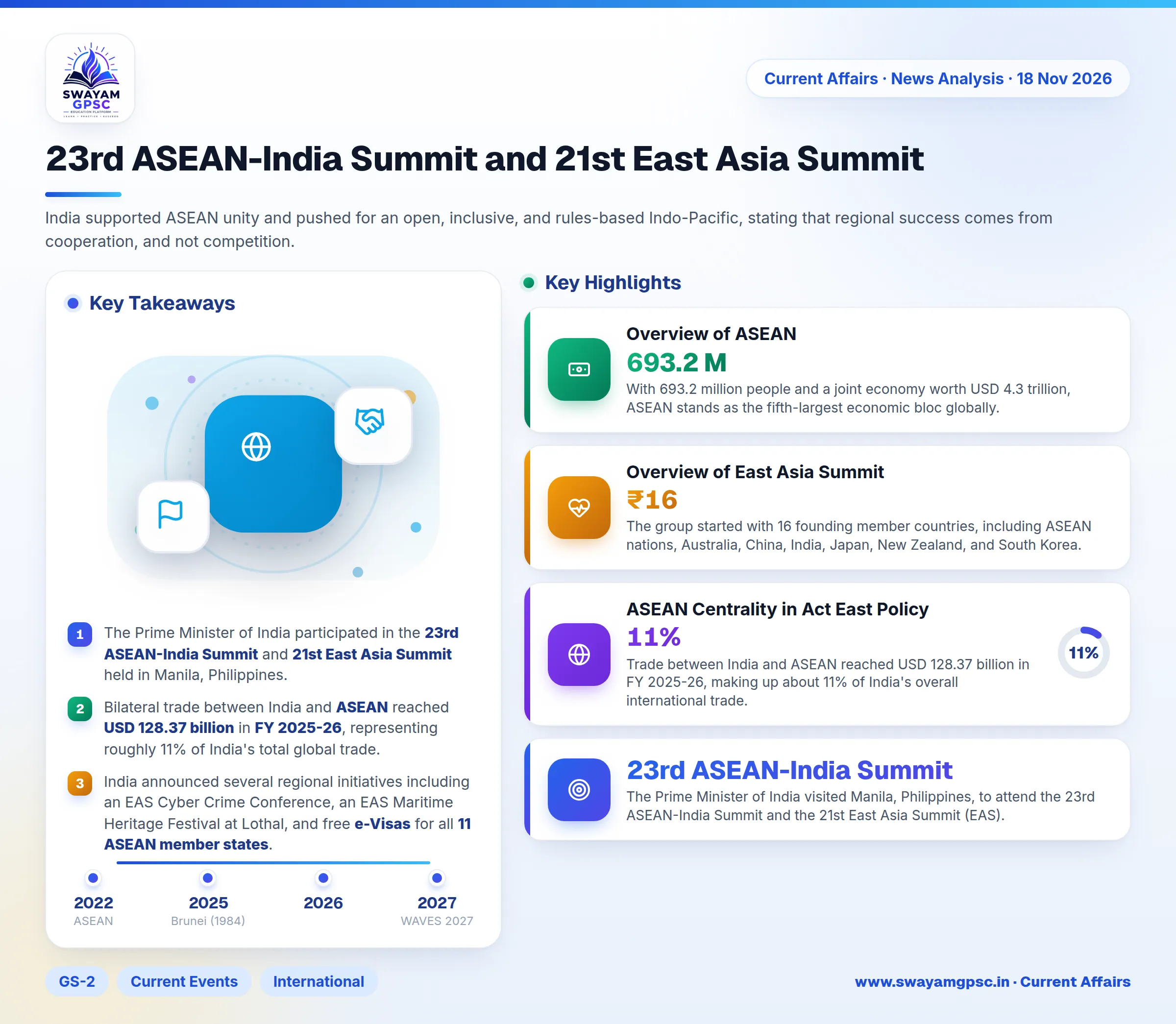
- The Prime Minister of India participated in the 23rd ASEAN-India Summit and 21st East Asia Summit held in Manila, Philippines.
- Bilateral trade between India and ASEAN reached USD 128.37 billion in FY 2025-26, representing roughly 11% of India's total global trade.
- India announced several regional initiatives including an EAS Cyber Crime Conference, an EAS Maritime Heritage Festival at Lothal, and free e-Visas for all 11 ASEAN member states.
- Both sides adopted the ASEAN-India Joint Statement on Disaster Preparedness and Management 2026 and designated 2026 as the ASEAN-India Year of Maritime Cooperation.
Why in News
- The Prime Minister of India visited Manila, Philippines, to attend the 23rd ASEAN-India Summit and the 21st East Asia Summit (EAS).
- This visit highlighted India's strategic commitment to Southeast Asia and reaffirmed the central role of the Association of Southeast Asian Nations (ASEAN) in India's Act East Policy and its broader Indo-Pacific vision.
Summary of the Article
- ASEAN remains the cornerstone of India's Act East Policy and its goal to build a free, open, and multipolar Indo-Pacific through stronger economic, maritime, and security cooperation.
- To build deeper ties, India must resolve trade imbalances, finish delayed connectivity projects, and step up joint work in technology, ocean security, and cultural exchanges.
Highlights of 23rd ASEAN-India Summit
- India pointed out that the ASEAN Community Vision 2045 matches closely with India's own Viksit Bharat 2047 goal to serve regional growth.
- India supported ASEAN unity and pushed for an open, inclusive, and rules-based Indo-Pacific, stating that regional success comes from cooperation, and not competition.
- Leaders adopted the ASEAN-India Joint Statement on Disaster Preparedness and Management 2026 to build better regional safety networks.
- Disaster relief cooperation will directly connect the ASEAN Committee on Disaster Management (ACDM), the AHA Centre, and India's National Disaster Management Authority (NDMA).
- Both sides launched a long-term Maritime Cooperation Plan to boost port connectivity, scientific research, ocean safety, Coast Guard ties, and seafarer security.
- India and ASEAN announced a Joint Cyber Forensics Training Programme and technical exchanges on nuclear energy.
- The summit introduced an ASEAN-India Space Hackathon alongside plans to secure supply chains for critical minerals and mining.
- The new ASEAN-India Youth Connect initiative will feature a Youth Summit, young parliamentarian visits, start-up events, and more scholarships at Nalanda University.
- Both partners agreed to set up an ASEAN-India Creative Partnership Pavilion during the WAVES 2027 cultural event.
- India offered free electronic tourist visas (e-Visas) to citizens from all 11 ASEAN member states to encourage travel and people-to-people contact.
Highlights of 21st East Asia Summit
- The summit declaration adopted in Manila reaffirmed support for ASEAN centrality and international law to maintain regional peace.
- Leaders confirmed ASEAN as the anchor of regional setup under the ASEAN Outlook on the Indo-Pacific (AOIP), guiding peaceful dispute resolution via the UN Charter and the Treaty of Amity and Cooperation (TAC).
- The summit protected open sea navigation under UNCLOS, while promising to defend underwater cables and secure trade paths for energy and critical minerals.
- Members agreed to promote safe technology through the ASEAN AI Safety Network and new guidelines for Generative AI, while fighting cybercrime and human trafficking.
- The declaration focuses on closing development gaps via the Initiative for ASEAN Integration (IAI) Work Plan V (2026-2030), safeguarding migrant worker rights, and setting up early warning systems for natural disasters.
- The summit condemned military violence against civilians in Myanmar and called for complete action on the 2021 Five-Point Consensus.
- India backed democratic transition and the Five-Point Consensus while staying in contact with Myanmar's ruling military to protect border security.
- India outlined a clear vision for the Indo-Pacific built on three core goals: Peace, Prosperity, and Predictability.
- India proposed a Seafarers' Safety Initiative to boost joint maritime training and emergency response coordination.
- India announced plans to host an EAS Cyber Crime Conference at the National Forensic Sciences University to tackle digital threats.
- India proposed an EAS Maritime Heritage Festival at Lothal in Gujarat, home to the new National Maritime Heritage Complex (NMHC).
- India will host an EAS University Heads Conclave at Nalanda in 2027 to strengthen academic and research links across member nations.
Overview of ASEAN
- ASEAN is a key regional organization formed to build economic strength, political stability, and social growth across Southeast Asia.
- Five founding countries (Indonesia, Malaysia, Philippines, Singapore, Thailand) established ASEAN on 8th August 1967 through the Bangkok Declaration, building it on mutual consensus and non-interference.
- The group expanded over time by adding Brunei (1984), Vietnam (1995), Laos and Myanmar (1997), Cambodia (1999), and Timor-Leste (2025).
- Unlike the European Union, ASEAN has no central authority that dictates laws; its chairmanship shifts every year, and its main Secretariat sits in Jakarta.
- The regional disaster framework relies on the ASEAN Agreement on Disaster Management and Emergency Response (AADMER) signed in 2005.
- The Jakarta-based AHA Centre, created in 2011, manages joint disaster relief and emergency supplies among member nations.
- With 693.2 million people and a joint economy worth USD 4.3 trillion, ASEAN stands as the fifth-largest economic bloc globally.
- Through its strategic position, ASEAN centrality ensures Southeast Asian nations drive regional talks with world powers like the US, China, Russia, and India.
- The region holds critical sea routes such as the Strait of Malacca and the South China Sea, which carry a large portion of global trade.
- ASEAN serves as the primary base for major regional talks, including the ASEAN Regional Forum (ARF) and the ASEAN Defense Ministers' Meeting Plus (ADMM-Plus).
Overview of East Asia Summit
- The EAS platform launched in 2005 during its first gathering in Kuala Lumpur, Malaysia.
- The group started with 16 founding member countries, including ASEAN nations, Australia, China, India, Japan, New Zealand, and South Korea.
- The United States and Russia joined the forum in 2011, while Timor-Leste joined in 2025, expanding total membership to 19 countries.
- It operates as an annual leaders-led meeting to discuss major strategic, political, and economic matters.
- The forum aims to foster long-term regional peace, security, and economic cooperation.
- Work across the EAS covers 16 key sectors, including ocean security, trade, finance, climate change, energy, health, disaster management, and education.
ASEAN Centrality in Act East Policy
- Upgraded from the Look East Policy in 2014, the Act East Policy (AEP) rests on four pillars: Culture, Commerce, Connectivity, and Capacity Building.
- India upgraded ties with ASEAN from a Sectoral Partnership in 1992 to a Strategic Partnership in 2012, and then to a Comprehensive Strategic Partnership (CSP) in 2022.
- Trade between India and ASEAN reached USD 128.37 billion in FY 2025-26, making up about 11% of India's overall international trade.
- While the ASEAN-India Free Trade Area (AIFTA) anchors economic ties, both sides are reviewing the ASEAN-India Trade in Goods Agreement (AITIGA) to help Indian small businesses enter regional supply chains.
- With 2026 named as the ASEAN-India Year of Maritime Cooperation, both sides focus on the Blue Economy and naval security under UNCLOS rules.
- This cooperation connects India's SAGAR doctrine and the Indo-Pacific Oceans Initiative (IPOI) directly with the ASEAN Outlook on the Indo-Pacific (AOIP).
- India supports regional defence by exporting equipment such as BrahMos missile systems to the Philippines, gifting naval ships like INS Kirpan, and holding regular naval drills like AIME, SIMBEX, and CORPAT.
- Major physical projects like the India-Myanmar-Thailand (IMT) Trilateral Highway and the Kaladan Multi-Modal Transit Transport Project aim to link India's Northeast to Southeast Asian markets.
- Digital links are expanding by connecting payment systems like India's UPI with Singapore's PayNow alongside shared cybersecurity programs.
- A strong India-ASEAN relationship helps balance growing power rivalries in the South China Sea.
- Approaching their 35th anniversary in 2027, the two sides are using the Plan of Action (2026-2030) to build strong supply chains and advance strategic technologies.
Challenges in India-ASEAN Relations
- India deals with a growing trade gap under AITIGA, caused by strict origin rules, non-tariff trade barriers, and cheap goods routed from third countries.
- Paperwork delays, budget limits, and security problems in Myanmar have slowed key physical links like the IMT Highway.
- China's heavy investment and trade ties through the Belt and Road Initiative (BRI) make it hard for ASEAN members to take a united stand on maritime disputes.
- India uses security groups like the Quad, while ASEAN prefers development-focused frameworks like the AOIP to avoid joining great-power conflicts.
Way Forward
- Finishing the AITIGA review quickly will reduce trade barriers and help Indian small businesses join Southeast Asian supply networks.
- India should use annual review mechanisms under the 2026-2030 Plan of Action to complete joint technical projects on schedule.
- While land routes face delays, India must focus more on sea ports, underwater digital cables, coastal shipping lines, and Blue Economy projects.
- India can build stronger social ties by granting free e-Visas to ASEAN citizens and expanding scholarships at Nalanda University.