2025 Animal and Plant Discoveries and ZSI Foundation Day
#GS-3 #Environment #Biodiversity #Wildlife #Conservation #Current Events #National #Quick Facts For Prelims
Why in News
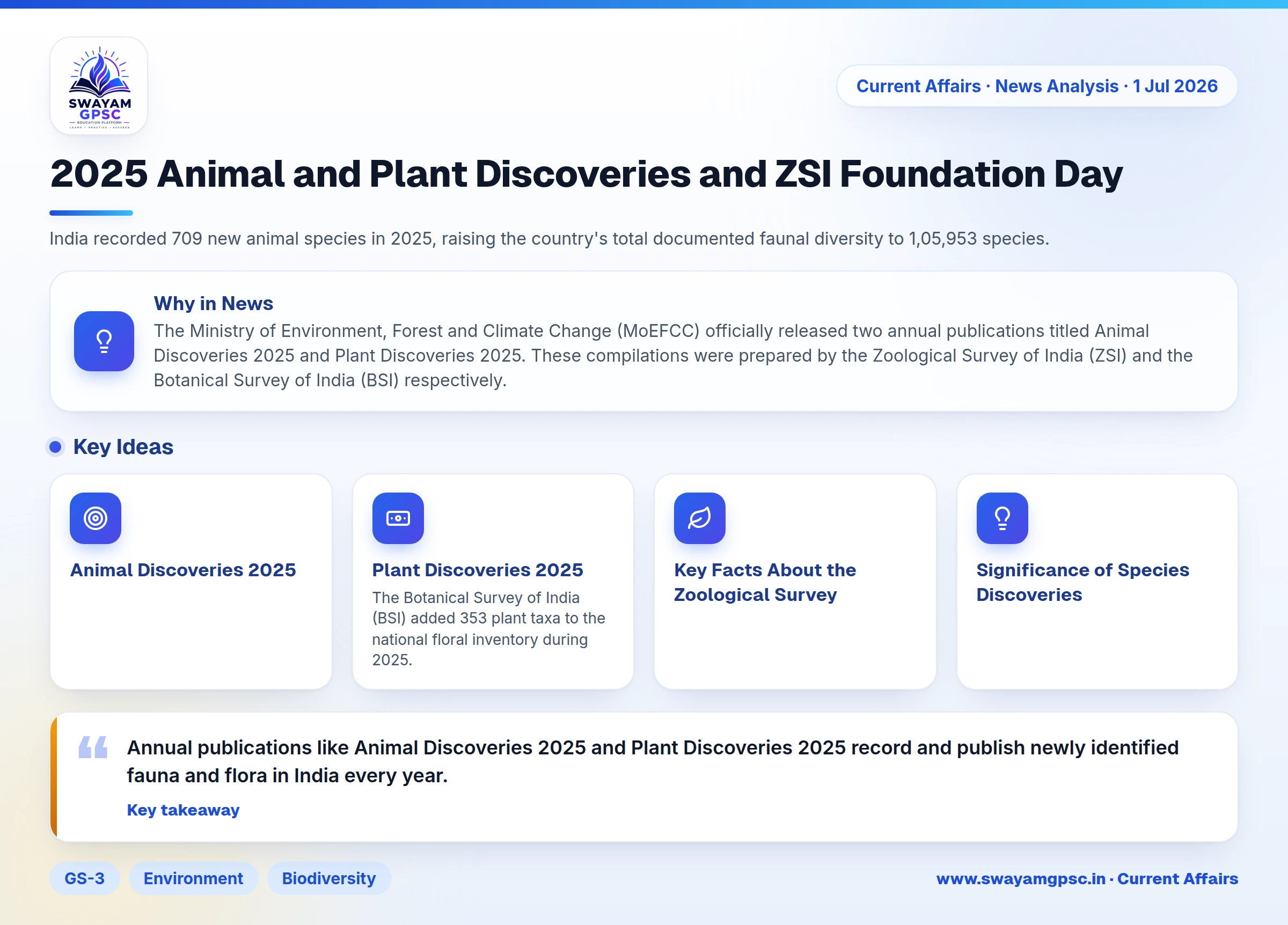
- The Ministry of Environment, Forest and Climate Change (MoEFCC) officially released two annual publications titled Animal Discoveries 2025 and Plant Discoveries 2025.
- These compilations were prepared by the Zoological Survey of India (ZSI) and the Botanical Survey of India (BSI) respectively.
- The official release took place in Kolkata during the celebration of the 111th Foundation Day of the ZSI.
Animal Discoveries 2025
- India recorded 709 new animal species in 2025, raising the country's total documented faunal diversity to 1,05,953 species.
- State-wise rankings show Kerala leading with 98 new animal species, followed closely by West Bengal, Karnataka, and Arunachal Pradesh.
- Key vertebrate findings include the Himalayan bat (Myotis himalaicus), Irwin's wolf snake (Lycodon irwini), and two fan-throated lizard species (Ptyctolaemus mamdaphaensis and Ptyctolaemus siangensis).
- The Himalayan long-tailed Myotis (Myotis himalaicus) was found in Uttarakhand in the Western Himalayas as an insect-eating bat with a tail nearly equal to its body length, aiding in pest management.
- The non-venomous, glossy black Irwin's wolf snake (Lycodon irwini) was discovered on Great Nicobar Island and named after nature educator Steve Irwin.
- Researchers identified the Namdapha green fan-throated lizard (Ptyctolaemus mamdaphaensis) inside the Namdapha Tiger Reserve in Arunachal Pradesh.
- Scientists discovered the Siang green fan-throated lizard (Ptyctolaemus siangensis) as a distinct lizard species in the Siang district of Arunachal Pradesh.
Plant Discoveries 2025
- The Botanical Survey of India (BSI) added 353 plant taxa to the national floral inventory during 2025.
- Non-vascular plants formed 57% of these new floral additions, while vascular plants accounted for the remaining 43%.
- Arunachal Pradesh topped state discoveries with 49 floral findings, with Uttarakhand and Kerala taking the next positions.
- Important plant discoveries include a fern species (Polystichum siangense) in Arunachal Pradesh and a wild relative of custard apple (Miliusa beddomei) in the Western Ghats.
- Researchers also documented a novel wild edible tooth-fungus species named Hericium indicum.
Key Facts About the Zoological Survey of India
- The Zoological Survey of India (ZSI) acts as the main national body under MoEFCC for animal taxonomy, biodiversity surveys, and zoological research.
- Headquartered in Kolkata, West Bengal, the organization manages 16 regional centers placed in distinct ecosystems like the Western Ghats, coastal areas, and high mountain zones.
- Its historic roots began with the Zoological Section of the Indian Museum in 1875, influenced by Sir William Jones who created the Asiatic Society of Bengal in 1784.
- The government officially set up the ZSI as an independent organization on 1st July 1916 to survey wildlife across undivided India.
- After India ratified the Convention on Biological Diversity (CBD) in 1994, ZSI expanded its work beyond basic taxonomy into ecosystem conservation tracking.
- Under the Biological Diversity Act, 2002, ZSI serves as the official custodian of the National Zoological Collection, holding millions of animal specimens.
- The institute conducts Environmental Impact Assessments (EIA) and uses tools like DNA barcoding and wildlife forensics including the Pangolin Indexing System to stop illegal wildlife trade.
- To aid national policy, ZSI regularly releases landmark publications including the Indian Red Data Book, the Fauna of India series, and the annual Animal Discoveries directory.
Significance of Species Discoveries
- Annual publications like Animal Discoveries 2025 and Plant Discoveries 2025 record and publish newly identified fauna and flora in India every year.
- Discovering new species strengthens biological knowledge, improves habitat conservation strategies, and provides evidence for Environmental Impact Assessments (EIA).
- These scientific documenting efforts help India fulfill its global commitments under the Convention on Biological Diversity (CBD).