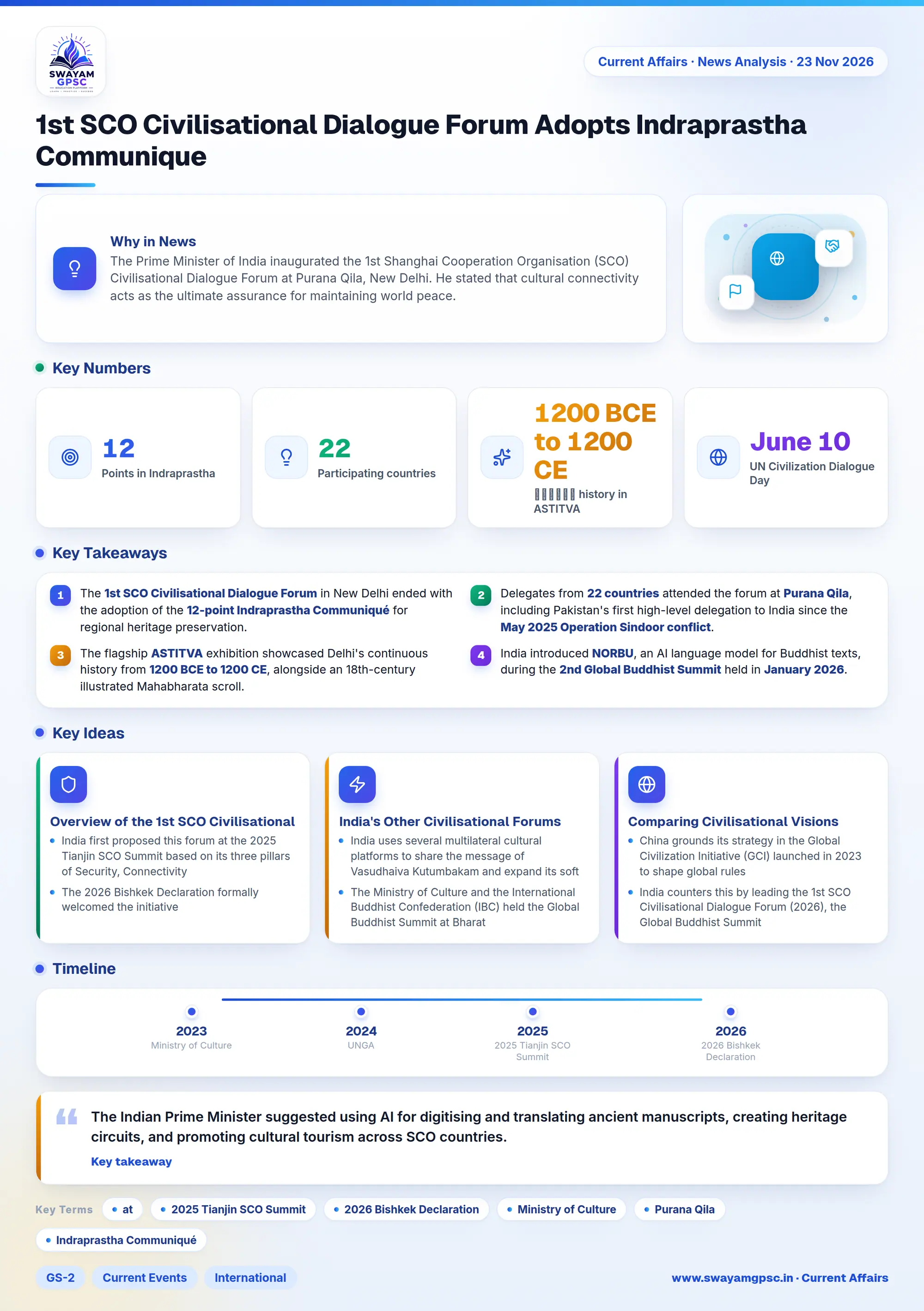
1st SCO Civilisational Dialogue Forum Adopts Indraprastha Communique
#GS-2 #Current Events #International #GS-1 #Culture #Heritage #Important International Institutions #Quick Facts For Prelims
Key takeaways
- The 1st SCO Civilisational Dialogue Forum in New Delhi ended with the adoption of the 12-point Indraprastha Communiqué for regional heritage preservation.
- Delegates from 22 countries attended the forum at Purana Qila, including Pakistan's first high-level delegation to India since the May 2025 Operation Sindoor conflict.
- The flagship ASTITVA exhibition showcased Delhi's continuous history from 1200 BCE to 1200 CE, alongside an 18th-century illustrated Mahabharata scroll.
- India introduced NORBU, an AI language model for Buddhist texts, during the 2nd Global Buddhist Summit held in January 2026.
Why in News
- The Prime Minister of India inaugurated the 1st Shanghai Cooperation Organisation (SCO) Civilisational Dialogue Forum at Purana Qila, New Delhi.
- He stated that cultural connectivity acts as the ultimate assurance for maintaining world peace.
- The three-day event ended with the adoption of the 12-point Indraprastha Communiqué to guide heritage conservation, cultural cooperation, and people-to-people ties across SCO members.
Overview of the 1st SCO Civilisational Dialogue Forum
- India first proposed this forum at the 2025 Tianjin SCO Summit based on its three pillars of Security, Connectivity, and Opportunity.
- The 2026 Bishkek Declaration formally welcomed the initiative, establishing a dedicated mechanism for academic exchange and shared heritage.
- The Ministry of Culture served as the lead organiser alongside the Ministry of External Affairs (MEA).
- India recommended hosting this SCO dialogue every two years, with member states deciding the host location for future editions.
- Delegates from 22 nations took part, including the SCO Secretary-General and dialogue partners like Pakistan.
- This event marked Pakistan's first high-level participation in an Indian-hosted multilateral meeting since the May 2025 conflict under Operation Sindoor.
- The choice of Purana Qila was significant because Sher Shah Suri built its 16th-century walls over the ancient site of Indraprastha.
- Selecting this historic site highlighted India's identity as a continuous, multi-layered, and diverse civilisation.
- The Indraprastha Communiqué reinforces cultural diversity and civilisational equality using the philosophy of Vasudhaiva Kutumbakam.
- The document urges members to protect heritage, fight illegal artifact trafficking, deal with climate risks, collaborate with UNESCO, use AI responsibly, and involve youth.
- The forum featured a key archaeological exhibition named ASTITVA - The Essence of Our Existence, tracking Delhi's history from 1200 BCE to 1200 CE.
- Organisers also displayed a rare 18th-century illustrated Mahabharata scroll to display India's rich manuscript tradition.
- The Indian Prime Minister suggested using AI for digitising and translating ancient manuscripts, creating heritage circuits, and promoting cultural tourism across SCO countries.
- This initiative strengthens India's cultural diplomacy by emphasizing shared Eurasian history and encouraging dialogue between nations facing diplomatic friction.
India's Other Civilisational Forums
- India uses several multilateral cultural platforms to share the message of Vasudhaiva Kutumbakam and expand its soft power outreach globally.
- The Ministry of Culture and the International Buddhist Confederation (IBC) held the Global Buddhist Summit at Bharat Mandapam, New Delhi, with its 1st edition in 2023 and 2nd in January 2026.
- The 2nd Global Buddhist Summit focused on collective wisdom and introduced NORBU, an AI Buddhist language model called Kalyan Mitra.
- Varanasi became the first-ever SCO Tourism and Cultural Capital during 2022-23, acting as a hub for Eurasian tourism and diplomatic ties.
- The government rebuilt Nalanda University in Bihar with support from the East Asia Summit to revive historical Asian educational networks.
- Project Mausam works to reconnect ancient maritime cultural routes across the Indian Ocean littoral region.
- The International Day of Yoga on June 21 promotes India's ancient wellness traditions around the globe.
Comparing Civilisational Visions of China and India
- China grounds its strategy in the Global Civilization Initiative (GCI) launched in 2023 to shape global rules and standards.
- India counters this by leading the 1st SCO Civilisational Dialogue Forum (2026), the Global Buddhist Summit, and the SAMVAD project.
- China convinced the UNGA to make 10th June the International Day for Dialogue among Civilizations in 2024 and established the Nishan Forum.
- India shapes the international agenda through Varanasi as the first SCO Cultural Capital, Nalanda University, and International Day of Yoga (June 21).
- China uses its historical continuity to justify a centralised state structure, dismissing Western universal ideas as external impositions.
- India highlights Vasudhaiva Kutumbakam to show that ancient heritage aligns naturally with democracy, diversity, and open discussion.
- China backs its vision with financial power, using institutions like the SCO Secretariat in Beijing and the SCO Development Bank.
- India relies on low-friction soft power, spiritual bonds like Buddhism, Sufism, and Yoga, and multi-alignment diplomacy.