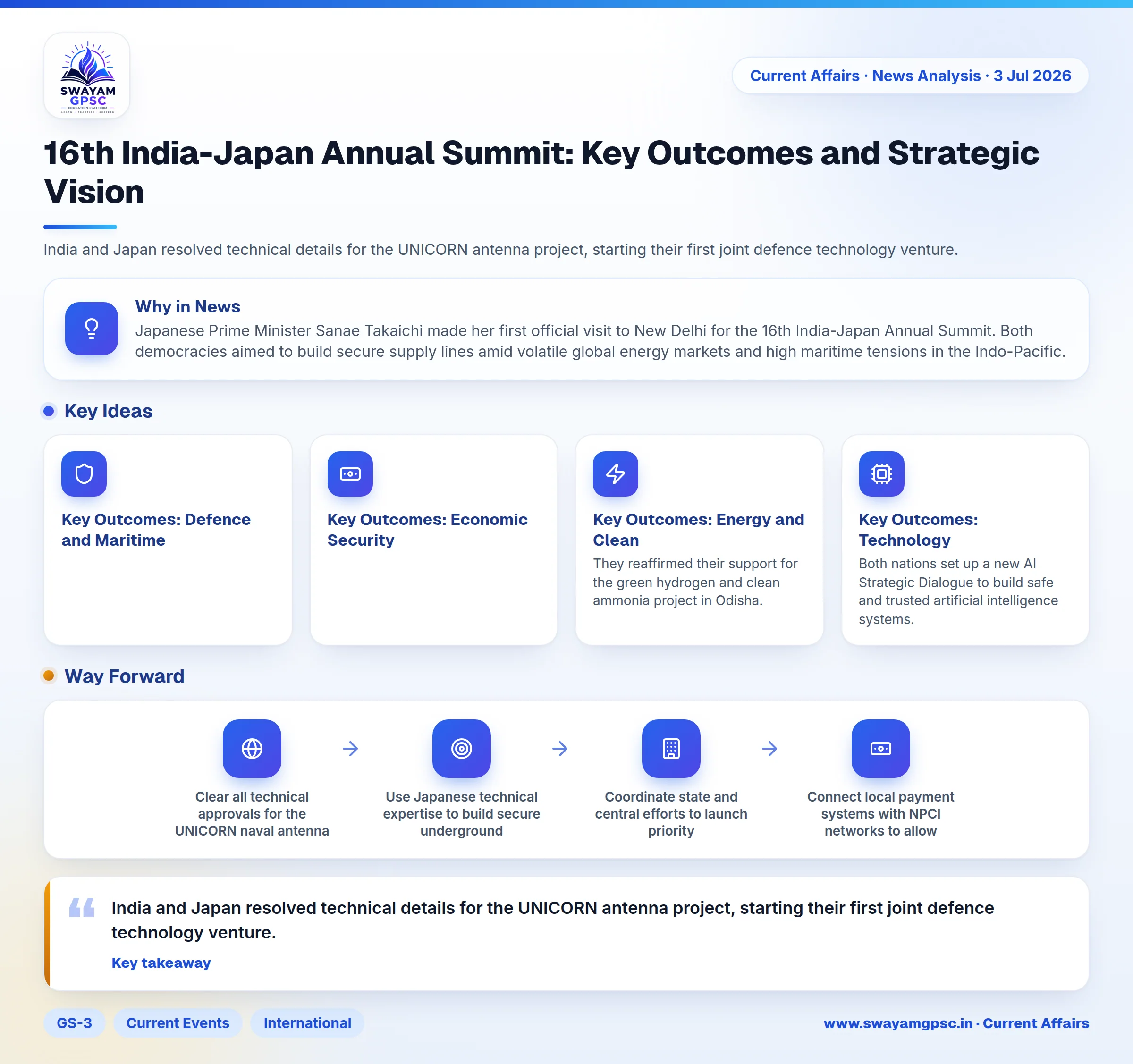
16th India-Japan Annual Summit: Key Outcomes and Strategic Vision
#GS-3 #Current Events #International #Economy #Infrastructure #India-Japan Relations
Why in News
- Japanese Prime Minister Sanae Takaichi made her first official visit to New Delhi for the 16th India-Japan Annual Summit.
- Both democracies aimed to build secure supply lines amid volatile global energy markets and high maritime tensions in the Indo-Pacific.
- The summit connected Japan's updated Free and Open Indo-Pacific (FOIP) strategy with India's Indo-Pacific Oceans' Initiative (IPOI) and MAHASAGAR doctrine.
Key Outcomes: Defence and Maritime Security
- India and Japan resolved technical details for the UNICORN antenna project, starting their first joint defence technology venture.
- Both nations decided to hold the 4th India-Japan 2+2 Foreign and Defence Ministers' Meeting in Tokyo before 2026.
- Leaders expanded naval cooperation through JIMEX exercises and agreed to support naval MRO facilities under Make in India.
Key Outcomes: Economic Security and Supply Chains
- Both countries formed a Joint Economic Security Framework covering semiconductors, critical minerals, clean energy, ICT, and pharmaceuticals.
- They agreed to simplify export rules, promote trade in local currencies, and boost secure technology transfers.
Key Outcomes: Energy and Clean Transition
- Both partners launched the India-Japan Cooperative Biogas for Growth Initiative to help build 1,000 biogas plants in India.
- They reaffirmed their support for the green hydrogen and clean ammonia project in Odisha.
- Both signed an Energy Resilience Statement on oil reserves, while Japan supported India's membership in the International Energy Agency (IEA).
Key Outcomes: Technology and Infrastructure
- Both nations set up a new AI Strategic Dialogue to build safe and trusted artificial intelligence systems.
- Japan confirmed continued backing for the Mumbai-Ahmedabad Bullet Train and future high-speed rail lines.
- Both sides advanced JICA-supported infrastructure projects in healthcare, education, horticulture, and metro rail networks.
Strategic Opportunities
- Strategic investments from Japan will help flow funds across Indian states, supporting the Viksit Bharat vision.
- Both sides plan to review their 15-year-old Comprehensive Economic Partnership Agreement (CEPA) to lower trade tariffs.
- Japanese funding will create industrial supply chains connecting India's North Eastern Region (NER) with the Bay of Bengal.
- Joint research through the Sakura Science Exchange and space missions like LUPEX will reduce single-vendor technology dependence.
- The new India-Japan SME Forum will allow Indian small businesses to link with Japanese global supply networks.
Challenges
- Unfair export limits on critical minerals by dominant nations create severe supply chain risks for both economies.
- Middle East conflicts threaten maritime trade, leaving 31 Japanese commercial vessels stuck near the Strait of Hormuz.
- Growing military budgets and island militarization in the South and East China Seas disrupt regional trade lanes.
- Infiltration via cyber attacks, regional terrorism, and failing arms control treaties create complex security challenges.
- Specialized Japanese engineering rules and local Indian labor practices need alignment to build high-speed rail projects smoothly.
Way Forward
- Clear all technical approvals for the UNICORN naval antenna project before the 17th Annual Summit.
- Use Japanese technical expertise to build secure underground strategic petroleum reserves in India.
- Coordinate state and central efforts to launch priority sections of the high-speed rail by 2027.
- Connect local payment systems with NPCI networks to allow smooth retail trade in local currencies.
- Start the planned 1.5 track trilateral dialogue with the Philippines to improve maritime awareness in the South China Sea.
Conclusion
- Joint defence projects like UNICORN and deep investments move India-Japan relations beyond simple trade into advanced technology co-development.
- Securing crude oil stockpiles, critical minerals, and the 2027 high-speed rail line will ensure economic safety and regional peace.