16th India-Japan Annual Summit 2026: Strategic and Economic Partnership
#GS-2 #Indian Polity & Constitution #Governance & Social Justice #GS-3 #Economy #Infrastructure #Current Events #International #India-Japan Relations #Indo-Pacific #Defence Cooperation
Why in News
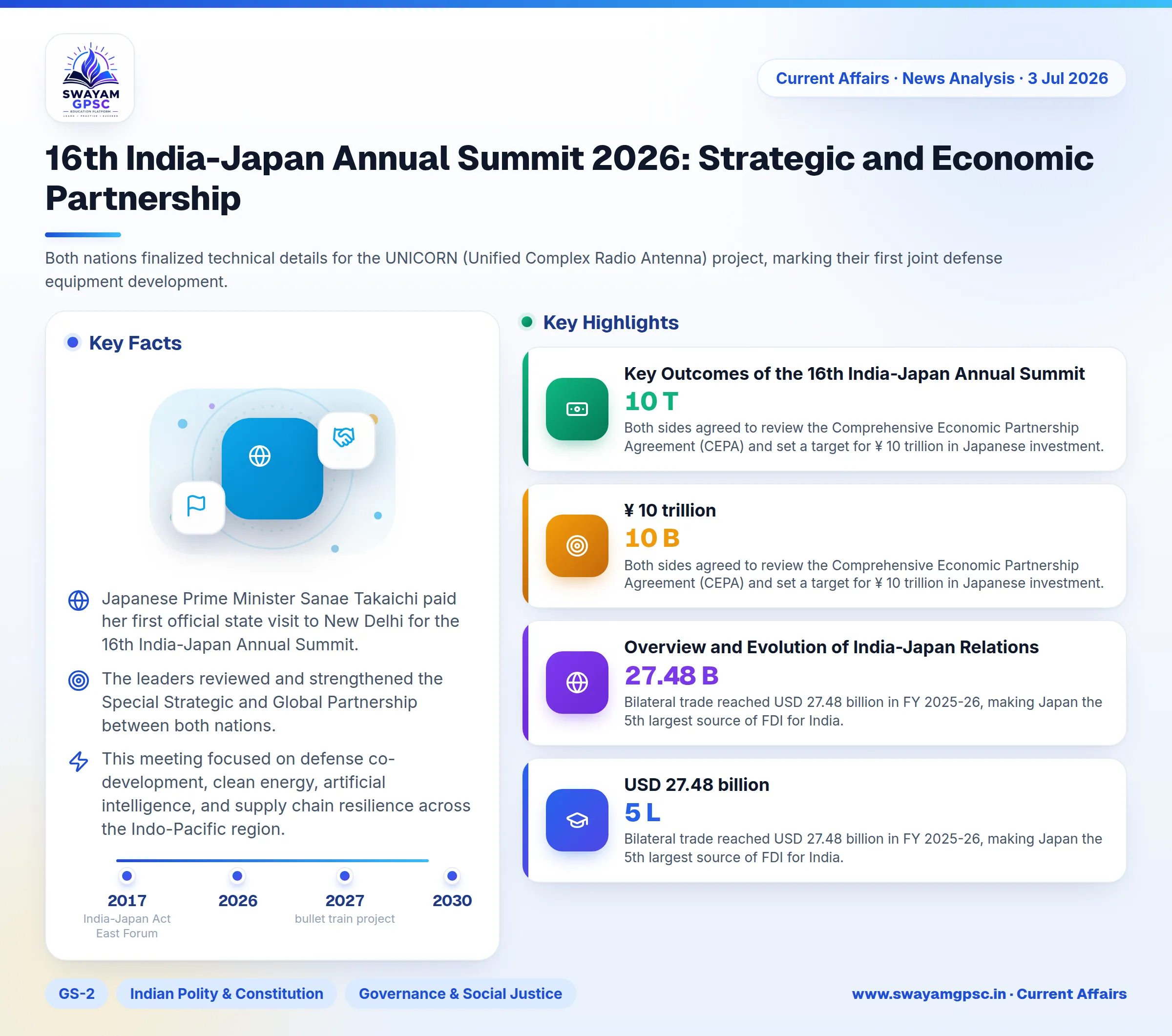
- Japanese Prime Minister Sanae Takaichi paid her first official state visit to New Delhi for the 16th India-Japan Annual Summit.
- The leaders reviewed and strengthened the Special Strategic and Global Partnership between both nations.
- This meeting focused on defense co-development, clean energy, artificial intelligence, and supply chain resilience across the Indo-Pacific region.
Key Outcomes of the 16th India-Japan Annual Summit
- Both nations finalized technical details for the UNICORN (Unified Complex Radio Antenna) project, marking their first joint defense equipment development.
- They agreed to conduct the 4th India-Japan 2+2 Ministerial Meeting in Tokyo before the end of 2026.
- Naval ties expanded through JIMEX exercises, alongside joint work on naval Maintenance, Repair, and Overhaul (MRO) under the Make in India program.
- Both governments signed the India-Japan Joint Declaration on Economic Security Cooperation covering semiconductors, critical minerals, ICT, clean energy, and pharmaceuticals.
- They launched the India-Japan Cooperative Biogas for Growth (CBG) Initiative to help build 1,000 biogas plants in India.
- Japan reaffirmed support for the Odisha green hydrogen project and backed India's full membership in the International Energy Agency (IEA).
- The two countries created the first India-Japan AI Strategic Dialogue to promote secure artificial intelligence governance and supply chains.
- Both sides agreed to review the Comprehensive Economic Partnership Agreement (CEPA) and set a target for ¥ 10 trillion in Japanese investment.
- A Memorandum of Cooperation established a USD 10 Billion investment package to facilitate Japanese banking expansion in India.
- Trade programs will expand under the India-Japan SME Forum and JISSI to integrate Indian small businesses into global supply chains.
- Both leaders reaffirmed their commitment to a Free and Open Indo-Pacific, aligning India's IPOI and MAHASAGAR visions with Japanese strategy.
- India and Japan announced a new 1.5 track policy dialogue with the Philippines to improve maritime security in the South China Sea.
- Japan agreed to support India in hosting the 4th UN World Conference on Disaster Risk Reduction in 2030.
- Both nations committed to expanding joint development projects in Africa through the India-Africa Forum Summit (IAFS) framework.
Overview and Evolution of India-Japan Relations
- India and Japan established formal diplomatic ties in 1952, which grew into a Global Partnership in 2000 and a Special Strategic and Global Partnership in 2014.
- The India-Japan Act East Forum was created in 2017 alongside the revival of the Quad to boost security and regional connectivity.
- Bilateral trade reached USD 27.48 billion in FY 2025-26, making Japan the 5th largest source of FDI for India.
- Japan is currently India's 10th largest trading partner, while India ranks as Japan's 14th largest trading partner.
- Japanese Official Development Assistance (ODA) funds major projects like the Mumbai-Ahmedabad High-Speed Rail (MAHSR) and the Delhi Metro.
- Japan supports India's plan to build a 7,000-km high-speed rail network by 2047.
- The JICA-funded 750-km North East Road Network Connectivity Improvement Project aims to turn North-East India into a trade hub for Southeast Asia.
- Space agencies ISRO and JAXA are jointly developing the Lunar Polar Exploration (LUPEX) mission for launch by 2026-27.
- Labor mobility programs like the Specified Skilled Worker (SSW) scheme support nearly 59,000 Indians currently living in Japan.
- Both nations aim to facilitate the movement of 5 lakh Indian students and skilled workers to Japan over the next five years.
Key Challenges in India-Japan Relations
- Bilateral trade remains low at USD 27 billion and heavily favors Japan, trailing far behind trade volumes seen with China.
- The Mumbai-Ahmedabad High-Speed Rail project faces timeline delays due to land acquisition issues and local political friction.
- The Asia-Africa Growth Corridor (AAGC) has shown slow progress due to the lack of a dedicated joint funding mechanism.
- Japanese companies report obstacles from bureaucratic red tape, complex labor laws, and regulatory shifts in India.
- Indian agricultural and pharmaceutical exports face strict Phytosanitary (SPS) rules and non-tariff barriers in Japanese markets.
- Language differences and strict work environments slow down the recruitment of Indian talent under the SSW scheme.
- Strategic differences persist regarding Russia, as Japan enforces G7 sanctions while India maintains its independent foreign policy.
- Japan's constitutional limits on defense exports previously slowed military tech transfers, though recent policy changes have lifted restrictions on certain equipment exports.
- Supply chains remain vulnerable to export restrictions on critical minerals and maritime disruptions, such as 31 Japanese ships stranded near the Strait of Hormuz.
Way Forward
- Both countries should sign Mutual Recognition Agreements (MRAs) under CEPA to clear trade barriers for Indian pharmaceuticals and agricultural goods.
- Setting up a dedicated Joint Sovereign Infrastructure Fund will help speed up projects under the Asia-Africa Growth Corridor.
- Establishing specialized Centres of Excellence in India will train workers in Japanese language and industrial standards for the SSW program.
- Expanding minilateral groupings like the India-Japan-Philippines framework will strengthen maritime security across crucial sea lanes.
- Authorities must resolve local land and administrative issues to operationalize the priority sections of the bullet train project by 2027.
- Integrating NPCI digital payment systems and local currency settlement mechanisms will simplify cross-border trade and tourism.
Conclusion
- The partnership between India and Japan has grown from basic commercial trade into a vital pillar of stability for the Indo-Pacific.
- By focusing on shared economic and security goals, both nations are well positioned to guide regional growth and peace in the coming decades.