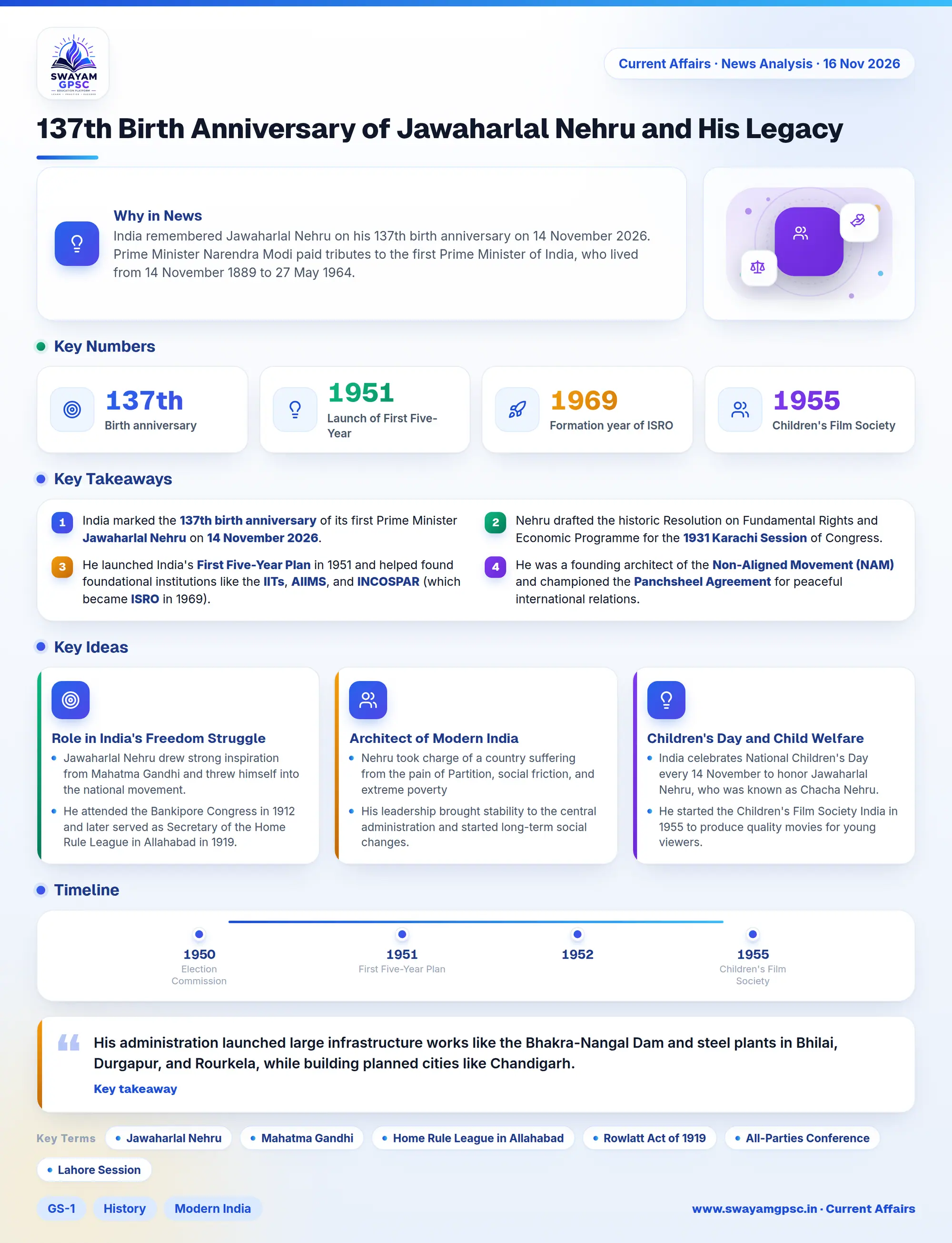
137th Birth Anniversary of Jawaharlal Nehru and His Legacy
#GS-1 #History #Modern India #Freedom Struggle #Important Personalities #GS-2 #Current Events #National #Governance & Social Justice #Education #Poverty
Key takeaways
- India marked the 137th birth anniversary of its first Prime Minister Jawaharlal Nehru on 14 November 2026.
- Nehru drafted the historic Resolution on Fundamental Rights and Economic Programme for the 1931 Karachi Session of Congress.
- He launched India's First Five-Year Plan in 1951 and helped found foundational institutions like the IITs, AIIMS, and INCOSPAR (which became ISRO in 1969).
- He was a founding architect of the Non-Aligned Movement (NAM) and championed the Panchsheel Agreement for peaceful international relations.
- Children's Day was officially shifted to 14 November following Nehru's death in 1964 to honor his vision for child welfare and constitutional safeguards like Article 21A.
Why in News
- India remembered Jawaharlal Nehru on his 137th birth anniversary on 14 November 2026.
- Prime Minister Narendra Modi paid tributes to the first Prime Minister of India, who lived from 14 November 1889 to 27 May 1964.
Role in India's Freedom Struggle
- Jawaharlal Nehru drew strong inspiration from Mahatma Gandhi and threw himself into the national movement.
- He attended the Bankipore Congress in 1912 and later served as Secretary of the Home Rule League in Allahabad in 1919.
- He opposed the Rowlatt Act of 1919, joined the Non-Cooperation Movement, and spent years in prison during the Salt Satyagraha and Quit India Movement.
- He spoke for India at international forums like the Congress of Oppressed Nationalities in Brussels in 1927.
- He participated in the All-Parties Conference in 1928 regarding the Nehru Report prepared under Motilal Nehru, but he insisted on complete freedom instead of Dominion Status.
- Congress delegates chose Nehru as President for the historic Lahore Session in 1929, where the party set Poorna Swaraj as its main goal.
- He authored the Resolution on Fundamental Rights and Economic Programme for the Karachi Session of the Indian National Congress in 1931.
- Mahatma Gandhi picked Nehru as the second Individual Satyagrahi in 1940, right after Vinoba Bhave.
- He took office as independent India's first Prime Minister on 15 August 1947 and delivered his famous Tryst with Destiny speech.
- As head of government, he spent his years strengthening democratic traditions, secular principles, and scientific thinking across the country.
Architect of Modern India
- Nehru took charge of a country suffering from the pain of Partition, social friction, and extreme poverty, yet he outlined a clear path for a modern nation.
- His leadership brought stability to the central administration and started long-term social changes.
- He built top-tier national institutions like the IITs and AIIMS, and he backed the creation of INCOSPAR under Vikram Sarabhai in 1962, which eventually became ISRO in 1969.
- He introduced the First Five-Year Plan in 1951 to give India a clear economic map after independence.
- This initial plan directed investments toward farming, irrigation networks, food production, and village welfare.
- The five-year planning strategy guided national development priorities for several decades.
- Nehru worked to protect core democratic values, individual rights, and religious equality.
- He led the setup of the Election Commission of India in 1950 and guided the country through the first general elections from 1951 to 1952.
- He kept additional charge of the Ministry of External Affairs and helped build the Non-Aligned Movement to stay clear of Cold War power blocs.
- He organized the Asian Relations Conference in 1947 and promoted the Panchsheel Agreement as a core set of diplomatic guidelines.
- His administration launched large infrastructure works like the Bhakra-Nangal Dam and steel plants in Bhilai, Durgapur, and Rourkela, while building planned cities like Chandigarh.
- He shaped India as a welfare state by choosing a middle path between raw capitalism and strict state communism.
Children's Day and Child Welfare Framework
- India celebrates National Children's Day every 14 November to honor Jawaharlal Nehru, who was known as Chacha Nehru.
- He started the Children's Film Society India in 1955 to produce quality movies for young viewers.
- India used to mark Children's Day on 20 November alongside UN World Children's Day, but moved it to Nehru's birth date after his passing in 1964.
- He believed that the choices made for children today shape the nation's future strength.
- Constitutional safeguards for children include Article 21A for free schooling between ages 6 and 14.
- Article 24 bars children from working in dangerous factory jobs.
- Article 39(f) directs the government to protect children from exploitation and support healthy growth.
- Article 45 asks states to offer early childhood care for children under six years of age.
- These constitutional goals backed later laws like the Right to Education Act of 2009, the POCSO Act of 2012, and the Juvenile Justice Act of 2015.